Follow @TomVMorris
Retreats
Keynote Talks and Advising
About Tom
Popular Talk Topics
Client Testimonials
Books
Novels
Blog
Contact
ScrapBook
Short Videos
The 7 Cs of Success
The Four Foundations
Plato's Lemonade Stand
The Gift of Uncertainty
The Power of Partnership

Tom Morris

Great Ideas. With Power. And Fun.
Retreats
Keynote Talks and Advising
About Tom
Popular Talk Topics
Client Testimonials
Books
Novels
Blog
Contact
ScrapBook
Short Videos
The 7 Cs of Success
The Four Foundations
Plato's Lemonade Stand
The Gift of Uncertainty
The Power of Partnership
Lemonade.jpg

Life's Lemons

Ten years ago, I realized I knew a lot of people who had trouble dealing with change in their lives. I would get asked over and over, "What do you do when bad things happen, or disappointing things, unexpected and difficult things?" People wanted strategies for handling challenges in their lives.

I had grown up hearing the old adage, "When life hands you lemons, make lemonade," which pretty much sums up the attitude of the ancient stoic philosophers toward the problem, but in my childhood no one who repeated these words also explained how to do it. How do you turn lemons into lemonade? So I got to work, reading all the great thinkers on the topic, and writing my own book of advice. It was called "Lemonade!" Then I changed the name to "Lemons to Lemonade" and after 24 total re-writes, it became "Plato's Lemonade Stand: Stirring Change into Something Great." Previous versions have been turned down by publishers 45 times, because they're not convinced that a practical book about the personal alchemy needed to turn something sour into something sweet will sell. I'm convinced they're wrong. And whenever I've done the ideas on retreats, people have insisted on having the book available. No one has seen the newest version yet. And I really, really like it. But I'm prepared for more lemonade making before someone in the world of publishing says, "Wait. People need this."

In the Sunday Business Section of the New York Times, Adam Bryant had a very interesting interview with the fashion designer and design mogul Diane von Furstenberg. Let me give you one Q&A:

Q. You’ve said many times that your mother was your biggest influence. What are the most important lessons you learned from her?

A. My mother was a Holocaust survivor and, having survived 13 months in the concentration camps, she taught me that fear is not an option. And no matter what happens, never be a victim. Life is a journey, and when you face obstacles the only thing you can do is accept them and embrace the reality. Very often, with things that are bad or not what you wanted, it’s your job to turn them into something positive.

I love the sentiment about accepting obstacles. Maybe the things that block your path can be taken up and assembled into just the bridge you need. That last sentence of the answer says it all:

Very often, with things that are bad or not what you wanted, it’s your job to turn them into something positive.

That's one of the enduring themes of the practical philosophers. And it's become something I believe deeply. So, when you face your next challenge, difficulty, or disappointment, get out a paring knife, some sugar, ample ice, and whatever additional spices you think you'll like, and make from the lemons that confront you some world class lemonade. Plato would have wanted it.


PostedMay 5, 2015
AuthorTom Morris
CategoriesAdvice, Life, Business
TagsChallenge, Life's Lemons, Difficulties, Disappointment, Change, Pain, Lemonade, Stoic philosophy, Tom Morris, TomVMorris, Diane von Furstenberg, New York Times, Adam Grant
Post a comment
CharlieBrown.jpg

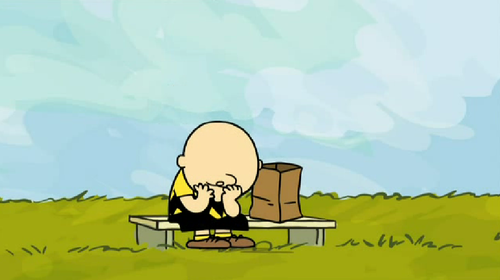
Good Grief, Charlie Brown.

Recently, I asked readers for some topics they'd like to see me blog on. I got lots of suggestions. I've written on two of them already. Today, I'll tackle a tough one, and briefly: Grief.

Grief is an experience and expression of great value lost. We can grieve the passing of a family member, a friend, a pet, or our youth. We can grieve the loss of a job, or a marriage, or the demise of a great business. 

Grief, like most emotions, can be rational or irrational. It would make no sense to grieve the loss of a potato chip. And there are probably philosophical conditions for sensible grief. It makes sense for me to grieve the loss of people and animals I've known, in a way that it might not, regarding people and animals whose passing I rationally know must be happening around the world, but with whom I've never had contact. In one of his early movies, Woody Allen's character says something like, "If one guy is starving somewhere in the world, it puts a crimp in my day." And I get that. I feel a keen regret about the suffering and loss around the world that happens every day - at least, when I have the time to think about it. But my experience of that is not quite the same thing as grief.

Grief is personal. And it can be good. If a person or relationship or endeavor or hope has indeed been of great value, and of great value to you, it would make no sense to experience its loss without such an emotional recognition of its value. The stoic philosophers wanted to avoid any disturbing emotion, but, as I've pointed out in my book The Stoic Art of Living, in a discussion of Epictetus, they went too far. Epictetus even went so far as to think that on hearing of the death of your son or spouse, you should react exactly as you would if you had heard instead that someone else's son or spouse had died. And that makes no sense at all. It would signal a pathology, or emotional void that isn't properly human.

But what Aristotle said about anger is also appropriate concerning grief. In order to evaluate its experience in our lives, he urged us to ask questions like: For whom? On account of what? How intense? And for how long? As a philosopher I believe that things and people can have objective value. And I think they can also have subjective value, which constitutes the manner and degree with which we place value on them. Part of rational living is to acknowledge anything that has objective value with a subjective response proportionate to it. Of course, we can value personal possessions, or a tree in the backyard, with our own special subjectivity, tracking the history we have with such things, and our subjective response can in such cases go far beyond any question of objective value, but when there is high objective value, or an appropriately elevated subjective value, grief is an altogether appropriate response to loss.

But grief must have limits, in order to be good - limits of both intensity and duration. In order to honor the high value of something or someone who has been lost, we don't have to inflict on ourselves the other great losses that would result from being totally overwhelmed and shut down for a long period of time by overly intense or prolonged grief. We have a responsibility to ourselves and those who remain around us to be as strong as we can, and make efforts to stay on the path that life has provided us, remembering that, despite any loss, there are many gains and even joys that can await us, and be brought to others by us, if we can regain our equilibrium.

No one promised us that life would be easy and without loss. In fact, as great philosophers have understood, we need difficulty and loss to refine us and goad us to grow into the full maturity that life can afford us.

To know good grief is to know a part of that growth.


PostedMarch 10, 2015
AuthorTom Morris
TagsGrief, Sorrow, Pain, Loss, Divorce, Death
Post a comment

Some things that may be of interest. Click the images below for more!

First up: Tom’s new Silver Anniversary Edition of his hugely popular book on The 7 Cs of Success!

The New Breakthrough Guide to Stoicism for our time.

Tom's new book, out now!
Finally! Volume 7 of the new series of philosophical fiction!

Finally! Volume 7 of the new series of philosophical fiction!

Plato comes alive in a new way!

Plato comes alive in a new way!

On stage in front of a room full of leaders and high achievers from across the globe.

On stage in front of a room full of leaders and high achievers from across the globe.

My Favorite Recent Photo: A young lady named Jubilee gets off to a head start in life by diving into some philosophy!

My Favorite Recent Photo: A young lady named Jubilee gets off to a head start in life by diving into some philosophy!

Great new Elizabeth Gilbert book on creative living and the creative experience.

Great new Elizabeth Gilbert book on creative living and the creative experience.

Two minutes on a perspective that can change a business or a life.

So many people have asked to see one of my old Winnie the Pooh TV commercials and I just found one! Here it is:

Long ago and far away, on a Hollywood sound stage, I appeared in two network ads for the wise Pooh, to promote his adventures on Disney Home Videos. For two years, I was The National Spokesman for that most philosophical bear. This is one of the ads. I had a bad case of the flu but I hope you can't tell. A-Choo!

One of my newest talk topics is "Plato's Lemonade Stand: Stirring Change into Something Great." Based on the old adage, "When life hands you lemons, make lemonade," this talk is about how to do exactly that. Inquire for my availability through the c…

One of my newest talk topics is "Plato's Lemonade Stand: Stirring Change into Something Great." Based on the old adage, "When life hands you lemons, make lemonade," this talk is about how to do exactly that. Inquire for my availability through the contact page above! Let's stir something up!

Above is a short video on finding fulfillment in anything you do, that was taped a few years ago. I hope you enjoy it!