Follow @TomVMorris
Retreats
Keynote Talks and Advising
About Tom
Popular Talk Topics
Client Testimonials
Books
Novels
Blog
Contact
ScrapBook
Short Videos
The 7 Cs of Success
The Four Foundations
Plato's Lemonade Stand
The Gift of Uncertainty
The Power of Partnership

Tom Morris

Great Ideas. With Power. And Fun.
Retreats
Keynote Talks and Advising
About Tom
Popular Talk Topics
Client Testimonials
Books
Novels
Blog
Contact
ScrapBook
Short Videos
The 7 Cs of Success
The Four Foundations
Plato's Lemonade Stand
The Gift of Uncertainty
The Power of Partnership
That moment, right after being knocked down, before you marshal your energies and get back up to fight on.

That moment, right after being knocked down, before you marshal your energies and get back up to fight on.

Seneca on Difficulties and Confidence

Difficulties and confidence: On a superficial consideration, they might seem to be inversely related - the more you have of one, the less you'll have of the other. But allow me to quote one of my favorite philosophers, the prominent first century Roman lawyer, and advisor to very successful people, Seneca. These are his thoughts, in my own translation from The Stoic Art of Living:

"The powers we have can never inspire in us a genuine inner self-confidence until we have confronted many difficulties along the way, and even now and then have had to struggle fiercely with them. This is the only way our true spirit can ever really be tested - the inner spirit we have that will never consent to be ruled by outer forces. The nature of such a spirit can be seen in the fact that no prizefighter can go into a contest with high spirits if he has never been beaten black and blue. The only man who can enter the ring with confidence is one who has seen his own blood, had felt his teeth rattled by an opponent's fist, has been tripped up and has experienced the full force of an adversary's charge, who has been knocked down in body, but not in spirit - one who, as often as he falls, gets up again with greater determination than ever." (Epistulae Morales, I.75)

In another place, Seneca goes so far as to say:

"Disaster is virtue's opportunity."

Disaster. Catastrophe. Failure. Disappointment. It's all about how we react to difficulties. Do they weaken us and take us down, or strengthen us and build us up? To an amazing extent, and within an extraordinarily wide range of circumstances, that's largely up to us. And in responding well to the trouble we face in our own lives, we can be an example to others of what it's like to be knocked down, but not knocked out.

PostedJuly 11, 2014
AuthorTom Morris
CategoriesBusiness, Leadership, Attitude, Advice, Life, Performance
TagsDifficulties, difficulty, problems, trouble, pain, failure, success, resilience, overcoming difficulty, stoic philosophy, Tom Morris, Seneca
Post a comment
LightSwitch.jpg

Trust The Process

We have this tendency, most of us, to want things in the world to operate like a classic light switch, on or off. You want to change a bad habit? Cut the switch off. Done. You want a new skill? Click the switch on. You got it.

But, of course, life is mostly about process. As Aristotle realized long ago, we're all in a state of becoming. As we pursue goals, we're engaged in a process of transformation, altering not just the world around us, but ourselves, along the way.

If you want a light switch image for making things happen, try the modern dimmer switch, where you can start seeing positive results with the least little bit of illumination and gradually, over a sweep of effort and time, however brief in this little symbol, increase the results to a blaze of light where you then glow, along with your circumstances.

Almost everything in the world is a process. We're in a hurry for results. But if we're moving in the right direction, there's one thing we need, one thing we often forget. We need to trust the process, however slow or indirect it might seem. We can certainly improve the process, in many cases, and where we can, we should. But in order to be motivated to do even that, we need to trust the process. We need to honor the truth, or reality, of process itself.

We value doing. Most of us value being. More of us need to value becoming.

Trust the process.

That's your thought for today, as your process unfolds.

PostedJuly 10, 2014
AuthorTom Morris
CategoriesAdvice, Attitude, Business, Leadership, Life, Performance
Tagsdecisions, change, improvement, growth, life, process, Aristotle, Tom Morris, Philosophy
Post a comment
Today's advice: Be tenacious in your curiosity. Then fine a window, and ponder for a bit.

Today's advice: Be tenacious in your curiosity. Then fine a window, and ponder for a bit.

Pondering Tenacious Curiosity

Recently, I wrote in praise of curiosity ("The Secret Source of Creative Success" - to be found about a dozen blogs below). Today, I have an addendum. A friend yesterday sent me a link to a New York Times article on a 76 year old mathematician who happens to be a billionaire, and a good deal richer than others in the world of business whose names are nearly household words. Plus, he's a really nice guy who gives to worthy causes.

In the article, Jim Simons gradually reveals the key to his success. It's tenacious curiosity.

Curiosity can sometimes be like a bubble, forming quickly and popping just as fast. I wonder, we think, and then something interrupts us, ending our momentary intrigue. And the fleeting interest results in nothing. But in some people, curiosity can be like a plant, or a tree, springing forth from a seed of wonder, and then continuing to grow, and becoming strong. It's more like persistence, and dogged pursuit in this state of attention and concern that can lead to something great.

Clearly, curiosity won't help us much if it has an ephemerally short shelf life. It's tenacious curiosity that gives rise to patient investigations and what Simons credits as his ultimate secret weapon to seal the deal in his investigations - the proclivity to ponder.

Now, let's face it, pondering is not high up on the list of activities we're encouraged to engage in at the current cultural moment. To many people, it would seem as practical as yodeling, but without all the noise. And yet, it's behind breakthrough creativity, in math, science, business, art, and life.

Philosophy, Aristotle said, begins in wonder. Philo - the love of. Sophia - wisdom, or insight. All creativity begins in curiosity, or wonder, and the highest creations then come from sustaining that state of mind and heart, while also putting to work the power of pondering - turning ideas around in our thoughts, contemplating various aspects of them, consulting our deepest intuitions, and opening ourselves almost meditatively to greater insight.

So, my augmented recommendation today is to cultivate in yourself a tenacious curiosity, coupled with the profound power of pondering.

And when people question you for simply sitting still, staring out the nearest window, in silent consideration of the thoughts that your curiosity has sparked, you can tell them your philosopher recommended it as your key to the next great thing you'll do.

Ponder the possibilities.

PostedJuly 9, 2014
AuthorTom Morris
CategoriesLeadership, Business, Attitude, Advice, Life, Performance, Philosophy
Tagscuriosity, creativity, creation, tenacity, pondering, thinking, innovation, Jim Simons, Tom Morris
Post a comment

The Necessity of Luxury

I have a suggestion that will strike you as either modest or outrageous. I hope you agree, but l'll certainly welcome any airing of a contrary perspective.

Traditionally, philosophers have distinguished between our wants and our needs. But the two categories are not exclusive. Most of the things we need, we also want, as long as we know we need them, and no contrary desires get in the way of the natural effect that knowledge would otherwise have. And if some needs are wants, it follows that some wants are needs. But there is a side of this that goes beyond what's logically demanded.

I contended in the book If Aristotle Ran General Motors, that we all need Truth, Beauty, Goodness, and Unity - a sense of connectedness - in our lives, whether we happen at any moment to feel that we want all these things or not. But I'd like to suggest today an interesting extension of this.

Consider the two categories: Necessity and Luxury. Yesterday, I ventured to surmise that luxury is at its core about refined enjoyment and uncommon ease. In different social and economic contexts, different things can fall into this category. For people living very simply, there are simple luxuries that can be just as satisfying, in their context, as more rarified luxuries in another setting - your experience of a vase of flowers picked in the wild, a warm bath, cold water on a hot day, someone taking over a difficult task you were dreading, and lifting that burden from you, can count, when attended to properly, as luxuries.

Here's my modest suggestion today - or my crazy, outrageous idea, depending on your perspective: Some measure of luxury is a necessity in life. It's necessary for a full and flourishing human experience.

So, if I'm right, as you seek first to take care of the necessities of life, remember that among them  are at least a few luxuries. And when you indulge, you can explain that your philosopher told you to.

PostedJuly 8, 2014
AuthorTom Morris
CategoriesArt, Advice, Life, nature
Tagsluxury, necessity, humanity, philosophy, life, Tom Morris
Post a comment
The more accessible luxury that keeps you on time, built around a new philosophy of the aesthetic and of what luxury should be.

The more accessible luxury that keeps you on time, built around a new philosophy of the aesthetic and of what luxury should be.

A Simple Luxury: Everyday Beauty

Every morning, we get these push notifications from social media - this person has requested or accepted a LinkedIn connection, that person has endorsed you, there is a new comment on your post, and you have new followers on Twitter. Going through the first run of emails for the day, I usually brush by these quickly. But today, a name caught my eye. I have a new Twitter follower who is the founder and CEO of one of the world's most interesting companies, and one that I especially admire. 

In 1988, Peter Stas and his wife Aletta Bax launched the Swiss watchmaking firm of Frederique Constant. Their vision was simple and brilliant: craft beautiful, elegant watches that would be useful works of art, and accessible to more people than the already existing high-end timepieces for which Switzerland had long been known.

If you are fortunate enough to have artwork in your home that you love - paintings, drawings, sculpture, beautiful rugs, china, or pottery - I hope you enjoy each piece nearly every time you pass it, or sit near it. And if you have easy access to a great museum, or gallery, you can visit to enjoy whatever is on display, sometimes created by the most talented of artists in history, or perhaps in your region of the world. But what about the rest of your time? Are you in touch with beauty in an ongoing way? I've come to believe quite firmly that there is a deep aesthetic dimension to our experience of the world, every day, and that we need frequent contact with beauty, in many of its various forms, in order to be our best, feel our best, and flourish in the most complete ways.

A beautiful watch is a small work of art, inside and out, that can go with you nearly everywhere, available throughout the day to add just a spark of the aesthetic to your experience. But the most beautiful watches, for the past half century, have become exorbitantly expensive, and have, in many circles, turned into rare luxuries whose value has subtly shifted, from intrinsically valuable works of art, to often primarily social signifiers - signs that set their wearers apart as members of the cultural elite, the "one percenters" with power, money, and status. Too many people who purchase such amazing, small handmade machines of intricate elegance that sit on the wrist and provide some of the most important information we can gain, do so these days primarily for show, to prove something, to indicate their level of financial attainment and membership in a rarified club of peers. Luxury, in step with this, has become almost synonymous with inaccessibility, the unaffordable and out of reach for the majority of people who could genuinely enjoy that experience of using the goods and services typically thought of as luxuries.

Peter rightly saw that this has gotten all out of joint. Luxury, at its heart, is meant to be primarily about ease and enjoyment, not social display and status achievement. So he and Aletta set out to create beautiful watches, useful works of art that could travel with you throughout your day, and be accessible luxuries, valued primarily for their mastery of craftsmanship and aesthetic qualities, not simply for their brand symbolism, flash, or bling. But of course, beauty has its own flash and bling. And now their brand, Frederique Constant, has become known for its purity of concern with luxury in its original sense, providing ease and enjoyment, which, of course, for most of us must involve reliability, something else they view as of peak importance. They significantly underprice their competition, not by cutting corners on quality, but by focusing on what really matters, and on what they most want to accomplish. And they provide beauty to more of the world, as a result.

Welcome to my little philosophy family, Peter! You believe in the right things!

You can follow Peter on Twitter, where he exists as @pcstas.

PostedJuly 7, 2014
AuthorTom Morris
CategoriesLife, Leadership, Business, Art
Tagswatches, Swiss watches, fine timepieces, luxury, art, aesthetic, human flourishing, philosophy, Tom Morris, Peter Stas, Frederique Constant
Post a comment
ManonComputer.jpg

The Inner Game of Everything

Imagine two outer actions, which would appear exactly the same to an onlooker. In one case, the act springs from a routine in a job that's long lost its luster. And if we could walk into that office and ask the guy involved in that action, he might tell us that he was excited about his job at first. It was his big break. It was an entry level job, but in a big company. The building was beautiful. His colleagues were smart and ambitious. He seemed to have his foot firmly in the door of greatness. But the culture around him soon became clear. It was all about the sale, all about the money. Profits were the air they breathed. But breathing that air, and only that, every day over time, had taken a toll. He had lost the true excitement of the early days. The enchantment was gone. It had gradually become a matter of pressure, and routine. He now still kept up the pace, and all relevant appearances, and did the work, but it was almost automatic, and without any inner soul.

The other guy, across town, the one performing apparently the same outer action - say, reaching for a phone, or filling out a form, or making an entry into his computer - lives and works each day with a strong sense of purpose, and a real passion for what he's doing. He's with great people who think and feel the same way. They have a camaraderie and a sense of mission for the work they do. They're building something new together. They're making a difference.

I submit that the two identical looking actions of these different individuals are really not the same at all. One of the actions is ennobled by the inner state from which it springs. The other is not. And this is not some flaky mumbo-jumbo mysticism. It's a difference that makes a difference. One action embodies something almost magical, and it will, eventually, if not right away, have seriously different results, on many dimensions, regardless of how small an act it is.

I've come to think that it's the inner that's always definitive of the outer, in everything. When the spirit is right, the enterprise is just different, and vastly more. Plato distinguished clearly between appearance and reality. We should all do so, as well. No matter what the appearances might be, it's what bubbles up inside us, what animates us in our minds and hearts, that makes all the difference.

Inner purpose, real passion, and the sort of commitment that embodies a spark of nobility simply brings something different into the world. Don't you think?

What will animate your actions today?

PostedJuly 5, 2014
AuthorTom Morris
CategoriesAttitude, Leadership, Life, Performance, philosophy
Tagsbusiness, purpose, passion, commitment, business life, motivation, money, profit, conscious capitalism, philosophy, Tom Morris
Post a comment
FourthOfJuly.jpg

Hot Dogs, Potato Salad, Chips, and Commitment

I wasn't going to write anything today about the Fourth of July. It's too obvious a blog post to do. But then I came across a news article alleging that young adults tend to be less patriotic than older adults these days, and that's it's a generational thing, rather than a life stage phenomenon. The essay went on to say that there's an even greater commitment to freedom and equality and opportunity among young adults - founding values of our nation - but less commitment to the nation itself, or to common notions of patriotism.

Years ago, during a debate over patriotism that took place in the aftermath of the events on 9-11, 2001, I privately printed a little book for friends and clients called The Everyday Patriot: How to Be a Great American Now. It's message was that patriotism isn't supposed to be a large-scale version of tribalism at its worst, a nationalistic form of bellicose jingoism, an "us against them" mentality, or even a superior, exceptionalist mindset. It's meant to be about a commitment, to ideals that can be universal, yes, but also to an enterprise begun in this part of the world not that long ago, by historical standards.

Patria: Homeland. Love: Commitment. I see patriotism through the framing of our founders, as meant to be a commitment, or an engagement, of our better selves in an enterprise that, with all its flaws, is an attempt to enact principles of governance and social freedom that will allow people, as individuals, in families, and throughout communities, to flourish and have lives that are worthy and meaningful.

The essay I read today in the paper said that young people aren't as excited about the symbols of our nation as older adults tend to be. But, since when was patriotism primarily about flag pins, and flags, and certain songs, and parades and fireworks? 

Symbols are always secondary to, and reflective of, realities, if they're any good at all. And patriotism is about the realities of commitment that I like to call "voting every day." I think that voting in every election is important, for several reasons. But I think it's just as important, if not more so, to vote every day with our time and attention, and efforts to make our little parts of this nation better - our homes, neighborhoods, communities, and businesses: That's what patriotism, at its best, is all about. It's about voting every day in a way that adds something a little positive to this big enterprise that is America, not in opposition to the rest of the world, but as a positive contribution to the rest of the world, as well. Anything less is a counterfeit of patriotism, and not the real thing at all.

So today, enjoy any celebrations that you do. And take a moment to ponder your own relationship to what's being celebrated. I hope I can also encourage you to reflect on ways that you can vote every day, and demonstrate that patriotic spirit that's behind all the best in our nation's history.

PostedJuly 4, 2014
AuthorTom Morris
CategoriesLife, Advice, Philosophy
TagsFourth of July, Patriotism, National Commitment
Post a comment
OldBooks.jpg

The Power of Old Books

If you read what everyone else is reading, you'll tend to think what everyone else is thinking, which can lead you to do what everyone else is doing. And that certainly won't set you apart.

We've all noticed the way best selling-books on business or life can change what's on people's minds and their to-do lists. Fads develop and sweep the world of business, until the next one comes along. And at each stage, at some point, you come to realize that what you thought would give you an advantage and make you stand out has been adopted by all your competition, and your new trick has become the standard used by all, leveling the playing field just when you thought you'd be summiting the mountain.

As C. S. Lewis once said, the only way to break out of the thought patterns of the present and get some truly novel ideas would be either to read the books of the future, or the books of the past. The books of the future are, inconveniently enough, not yet available to us. Therefore, we should read books of the past.

In an era where everyone is trying to make the leap from good to great, there are a few who attain the status of legendary. And that never happens by just doing a little better what everyone else is doing. It requires some revolutionary twist. And how does that get sparked? I've found that it's often people who feed their minds on something different, whose own thinking then becomes interestingly different, and, on occasion, even revolutionary.

So, my advice, on this Sunday morning, is to go find a book of the past to read. Some that have meant a lot to me recently are Gilgamesh, the story of a rich, powerful, handsome king in 2700 BCE who went from being an exploitative tyrant to becoming a good leader, building things to last. How? The old epic tale tells the story. Then, there's Beowulf, a great classic cautionary tale about a powerful achiever and slayer of monsters who made one crucial and all too common mistake that cost him everything. You want to avoid it? Read the book. Or try Frankenstein, Mary Shelley's amazing tale of goal setting gone bad. Who knew that Dr Frankenstein, through a turbulent mix of classic hubris, outsized ambition, self-centeredness and fear, could create a nightmare which he tried to solve, not by doing the right things, but by becoming a motivational speaker!

If you have more time, Don Quixote may be the greatest novel of all time. Is he the ultimate paradigm of the ideal visionary now beloved by the tech world and VCs everywhere, or a stark raving madman to be avoided at all costs? Or look at Moby Dick. If you can stomach all the whale blubber, you get a tale of a captain who is supposed to steer the ship to profits for its owners, but takes it over for his own purposes and ruins everything. Short of time to read?  The great Roman stoic Seneca has some of the greatest advice ever in his letters and essays.

Then, there's the Manual of Epictetus, the Meditations of Marcus Aurelius, and Xenophon's captivating and amazing book on leadership, The Education of Cyrus. 

I could go on. But I have to go read something old. Meanwhile, have a great day.

PostedJune 29, 2014
AuthorTom Morris
Categoriesphilosophy, Performance, Life, Advice
Tagsbooks, competitive advantage, strategy, good to great, legendary results, advice, Gilgamesh, Beowulf, Frankenstein, Don Quixote, Moby Dick, Seneca, CS Lewis
Post a comment
Newer / Older

Some things that may be of interest. Click the images below for more!

First up: Tom’s new Silver Anniversary Edition of his hugely popular book on The 7 Cs of Success!

The New Breakthrough Guide to Stoicism for our time.

Tom's new book, out now!
Finally! Volume 7 of the new series of philosophical fiction!

Finally! Volume 7 of the new series of philosophical fiction!

Plato comes alive in a new way!

Plato comes alive in a new way!

On stage in front of a room full of leaders and high achievers from across the globe.

On stage in front of a room full of leaders and high achievers from across the globe.

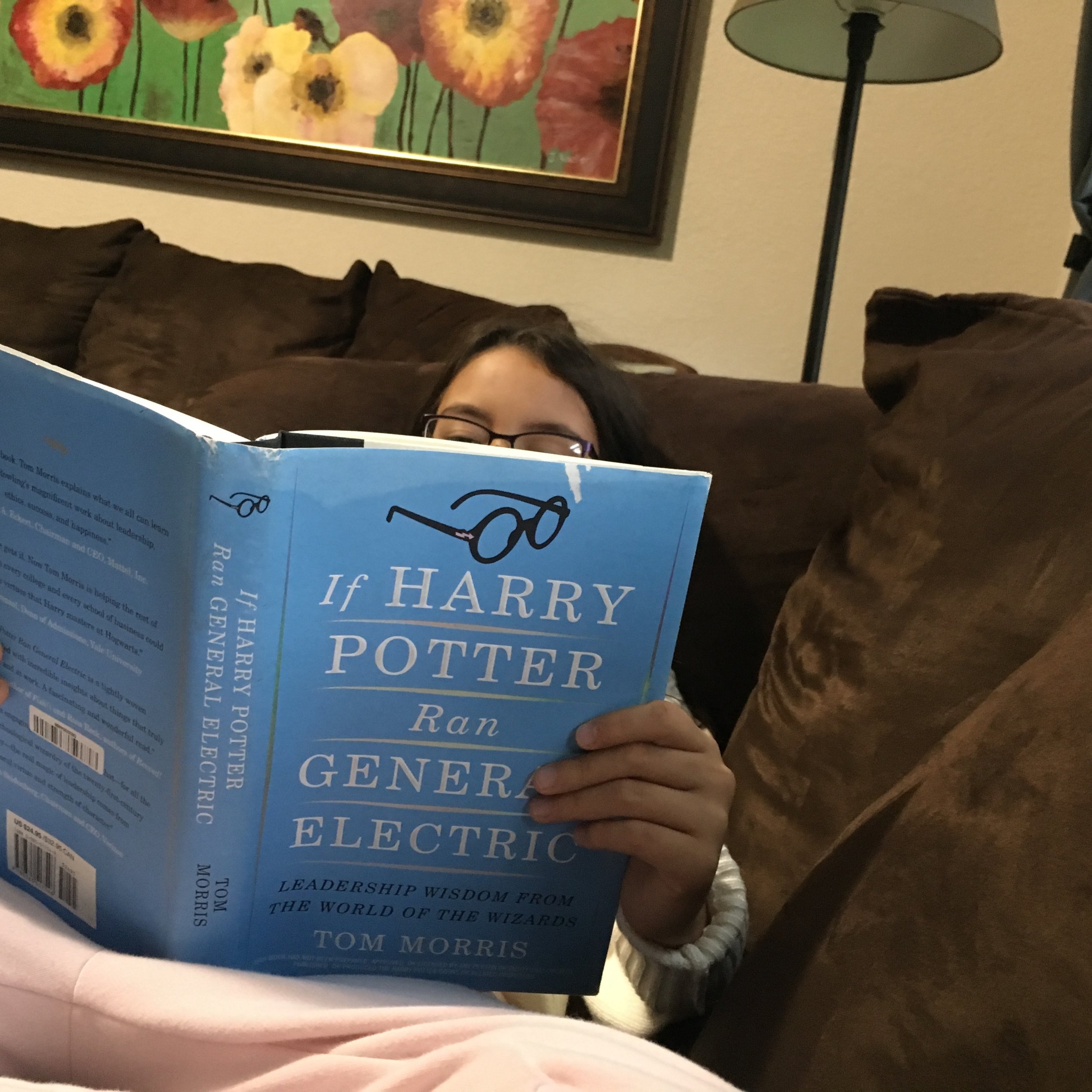
My Favorite Recent Photo: A young lady named Jubilee gets off to a head start in life by diving into some philosophy!

My Favorite Recent Photo: A young lady named Jubilee gets off to a head start in life by diving into some philosophy!

Great new Elizabeth Gilbert book on creative living and the creative experience.

Great new Elizabeth Gilbert book on creative living and the creative experience.

Two minutes on a perspective that can change a business or a life.

So many people have asked to see one of my old Winnie the Pooh TV commercials and I just found one! Here it is:

Long ago and far away, on a Hollywood sound stage, I appeared in two network ads for the wise Pooh, to promote his adventures on Disney Home Videos. For two years, I was The National Spokesman for that most philosophical bear. This is one of the ads. I had a bad case of the flu but I hope you can't tell. A-Choo!

One of my newest talk topics is "Plato's Lemonade Stand: Stirring Change into Something Great." Based on the old adage, "When life hands you lemons, make lemonade," this talk is about how to do exactly that. Inquire for my availability through the c…

One of my newest talk topics is "Plato's Lemonade Stand: Stirring Change into Something Great." Based on the old adage, "When life hands you lemons, make lemonade," this talk is about how to do exactly that. Inquire for my availability through the contact page above! Let's stir something up!

Above is a short video on finding fulfillment in anything you do, that was taped a few years ago. I hope you enjoy it!