Follow @TomVMorris
Retreats
Keynote Talks and Advising
About Tom
Popular Talk Topics
Client Testimonials
Books
Novels
Blog
Contact
ScrapBook
Short Videos
The 7 Cs of Success
The Four Foundations
Plato's Lemonade Stand
The Gift of Uncertainty
The Power of Partnership

Tom Morris

Great Ideas. With Power. And Fun.
Retreats
Keynote Talks and Advising
About Tom
Popular Talk Topics
Client Testimonials
Books
Novels
Blog
Contact
ScrapBook
Short Videos
The 7 Cs of Success
The Four Foundations
Plato's Lemonade Stand
The Gift of Uncertainty
The Power of Partnership
Disengaged.jpg

Half-Hearted Half-Lives

How intensely do you live? How fully embodied are you, throughout your day? Are you doing your thing All-In, or just semi-engaged?

Here's a challenging claim from Walter Kerr, in his book, The Decline of Pleasure:

"We are vaguely wretched because we are leading half-lives, half-heartedly, and with only one-half of our minds actively engaged in making contact with the universe about us."

Is that true of most people? Is it ever true of you, even half the time?

Just reading Kerr, I'm already vowing to make sure that, throughout this day, I'm playing life as a full contact sport, totally immersed, and committed to the full, with all my heart and mind.

How about you?

PostedJanuary 14, 2015
AuthorTom Morris
CategoriesAdvice, Business, Life, Wisdom, Performance
TagsEngagement, Commitment, life, work, enthusiasm, Tom Morris, TomVMorris, Philosophy, Wisdom, Walter Kerr, The Decline of Pleasure
Post a comment
Limits.jpg

Limits

We typically talk about limits as if they're always a bad thing. Because of this, I've seen lots of organizations and even corporate and association meetings given names like "Without Limits" or "Limitless" or "No Limits!" It's the ultimate cheerleading motto. Abundance. Infinity. Ultimate Expansiveness. The World is Yours. No, the Entire Universe - And Infinitely Beyond!

The problem is that we all have limits. And if we don't know them and respect them, we get into deep trouble. The great Anglo Saxon epic Beowulf, one of my favorite books, is about a guy who bought the "no limits" hype in his own time, and thought he was immune to failure. And that, ironically, set him up for his ultimate demise.

In Mary Shelley's classic cautionary tale of success and failure, the novel Frankenstein, Dr. Victor Frankenstein doesn't know his limits, either, and a world-class mess ensues.

Consider the oldest human epic story, from 2,700 BC, Gilgamesh. It's only when King Gilgamesh - handsome, powerful, narcissistic, and insatiably hedonistic - discovers the most basic of his limits that he's transformed into a good leader and king.

The wise thing to do is to live creatively within your limits, and at other times, at your limits, or even on them, in something like a high wire existential balancing act. But to pretend they don't exist is both wrong and dangerous. Our limits give us form, and without form, there is no substance, no distinctive, individual existence. We can rhetorically dismiss limits or deny them, but we're impoverished and even imperilled if we don't know and navigate by them.

How about you? What are your limits? How can you recognize them, respect them, even embrace them, and act with them in mind while you, nonetheless, dream big, aim high, and accomplish the seemingly impossible?

I'm a fan of outrageous greatness. I believe in the extraordinary. We should reject and blast through any unhelpful and artificial limits. But I think that knowing our real limits and wisely working within them can alone get us to where we most need to be.

And any philosophy that doesn't see with this is far too ... limited.

PostedJanuary 13, 2015
AuthorTom Morris
CategoriesAdvice, Attitude, Life, Leadership, Wisdom
TagsLimits, Greatness, Abundance, Success, Secrets to Success, Beowulf, Gilgamesh, Frankenstein, Tom Morris, TomVMorris
Post a comment
Sitting.jpg

To Sit in a Small Room Well

To sit,

To sit in a small room,

To sit in a small room well,

To sit in a small room well is to be,

To sit in a small room well is to be at peace,

To sit in a small room well is to be at peace and content,

To sit in a small room well is to be at peace, content and fulfilled.

To sit in a small room well is, for a time, a luxury and a joy.

Most problems come from not being able to do this,

Pascal once said, while he managed to sit

in a small room well, being at peace

and content and fulfilled

just to sit.

PostedJanuary 12, 2015
AuthorTom Morris
CategoriesLife, Wisdom, Advice
TagsTom Morris, TomVMorris, Happiness, Peace, Contentment, Fulfillment, Sitting, Pascal
Post a comment
ChurchillArt.jpg

Churchill on Art and Life

Sir Winston Churchill discovered the joy of painting when he was forty years old. It was to be one of the most rewarding activities of his life. I just read, for the second or third time, his little book Painting as a Pastime. It's full of great advice about mastering new activities that can enhance our lives immeasurably.

At one point, Sir Winston is talking about learning the art that was his favorite, and he says something profoundly applicable to progress in any great endeavor, in anything worth learning, where great delight can reward great difficulty. Let me quote.

Every day you may make progress. Every step may be fruitful. Yet there will stretch out before you an ever-lengthening, ever-ascending, ever-improving path. You know you will never get to the end of the journey. But this, so far from discouraging, only adds to the joy and glory of the climb.

What a wonderful statement! The adventures that we're on should extend out into the horizon, without any end in sight. There's always scope for new discovery and mastery, and indeed, new delight. We each need something in our lives that promises never ending challenge and enjoyment.

And it's never too late to find your art. Until, of course, it is. Therefore, start!

PostedJanuary 10, 2015
AuthorTom Morris
CategoriesArt, Advice, Life, Wisdom, Performance
TagsArt, Painting, Churchill, Sir Winston Churchill, Learning, Mastery, Delight, Tom Morris, TomVMorris
Post a comment
Painting.jpg

A Better Model For Decisions

How we think about choices can help us or hinder us in making them. I suspect that most of us carry around, in the backs of our minds, an inappropriate model for decision making that actually gets in our way and trips us up.

Many of us approach decisions as we would a True-False Test - there's a right answer and a wrong one. Take the new job, or stay in the old job. Move across the country, or remain where we are. True, or False. The difference is that we haven't previously learned in any sort of class which is which, and so we're in the old dreaded situation of guessing.

Sometimes, the Multiple Choice exam question might seem to be a more accurate rendering of how we think: There are many options for how I could approach my work or my life right now, and only one of them is best. Depending on the circumstances and the options, this can seem to capture a decision situation better than the True-False. But normally, it still puts on us a pressure that's totally unnecessary.

Philosopher Ruth Chang has an interesting Op Ed in the New York Times relevant to this. She says we often approach life decisions as a maximizing gain, minimizing loss scenario, and assume that if we could just get at the right facts out there in the world, the decision would be made for us. And she suggests that this isn't so. She counsels instead that when the options are at least "on a par" - there's no obvious best path forward, and we could live with either - we ought to ask what we could best commit ourselves to. It isn't a matter of guessing, but of commitment.

My suggestion is this. Decision making is less like an exam and more like an art. Every choice we make is a stroke on the canvas, a chip in the marble, a move in the dance. It's not necessarily a matter of True-False, or of picking The One Right Answer. It's a matter of "What's the next move we can feel really good about making?" And that aligns with Ruth Chang's consideration of commitment. What do you want? What can you commit to best?

When you think like that, you don't worry so much about "getting it wrong" and making a big mistake. Your thinking is more positive than protective, more about wants than about wariness. And that can liberate you to be the artist that you, deep down, are capable of being.

PostedJanuary 9, 2015
AuthorTom Morris
CategoriesLife, Advice, Wisdom, Performance, Art
TagsDeicisions, Choices, Ruth Chang, Philosophy, Tom Morris, Wisdom, New York Times, TomVMorris, Models
Post a comment
ArcherTarget.jpg

Self Knowledge and Goal Setting

I was giving a presentation recently on success, and we were talking about the importance of basing our goal setting in self knowledge. I explained that one philosopher had parsed self knowledge in an interesting way. He said, "Know your strengths. Know your weaknesses. Know your opportunities." And that's interesting, isn't it? Strengths and weaknesses are inner things. Opportunities are outer things. So how can knowing them, as external circumstances, be a part of self knowledge?

A situation that creates a great opportunity for one person will not provide the exact same thing for a different individual. Knowing what external situations are opportunities for you is a matter of self knowledge. But, how so?

Maybe we need to dig a little deeper. Maybe the imperative "Know Yourself" has a few more elements:

Know your strengths. Know your weaknesses. Know your limits.

Know your passions. Know your ideals.

Weaknesses are certainly limits, at least for now. But not all limits are weaknesses. Some limits are a result of our prior choices and commitments, and some are actually among our strengths. A robust and proper structure of commitments is a great thing to have. It empowers and it limits. And such limits will be very relevant to the goals we decide to set or adopt.

Knowing your passions is equally important. Some are strengths. Others are weaknesses. Some may be neither, in themselves, but developed can go either way. Passion is a source of drive and motivation. Setting goals outside of any concern for our passions is never a recipe for greatness.

And perhaps most important of all is knowing our ideals. We all have fantasies, desires, or passions that would not be right to pursue in a certain way or at a certain time. Our ideals are those values that should guide us in choosing. And they will help to determine what external situations do indeed provide opportunities for new goals and new successes.

All goal setting should be an ongoing exercise in self knowledge. And all these factors matter.

PostedJanuary 8, 2015
AuthorTom Morris
CategoriesAdvice, Business, Life, Wisdom, Philosophy
TagsSelf Knowledge, Know Thyself, Know Yourself, Strengths, Weaknesses, Limits, Opportunities, Passions, Ideals, Tom Morris, TomVMorris, Philosophy
Post a comment
Values.jpg

Values and Goals

This week, I'm reflecting a bit on goals, and I'll try to say some new things. Typically, we select new goals as a result of our desires and our values. Most of us have more desires than we ought to pursue. Our values help select which should be transformed into goals.

A goal is a guide to action. A value is a guide to action. So, then, what's the difference?

I've written that a goal is a commitment of the will. But then so is a value. A value is a commitment of the will. So, then, what's the difference?

On the simplest level, a goal is a specific commitment and a value is a general one.

But we can say more. A goal is a specific commitment to bring something about - to create or contribute to a certain result in the realm of fact. A value is a general commitment to honor, respect, protect, embody, or enact a quality or concern.

Some people confuse goals and values. They say, "Our goal this year is outstanding customer service." But that's too vague to be a goal. It isn't specific enough as to what fact will be created and how it will be measured or recognized. Outstanding Customer Service isn't a good or proper goal. But it's a great value. It's a fantastic general commitment that can suggest specific goals that are easily measurable and recognizable.

Values generate goals. But here's the equally important news. Values generate other values. For any value that suggests a new goal, there are often other values that lie behind it. And it's just as important to have the right values behind your choices and actions as it is to have the right goals.

Let me explain. If your commitment in the new year is outstanding customer service, if that's a driving value for you, then you should ask yourself why. Why do I value outstanding customer service?

Maybe, on reflection, you will come to realize that you want to be well known, or even famous for pleasing your customers. You want the praise and the reputation that will result. You also may value the financial benefits that often accrue to people who deliver great customer service. These are all common answers. And there's nothing wrong with wanting these things. People can properly value praise, reputation, and wealth. But they aren't the best ultimate values to drive the more immediate value of outstanding customer service.

Here's the contrast. There are other individuals who ask "Why?" about the value of outstanding customer service, and end up with the answer, "Because I really care about other people, and they always deserve the best I can give." That answer expresses the values of altruism and personal excellence. Those are the greatest drivers of more immediate values. Those are the answers that will help you to set, pursue, and stay consistent with the best and most worthy goals. Ironically, they'll also give you a better reputation, and often more wealth, than the guy just chasing reputation and wealth.

The commitments behind our commitments matter. They are where we get our ultimate strength. If you can get your inner house in order, at the deepest levels, you can fly the highest and do the best over the longest time frame. And that's the power of values.

PostedJanuary 7, 2015
AuthorTom Morris
CategoriesAdvice, Business, Attitude, Life, Wisdom
TagsGoals, Choices, Values, Good Values, Tom Morris, TomVMorris
Post a comment
CrowdedGym.jpg

New Goals

My gym has been amazingly full the past few days. Has yours? Don't worry, it won't last. There's a weekly version of this, too. Every Monday, the place is hopping. By Wednesday, it's just the old regulars.

In the opening days and weeks of a new year, we often allocate special energy to setting new goals. But then, a month or two later, it's back to normal, all too often. Why do so many of our New Year's Resolutions fade away?

Too many of us think we have new goals when we just have new fantasies. A fantasy is a figment of the imagination. I have a fantasy of lying in a hammock in Key West, perpetually. But it's not a real desire, not something that, when I actually think it through, I would want at all.

A desire is something stronger than a fantasy. Philosophers call it an inclination of the appetites, broadly speaking. It has some level of inner urgency to it. We feel a pull or a push toward anything that we actually desire. It isn't just an idle dream.

A goal is something very different. A real goal is a commitment of the will. The problem with many New Year's Resolutions is that they're fantasies, or desires, but not real goals. There's no commitment. And that's why they fade so quickly.

A commitment is a firm decision that has the quality of inner resilience. It can't easily be defeated. It's a motivated choice with renewable energy behind it, because of the values it embodies and that are therefore at stake. A commitment rides the wave of those values. And they are what will carry it on.

So if you've set new goals in the new year, and feel yourself wavering, ask whether you merely have a fantasy, or a desire, or have a real commitment, a choice based on values that you hold near and dear. Fantasies and desires can generate goals, guided by values, and they can support our goals, if we use them well. But they can't replace real goals.

Remember the importance of commitment. And I'll see you in the gym for a long time to come.


PostedJanuary 6, 2015
AuthorTom Morris
CategoriesAdvice, Business, Life, Wisdom, Performance
TagsFantasy, Desire, Goal, Commitment, new year's resolution, Wisdom, Tom Morris, TomVMorris
Post a comment
Yelling.jpg

Heavy and Hot Emotions

Why are there so many angry people in the world? At the gym the other day, some of us were talking about this. And I have a simple hypothesis. Anger is often an avoidance response.

Here's what I mean: Many people who express anger over little things, or even for no apparent reason at all, are subconsciously attempting to deflect an experience of certain other emotions that they will do almost anything to avoid.

This is the idea. There are certain heavy emotions like sadness, grief, disappointment, anxiety, discouragement, fear, and guilt. Such feelings can weigh on us. They can bring us down. We can be terribly oppressed by them. And when we acknowledge and express these emotions, that often just makes us feel worse. We wallow. We're stricken. We're crushed even lower.

And, on another side of the negativity spectrum, there are hot emotions like frustration, irritation, and - most of all - anger. When you express these emotions, it can be cathartic. You release the negative energy. You get it out. You stomp your foot, or throw a book, or punch a pillow. You curse. You send the power of the feelings through your voice or limbs and actively discharge it out into the world where you think it can't hurt you. Well, maybe you don't do this, but many people do.

You may know people who act like this all the time. In a situation where another person in their place would be feeling bad, or sad, or anxious, they instead turn the tables and attack someone who happens to be nearby, and often for transparently bogus reasons. But by doing this, they send any unpleasant inner energy they might be feeling out into the world for other people to deal with. They've transformed their guilt into offense, or their anxiety into rage. There's nothing wrong with them, they think. It's you, or the boss, or the neighbor, or the colleague, or the so-called friend who's just a jerk and the only source of any real problems in the situation.

It seems like many people won't allow themselves an authentic experience of the heavy emotions and, to avoid one or more of them, will deflect and externalize in these ways, instead. So, when you find yourself in the midst of an explosion of some hot emotion on the part of anyone close to you, and you can't figure out how it makes any sense in context, or in its degree or focus, consider that it may simply be avoidance behavior. It may be deflecting something deeper and too heavy to bear. And then, the only effective way to respond is to try to help your irate friend identify and deal with the real source of the problem, to the extent that he or she will let you. Otherwise, just let it go. It's not really about you, or the boss, or the neighbor, at all.

At least, that's my opinion as a simple philosopher utterly untrained in psychology, or psychiatry, or any of the disciplines that would actually cost you something to consult on such an issue. But then again, as they say, you get what you pay for. And if you disagree with me, just don't get hot about it. Ok?

PostedJanuary 4, 2015
AuthorTom Morris
CategoriesAdvice, Life, Wisdom
TagsAnger, Irritation, Frustration, Ire, Rage, Fury, Emotions, Sadness, Disappointment, Discouragement, Anxiety, Fear, Guilt, Tom Morris, TomVMorris
Post a comment
Friendship.jpg

Friendship is a Garden

Friendship is a garden that needs cultivation and care. There are many forces in the world that will strengthen it, and more that will weaken it. The good gardener understands this and doesn't allow neglect to spoil the beauty of what's been planted and grown.

Friendship is an investment whose returns can rise or fall. If your time and attention were money, whose stock would justify the price? Good investments, of course, benefit both sides. Bad investments ultimately fail everyone involved. Great investments are those that yield dividends for life.

Friendship is an adventure, a shared voyage into the unknown. It's both a journey and the best means that we have to journey well. It's a light that shines in the darkness, a map and compass for the trip. It's a partnership of exploration where guidance and help flows both ways.

Friendship is an enterprise, the building of something new. It's a dynamic structure of work and play with a purpose that, at its best, benefits more than just the friends themselves.

Friendship is a celebration of what's good in life, and a support through all that's hard. It's a sharing of interest, activity, exuberance, and fun. It can also be a sharing of trouble and grief. Friends multiply the good, while dividing the bad.

And so, without friends, Aristotle asked us, who would want to live?

Work in your garden today. Invest. Adventure. Build. Celebrate. And give the sort of support that you most would want to receive.


PostedJanuary 2, 2015
AuthorTom Morris
CategoriesAdvice, Life, Wisdom, Philosophy
TagsFriendship, Friends, Aristotle, Tom Morris, TomVMorris
Post a comment
HappyNewYear.jpg

Happy New Year

Yeah, it's just another day, another trip around the sun. So what's the big deal about this being the first day of a new year?

The truth is that we need rituals. We need symbolic markers that help us to look back, and look forward. Most of life is behind us and in front of us. Yes, we should live in the present moment, the only one we actually have. But we do so best by learning from the past and integrating each moment we now have into the coming future, in a way that's wise.

Markers help us to reflect - birthdays, anniversaries, and new year celebrations. What's just happened? What do we want next? How can we change and adapt to make new things possible?

The past is not supposed to define us, but to empower us, to push us along on our adventures. Do you want to lose some weight? Would you like to achieve a better balance between work and life? A new year gives you a starting point to begin to make those differences. Start today in small ways, and as little things add up, big changes can happen. It's up to us. We're never merely victims. We can all be victors, if we learn the importance of the little things, and the habits they can form.

May 2015 bring you all that you desire and deserve. May 2014 have prepared you well for this great new year!

PostedJanuary 1, 2015
AuthorTom Morris
CategoriesAdvice, Attitude, Life, Wisdom
TagsTime, the past, the present, Symbols, Markers, New Year
Post a comment
SprinklesBook.jpg

Sprinkling Wisdom

I got an envelop in the mail a couple of days ago. Its address was something like "Legendary Philosopher Extraordinaire Tom Morris" - and that, of course, got my attention. I tore it open and out fell a postcard picture of a new book, a write-up on the book, some other things, and a little jar of candy sprinkles in many colors. "What's this?" was followed by a big smile.

The package was from my old friend, the global customer service expert, Chip Bell. Chip was one of the first people to proclaim that what we need for what we do is not customer satisfaction but something much stronger - Customer Love. We need to create a product or service so great that our clients or customers become raving fans and walking ads for us, telling their friends and colleagues about us with enthusiasm. Chip himself walks the talk.

The new book, Sprinkles: Creating Awesome Experiences Through Innovative Service, is due out in February, but it's already available for pre-order on Amazon. It's apparently all about providing amazing experiences to people through thoughtful and creative service. And, knowing Chip, it will be full of great stories, insightful guidance, and real wisdom. 

I was sitting next to a well know architect on a plane ten years ago, and we must have talked for an hour. He told me that the luxury condo buildings he designs can't just be about beauty and convenience any more. They have to be about "Wow" experiences. From the moment you see the building, then at the moment you enter it, and throughout, he needs to craft opportunities for impressive aesthetic experiences. He has to sprinkle the wow factor all through his buildings. 

This was the first person to tell me that we're now in an experience economy, and that it's the engine that fuels our experience culture. People's buying decisions take into account all sorts of factors, but, he said, most important of all will be the consideration of experience. If we want great customers, we need to provide them with great experiences.

My friend Chip has been exploring this concept for a while now, and I bet his new book will be liberally sprinkled with new ideas and wisdom about how we can provide incredible experiences to the people we care about, in our work, and in our lives. Check it out.

I expect the new book, like the sprinkles that arrived in the mail, to put a big smile on my face. Sprinkles do tend to do that, wherever we see them.

SprinkleCake.jpg


PostedDecember 31, 2014
AuthorTom Morris
CategoriesAdvice, Business, Wisdom
TagsChip Bell, Customer Service, Customer Love, Sprinkles, Wisdom, Experience
Post a comment
Paradox.jpg

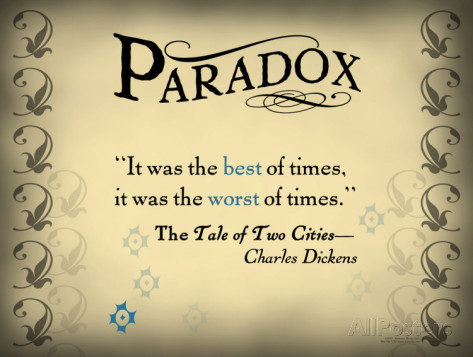
Paradoxes and Turnarounds

Paradox can be a key to much that's important in life.

In the seventeenth century, the French scientist and creative mathematician Blaise Pascal wrote of the greatness and wretchedness of man, of our bigness and smallness in the universe. He pointed out that we are so fragile, and yet so strong. Our minds are profoundly powerful, and yet so limited. He eloquently claimed that there is indeed a God, who is hidden. There is truth, and it's often buried beneath layers of falsehood. He often pointed us to paradoxes that were where he thought the deepest wisdom in life could be found.

Paradox often prevails in life, at least in surface appearances, and sometimes deeper down. For example: You can’t often get what you need unless you first give what you can. There’s rarely a success that doesn’t in some way come from failure, and many a failure results from success. By thinking you’re better than others, you can make yourself worse. Nobility and humility need each other, in balance. Little things can make a big difference. Big things can often make only a small difference. In strength, there can be weakness. In weakness, there can be strength. Playing it safe is rarely safe at all. 

What hurts us can help us. And helping a person can sometimes hurt him. To give what you get can make a bad situation worse. Play may be what you need most at work. The worst that happens can bring about the best that happens. We sometimes need to yield in order to prevail. We often have to relinquish in order to receive. Selfishness is self-defeating. Self-giving is self-fulfilling. A wise man admits his foolishness, while a fool prides himself on his wisdom. A bright light can illumine or blind. Revelations can be concealments. Concealments often reveal. And the list goes on. You can probably add your own examples, aplenty.

There are many wonderful paradoxes and turnarounds in life - deep surprises and unexpected connections. The more you understand them, the better you can be guided by them, and the more you can benefit from their magic.

PostedDecember 30, 2014
AuthorTom Morris
CategoriesLife, Advice, Wisdom, Philosophy
TagsParadox, Contradiction, Turnarounds, Opposites, Wisdom, Reality, Appearance, Philosophy, Tom Morris, TomVMorris
Post a comment
PrincessBride.jpg

"Have Fun Storming the Castle!"

Being nice to people can have amazing results. 

My granddaughter gave me one of my favorite Christmas presents this year, the book, As You Wish: Inconceivable Tales From the Making of the Princess Bride, by Cary Elwes, who played Westley in the hilarious and great movie, The Princess Bride. First of all, it was the most fun read of the year. The stories are incredible. Andre the Giant's eating and drinking habits alone will have you reading passages aloud to anyone willing to listen. The battles with nerves on the part of people we consider great actors, who gave world class performances in this film, are just amazing. Mandy Patinkin and Wallace Shawn, along with Cary, often worried about their abilities to portray such  characters as we see in the film, and ended up giving some of the most loved and quoted scenes ever. Plus, what you'll learn about the rigors of fencing, the real sword fighting of the movie, and what it takes to overcome big physical challenges may be worth the price of the book alone.

Sword.jpg

Then, there are such extreme stories of failure and success: William Goldman, screen writer for Butch Cassidy and All the President's Men, created a fairy tale story for his kids, and couldn't get anyone to turn it into a movie. Great directors and actors tried. No studio would go for it. Finally, Rob Reiner discovered the screenplay and showed it to his mentor, my old friend Norman Lear, who enthusiastically agreed to finance it. It opened to modest ticket sales. But it went on to become one of the true pop classics that spans generations.

To me, the most important lessons in the book revolve around Reiner, and his approach to directing a group of highly talented people. Cary described Rob as the ideal leader. He found the right people, convinced them to be involved, and then nurtured and encouraged them every step of the way. The book could have been called "The Power of Nice," because that's what the story about the making of this movie shows. Rob's calm in the face of apparent disaster, enthusiasm for the process, gentle kindness with his actors, raucous laughter, cheerful encouragement, and respect for everyone created a climate where the cast and crew became a big extended family able to do great things.

RobReiner.jpg

And I think that can happen in any leadership challenge. When you're genuinely nice to people, you create a spirit of partnership that allows you to have fun storming almost any castle, to use the image provided to us by Billy Crystal's wild character in the film, Miracle Max.

MiracleMax.jpg

True kindness to people can lead to some of the most astonishing miracles of fun, excellence, and creative joy that can be attained, in any endeavor.

PostedDecember 29, 2014
AuthorTom Morris
CategoriesAdvice, Leadership, Life, Wisdom
TagsThe Princess Bride, Cary Elwes, Rob Reiner, Andre the Giant, William Goldman, Mandy Patinkin, Robin Wright, Christopher Guest, Peter Cook, Carol Kane, Peter Falk, Wallace Shawn, Fred Savage, Chris Sarandon, Tom Morris, TomVMorris, Philosophy, Books
Post a comment
Courage.jpg

Courage in 5 Tweets

I was looking through my little book Twisdom and came across a few old tweets on courage, a topic I've mentioned recently in responding to a blog post comment. These tweets struck me anew and generated some nice additional pondering, so I thought I'd share them today. 

1. The courageous souls around us are here to remind us what we’re here to be.

2. Only courage will crack the thick shell of possibility and yield us the treasures within.

3. Courage is willing to walk in darkness while shining a light for others to follow.

4. Courage is something we have deep down in us when we need it – if we’ll just reach for it and act!

5. Courage is the power of choice even in the face of fear.

 It was number two that really got me thinking. How much possibility is unrealized in the world and in our lives, because we're not bold or brave enough to crack the shell around it? In the coming year, let's be courageous in little things as well as in big things. We need it. And so does the world. And that leads me to number three.

Shine your light.

PostedDecember 27, 2014
AuthorTom Morris
CategoriesAdvice, Life, Business, Wisdom
TagsCourage, Possibility, Life, Twisdom, Tom Morris, TomVMorris
Post a comment
Rejection.jpg

How To Handle Rejection

A book that's taken me eight years to finish, going through 24 versions, and six different titles,  has finally become, perhaps, my favorite nonfiction book I've ever had the joy and honor to conceive and write. And, so far, it's been rejected by potential publishers, in one version or another, 45 times.

My record before this was 36 rejections, for my first book, one that I wrote when I was twenty-one years old. The 37th editor who saw that manuscript said yes, and so I was a published author at age twenty-two, because I didn't give up. 

After that early stutter-start as an author, though, I've hardly ever tasted the disappointment of no. Instead, I came to enjoy a rare three-decade streak of unusual publishing success, producing twenty nonfiction books that launched me first into a great academic career, and then into a wild adventure as a public philosopher. 

The new book that no one wants to publish is all about the wisdom of the great practical philosophers on how to respond to change, and especially, how to deal with difficulty. And with it, I've suddenly experienced a very big change. I've never had such difficulty with any project. But the nice irony is that I've been able to use the advice of the book throughout the process of dealing with publishers, and I've learned how well all the wisdom of the ages works. I've attained a level of inner resilience and sustained confidence through it all to make Seneca or Marcus Aurelius proud.

Remember the old adage: When life hands you lemons, make lemonade. Everyone says it, but no one says how to do it. The philosophers have great advice on this. So, the new book is called Plato's Lemonade Stand: Stirring Change into Something Great. Editors at the major publishers have said that it's elegantly written, and that it contains important ideas. They've praised my past work, my present "platform" and the impact my books have, both in this country and around the world. They just worry that the new book would not be "big enough" for them, which in publisher-speak apparently means that it would not grab enough media attention and sell enough copies for all of us to retire and buy Kardashian-style Bentleys.

Only two editors, after various nice comments, added a clear concern. 

One said, "It's a little too prescriptive."

The other said, "It's not prescriptive enough."

Here's what I do. I don't let a spate of difficulty or rejection derail me. And you shouldn't either. The gatekeepers of any industry or enterprise are typically most comfortable with what they already know. And they may not know you, or understand what you're doing with your new idea, product, or process. But that doesn't determine the value of what you're doing, or how you should do it.

Creativity sometimes has a long road to walk. Dust off your shoes and keep walking.

Have your ideas been rejected? Have you been shot down? Well, remember that the Beatles were rejected and told, early on, that guitar music was "on the way out." The Dixie Chicks were advised to give up. They'd never make it in music. J.K. Rowling was informed over and over that there would be no market for her books about a kid named Harry Potter. And just yesterday, I read a book about one of my favorite movies ever - The Princess Bride - and how every major studio turned it down for 13 years, until my old friend Norman Lear paid to have it filmed by his friend Rob Reiner, who persisted despite all the difficulties. And the movie barely sold tickets when it came out, a seeming rejection at the box office as well, before it went on to become a classic.

Just do like all these creative people did. Keep doing what you you think is best.

That's what I do.

 

PostedDecember 26, 2014
AuthorTom Morris
CategoriesAdvice, Business, Life, Wisdom
TagsRejection, Persistence, Writing, Creativity
Post a comment
ClearBounce.jpg

A Christmas Message on Bouncing High

We benefit from people sharing their success stories with us. We want to know: How did it happen? What did they do? Could they predict the process in advance, or were there surprises?

We benefit from people sharing their failure stories with us. We want to know: How did it happen? What did they do? Could they predict the process in advance, or were there surprises?

I've been a student of success for a very long time. And along the way, I've come to grasp the vital importance of understanding failure as a crucial part of any worthwhile adventure. In this world, success is often hard to attain, and failure's easy to stumble into. But what's easy can teach us about what's hard. Rather than being embarrassed about failure, we need to acknowledge it, embrace it, and learn from it. It's the world's most common course for the growth and excellence we all aspire to achieve.

Christmas is, in principle, a holiday in which we Christians celebrate a great experiment, an adventure, really, that seemed to end, thirty-some years after the original Christmas day, in tragic failure. But in that apparent failure, were the seeds of ultimate success. We're told that God, the Source of All, transformed the terrible into the wonderful. And that's how it can go for us, as well.

Wise people have given us some advice about this. They've said: Fail often, fail well, fail forward. Avoid only those failures that would take you out of the game altogether. And, while this, in principle, is great advice, we often overestimate the damage that a certain failure would create, and we shy away from trying. We forget our inner resilience that sometimes only failure reveals.

So, today's advice is simple. Be the little ball that bounces high whenever it hits bottom hard.

Don't fear failure. Fear only a refusal to learn from it and transform it to the success whose seeds it contains.

Merry Christmas.


PostedDecember 25, 2014
AuthorTom Morris
CategoriesAdvice, Life, Wisdom, Philosophy
TagsSuccess, Failure, Christmas, Resilience, God, Adventure, Danger, Damage, Tom Morris, TomVMorris, Philosophy, Wisdom
Post a comment
Jobs-and-Socrates.jpg

Socrates and The Two Big Strengths

Socrates had two famous students: Plato, of course, but also Xenophon (pronounced as if started with a 'Z'). Plato was more theoretical and literary. Xenophon was more practical, and was actually a pretty amazing leader. In fact, the great management guru Peter Drucker once said that one of Xenophon's books, The Education of Cyrus, was the greatest book on leadership ever written. And having read it now three times, I think he was probably right. But I have a different concern today. And so, let me get to it.

Xenophon explained that what made Socrates such an impressive person was, first, his amazing degree of self-control. Xenophon actually thought of that quality as the basis for all the other many virtues, or strengths, that Socrates displayed. Then, he said, the second most important quality his teacher exhibited was consistency - that he was always thoroughly himself, genuinely and authentically.

Self-Control. Think about it for a second. It's the action or habit of resisting any pressures not to be or do what we know to be right. It's the quality we need to exercise in order to stay consistent with our beliefs, values, and sense of self. It's the ability to stand up to the pull of pleasure or the push of pain when either of these factors threatens to diminish our lives.

Pain and pleasure play big roles in our lives. Most people fight serious battles, accordingly, with fear and desire. Self-control is what it takes to win those battles. Some pains are properly to be feared and avoided. Some pleasures are rightly to be desired and sought. Self-control keeps us safely on our path, helping us to face what we should and reject what would be inconsistent to embrace. It prevents the damage that could happen if we were to act in improper and self-defeating ways, outside the borders of what's right for us, as the individuals we are.

I'm not sure that there is any such thing as perfect self-control in an imperfect world. But I've learned that the more of it we have, the better and stronger we are as we face the challenges and opportunities of life, and as we continue to create ourselves through our choices.

Plato's student Aristotle, who spent a lot of time analyzing human strengths, seemed to think that the chief virtue or strength we have is courage, without which none of the other virtues will ever be exercised in difficult circumstances. And how does courage function? It aids us in self-control, in doing what we know to be right, regardless of the difficulties and dangers that might face us. And that, in turn, yields consistency. But then, when you're a generally consistent person in your habits and history, that aids you greatly in exercising self-control. Again, perfection isn't the goal. But practice is the key.

So, according to Xenophon, the two chief qualities of Socrates, the basis building blocks of his greatness, were self-control and consistency. Properly understood, they can be such building blocks for us, as well.

PostedDecember 24, 2014
AuthorTom Morris
CategoriesAdvice, Life, Philosophy, Wisdom
TagsSocrates, Xenophon, Plato, Aristotle, Greatness, Self-Control, Consistency, Challenge, Fear, Danger, Desire
Post a comment
Secret.jpg

The Only Real Secret

Impact. Excellence. Legendary greatness. Happiness. Contentment. Fulfillment. A wonderful life and legacy.

Whatever ideal states you seek, there are people who for a price will tell you the five or seven secrets, or, perhaps the one that will deliver all. And when you learn these secrets, or this one big thing, you quickly discover that they aren't secrets after all. Either they're true and widely known. Or they're false and better ignored.

The only real secret is this: Get out of your own way.

We all have inner blockages to the ideal states we aspire to achieve. There was a childhood wounding. There's seething anger. There's a lack of education. There's an inability to really connect with others in a loving and compassionate way. There's self imposed stress. There's anxiety that will not let go. Your self esteem isn't what it should be. You don't have the confidence you need. You have this drive to be important, or the center of attention, or loved by everyone.

Get out of your own way. Uproot the obstacle. Tame the wild animal. Then, the purpose and passion and energy and excellence can flow through you. You can't attain any ideal without being a conduit to something greater than yourself. This is the universal testimony of those recognized as greatest in pretty much every field of human endeavor.

In basketball, a bad free-throw shooter has to practice and practice and practice and practice, so that the power of habit will come to smooth out his rough edges, and set up new inner patterns to allow him to get out of his own way.

A salesperson who blows ever call has to tame the inner worry and get out of her own way so that her personality and product can shine. So does an entrepreneur. So does an author.

We think we need to develop and grow. And we do. But the secret is that done right, these things help us to get out of our own way, so that we can shine with an authenticity we could never just manufacture. Be a conduit. Be a door. Get out of your own way, and enjoy the amazing results.

PostedDecember 23, 2014
AuthorTom Morris
CategoriesLife, Attitude, Wisdom, Advice, Business
TagsContentment, Power, Secrets, Happiness, Excellence, Fulfillment, Income, TomVMorris, Work, Tom Morris, Fame, Greatness, Secrets to Success, Fortune, Legendary Work, Impact
Post a comment
FoggyRoad.jpg

Anticipating the Future

The future is hidden by mist and fog.

Psychologists have recently been telling us that we're really bad at predicting how certain future outcomes of our actions will affect us and feel to us at the time they bear fruit. We ask ourselves, "If I do A, will that make me happy?" Or "If I do B, and C results, will that give me what I really want?" We try to imagine what a different or new or remote set of circumstances will feel like, and apparently, we almost always get it wrong.

There are two reasons we get it wrong. First, the future is uncertain. No one can really anticipate it, in all its details. Futurists have a history of howling failures. That's part of why they keep pointing us to the future - in the past, they haven't looked too good! Some things are predictable. Many are not, and they often interrupt our best planning and anticipating.

The second major cause of failure in anticipating the future consequences of our actions is that we're always extrapolating from the situation and mindset we're in, and that inevitably colors and distorts what we project the future to be. We view the future through present lenses. The problem is that hope and fear, desire and worry, along with ignorance and selective attention, can individually, or together, tint those lenses much more than we're aware.

This presents a problem. It seems to be the core of wisdom to think through the future consequences of our actions. But if our thinking, in so far as it projects future states, which imagining consequences always does, is inevitably flawed, then what are we supposed to do?

Fortunately, for understanding various possible futures, we're not forced to rely only on our own imaginations and projective abilities. We have the testimony of a great many people who have already lived through the consequences of every generally described action, or set of actions, imaginable. Although the details of life, society, and our options change continually, because of technology and politics, and for many other reasons, human nature has always been basically the same. That's why it's important to listen to people who have already experienced what we're thinking about doing. They can tell us how it actually felt to experience creating a small business, declaring bankruptcy, taking out a huge loan, getting married to someone very different from them, or very alike, having children, or separating from a friend or associate or family member who has changed in unfortunate ways.

Whatever situation you now contemplate, it's a specific instance of a general type that people have experienced before. That's why it's important to talk to wise people, and read the advice of wise people who have gone down this road before us. They can help tutor our otherwise unreliable imaginations, and guide us into the level of caution or action appropriate to our situation.

Wisdom is available. Use it well. That will help you in making all your most important decisions and will give you new lenses to help you see through the mist and fog up ahead.

PostedDecember 22, 2014
AuthorTom Morris
CategoriesAdvice, Life, Wisdom, Philosophy
TagsDecisions, The Future, Anticipation, The Imagination, Psychology, philosophy, wisdom, uncertainty, Tom Morris, TomVMorris
Post a comment
Newer / Older

Some things that may be of interest. Click the images below for more!

First up: Tom’s new Silver Anniversary Edition of his hugely popular book on The 7 Cs of Success!

The New Breakthrough Guide to Stoicism for our time.

Tom's new book, out now!
Finally! Volume 7 of the new series of philosophical fiction!

Finally! Volume 7 of the new series of philosophical fiction!

Plato comes alive in a new way!

Plato comes alive in a new way!

On stage in front of a room full of leaders and high achievers from across the globe.

On stage in front of a room full of leaders and high achievers from across the globe.

My Favorite Recent Photo: A young lady named Jubilee gets off to a head start in life by diving into some philosophy!

My Favorite Recent Photo: A young lady named Jubilee gets off to a head start in life by diving into some philosophy!

Great new Elizabeth Gilbert book on creative living and the creative experience.

Great new Elizabeth Gilbert book on creative living and the creative experience.

Two minutes on a perspective that can change a business or a life.

So many people have asked to see one of my old Winnie the Pooh TV commercials and I just found one! Here it is:

Long ago and far away, on a Hollywood sound stage, I appeared in two network ads for the wise Pooh, to promote his adventures on Disney Home Videos. For two years, I was The National Spokesman for that most philosophical bear. This is one of the ads. I had a bad case of the flu but I hope you can't tell. A-Choo!

One of my newest talk topics is "Plato's Lemonade Stand: Stirring Change into Something Great." Based on the old adage, "When life hands you lemons, make lemonade," this talk is about how to do exactly that. Inquire for my availability through the c…

One of my newest talk topics is "Plato's Lemonade Stand: Stirring Change into Something Great." Based on the old adage, "When life hands you lemons, make lemonade," this talk is about how to do exactly that. Inquire for my availability through the contact page above! Let's stir something up!

Above is a short video on finding fulfillment in anything you do, that was taped a few years ago. I hope you enjoy it!