Follow @TomVMorris
Retreats
Keynote Talks and Advising
About Tom
Popular Talk Topics
Client Testimonials
Books
Novels
Blog
Contact
ScrapBook
Short Videos
The 7 Cs of Success
The Four Foundations
Plato's Lemonade Stand
The Gift of Uncertainty
The Power of Partnership

Tom Morris

Great Ideas. With Power. And Fun.
Retreats
Keynote Talks and Advising
About Tom
Popular Talk Topics
Client Testimonials
Books
Novels
Blog
Contact
ScrapBook
Short Videos
The 7 Cs of Success
The Four Foundations
Plato's Lemonade Stand
The Gift of Uncertainty
The Power of Partnership
socratesjesus-1080x650.jpg

Socrates and Jesus

I always had my Intro to philosophy students read Plato's Apology (The Greek word means "Defense"), an account of the trial of Socrates, during the first week of our class, because of the portrait contained there of a man wholly dedicated to the life of the mind. Offered the chance to live and go free if he would just stop doing philosophy on the city streets, Socrates said, "As long as I live and breathe, I shall never cease to philosophize." My students were stunned to see an adult, as they would say, committed to a mission, so imbued with a purpose, that he would willingly go to his death rather than recant or change his ways. Such determination! Such passion!

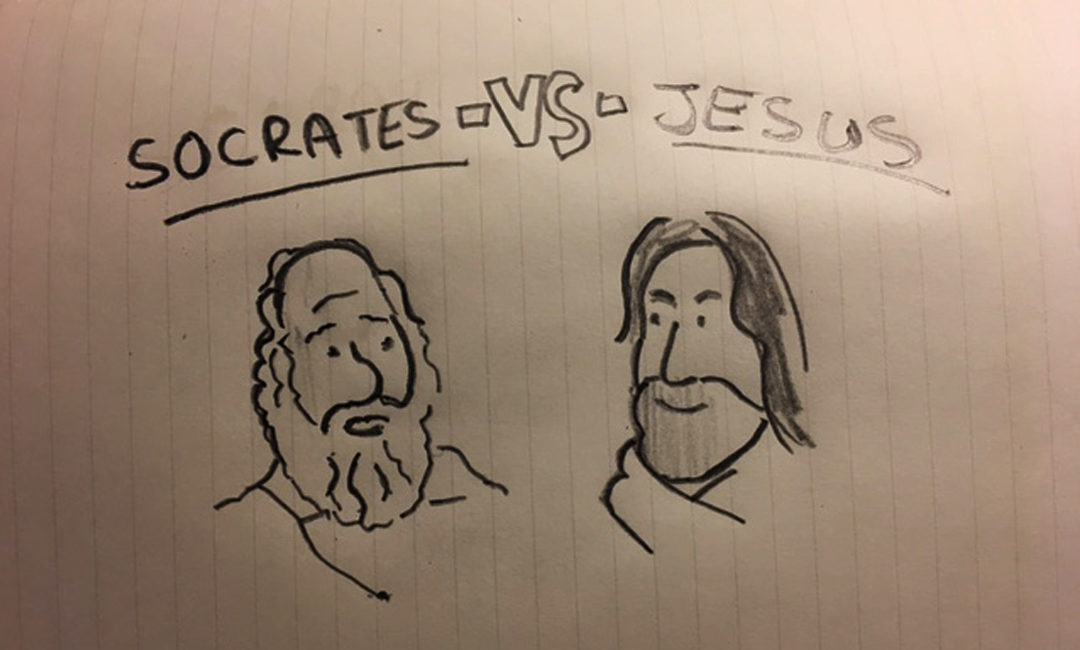
Socrates was intensely committed to truth. And he died for that commitment. Jesus, by contrast, was fully committed to love, and he died for that.

I would suggest that you can be committed to truth without an equal felt commitment to love and compassion, but that you can't really and fully be committed to love without also thoroughly honoring truth. So Socrates had, perhaps, a big part of life's puzzle, but not the whole thing.

An old professor, an orthodox Jewish Rabbi who taught philosophy of science, once said to me, "Christianity is all about what you believe, while Judaism is all about what you do." Well. It's not quite so stark, is it? But I get what he was saying. Since Jesus was a Jew, and so were most of the early Christians, maybe we should dig a bit deeper. Perhaps Christianity is more about an attitude and commitment of the heart than about either the beliefs or the actions that might properly attend that attitude and commitment. We do cherish our beliefs and opinions. We're willing to fight for them. Maybe we should cherish God and his creatures more.

There's this other contrast between Socrates and Jesus. Socrates could come across as arrogant. Jesus, strangely, despite alluding repeatedly to his own literal divinity, seemed to live and preach humility. The trick in life is to have all the right commitments, but with all the right attitudes.

The Greeks didn't appreciate the deep power of humility. Christian theologians have, because of Jesus. In the end, truth may indeed be worth dying for. But it's love that's worth living for.

PostedNovember 21, 2017
AuthorTom Morris
CategoriesAttitude, Faith, Wisdom
TagsSocrates, Jesus, Truth, Love
Post a comment
David Rigsbee.jpg

The Great Gift of Poetry

I hope you read good poetry now and then. Great poetry is of course even better. This week I've been reading the poetry of David Rigsbee, an amazing poet who grew up in a little house across the street from the home of my youth, his father a musician who had given up his performance dreams to have a son and then another, and took a job at the cigarette factory in town to support his family. And one boy, my funny and daring best friend in childhood, on a fraught day of anguish, shot himself dead. And the other grew up to perform, but with words. As I'm about to finish his third book of verse, I decided to write him my appreciation like this:

A Man Stretched Across The Hall, Four Feet Up

A philosopher, an older Yale trained logician and master of modality dedicated to defending the faith liked to walk outside my door like the rock climber he was, feet on the wall, soles pressing the paint as his hands pushed the opposing vertical face, shoving hard as if to relocate it inches farther back,

but then his body wouldn't span the full gap as your poems do so well, pressing the mundane, the small quotidian detail on one side, and keenly stretched to the metaphysical extreme on the other, caught between the concrete particulars of a flower or a bee or a gun, but with greater meanings

and longings tattooed on you, and now me, as on a father’s arm, intensely aware of the quick passing, evanescent, transient nature of all that we see and love and feel—and we're never really armed for that, are we?

But if I convey my appreciation like this, it’s as if a chimpanzee took a volume of Kant and opened it and stood on a podium, wearing a little suit

and said, “Chee, chee, chee” with a sound like a quotation from Confucius or Lao Tsu or one of their disciples on life energy—but we know better, and get it that he’s just monkeying around. And so, we can laugh.


PostedNovember 18, 2017
AuthorTom Morris
CategoriesArt, Wisdom, Philosophy
TagsPoerty, Wisdom, David Rigsbee, Tom Morris
Post a comment
kidmicroscope.jpg

Developmental Epistemology.

One of the most important things I came to realize in graduate school eons ago at Yale was that there are, throughout life, conditions and preconditions for knowing. The basic idea is simple. Not everyone can, at any given time, know just anything. Little kids don't know algebra. A six year old doesn't understand the job of a comptroller. The deeper realization is that, all through life, there are developmental conditions for knowing. The first time I looked through a microscope, I saw only my own eyelashes and some blurs. I didn't know how to look, or how to see in that context, properly.

Time and experience led me to understand that there are also moral, aesthetic, and spiritual conditions for knowing. If you've not grown in the right ways, you won't be able to see certain things, or understand them, even if you do see them.

For example, a malignant narcissist can't even understand what's wrong with his actions. He also can't fathom the motivations of altruism. Likewise, a superficial materialist can't understand things of the spirit. Even a religious person may not grasp the deeper matters and perspectives of faith. It depends on whether they've grown yet into the requisite conditions for knowing.

There's an assumption of epistemological egalitarianism in our world that's just false. We aren't all equals in knowing, at any given time. Some of us are farther along than others of us. But there is, in principle, an equality of opportunity to develop appropriately with regard to the basics needed for true wisdom in daily life. The road is there. We just need to walk it.

Remember this when you're in conversation with another person who just does not seem to "get" what you're talking about. There may be an epistemic gap, an incomprehension that can't in that moment be breached. Further growth is needed. Patience may be required. And compassion.

PostedNovember 14, 2017
AuthorTom Morris
CategoriesAdvice, Wisdom, Philosophy
TagsKnowing, Wisdom, Knowledge, Equality, Judgement, Discernment, Tom Morris, Philosophy
Post a comment
Wisdom.jpg

Wisdom

Wisdom.

When you hear or see that word, what do you think? Far too many people seem to mostly draw nearly a blank these days. If asked what it means, they might hesitantly venture that wisdom has something to do with age, or insight, or a calm and peaceful perspective on things. But it seems to be a word and a concept on the far periphery of our culture now. And that's the opposite of how things should be.

Wisdom isn't an extra swirl on the icing of the cake representing a good life well lived. It's a main ingredient of any such cake whatsoever.

There have been times and places of greater perspicacity where wisdom was seen as the ultimate edge in life, or in business, or in all political and military affairs. Look at the book of Proverbs in the Bible. Wisdom is praised as precious beyond all other things. A Japanese proverb states that wisdom and virtue are the two wheels of a cart. In my view, you can't have one without the other. And you can't have either without at least some measure of the additional quality of love praised by top saints and sages—that compassionate care and concern for ourselves and others that lifts us above the petty and degrading squabbles and needless anxieties of this world.

My job is to bring people more wisdom for their lives. And this is more of a challenge than you might imagine. I used to think that people pursue what they need and what they want. I now realize that we pursue only what we KNOW we need and what we want. And too many people in our day have no realization that they need wisdom for the journey. They think that "basic common sense" is all they need, and they have too low a standard even for what constitutes that.

Help me bring an appreciation for wisdom back to the culture at a time when we all greatly need it—across demographics, professions, genders, political parties, industries, and races. Its absence grows increasingly dangerous as the world rambles and meanders forward without its guidance.

PostedOctober 26, 2017
AuthorTom Morris
CategoriesAdvice, Wisdom, Philosophy
TagsWisdom, Philosophy, Tom Morris
Post a comment
HAPPY AUDIENCE.jpg

Give Your Best. Consistently.

I'm editing a book manuscript on what a successful life is, in our time. In the book I'm interacting extensively with six great thinkers throughout the centuries, including Lao Tsu, Confucius, Cicero, and Emerson. In a passage on Confucius, while explicating some of ideas, I made a point that I'd like to pass along today.  We enter amid the passage. So here goes.

<<When there’s action to be taken, give your best. This is great, basic advice for any endeavor. Early in my career as a public speaker, someone occasionally would tell me in advance of a talk, “This is a really important group”—as if I should take care to be on my game for this one. My response was always, “Every group is a really important group.”  And I meant it. Whether I’m earning the equivalent of a year’s academic salary from speaking to an international group of powerful leaders for an hour, or I’m giving a free talk to a local school or charity, I can’t even conceive of not doing my very best.  

Each group I speak to is, in my estimation and for the duration of that presentation, the single most important gathering of people on earth—regardless of their worldly status as measured by any other standards. I have my own standards. That group is of unrivalled importance to me. The same goes for sitting at home alone with a book, or typing away at the computer. My level of commitment is always the same. Why? First, it’s a matter of personal identity and professional honor. I am who I am. And my work is what it is. No external circumstance can change that. I bring to any situation the utmost of respect for all the people involved, or even potentially involved.

But there’s a second reason as well. A consistent effort in all things on a daily basis can make a huge difference to the ultimate outcomes we experience. Consistency is akin to what military thinkers call “a force multiplier.” It’s a source of leverageand power. And yet, it’s oddly and surprisingly rare to come across this quality in people’s lives – which truly astonishes me. Whether we think of consistency as harmony, fidelity, or constancy, this characteristic is as vital as it is widely ignored in our day.>>

PostedSeptember 8, 2017
AuthorTom Morris
CategoriesAdvice, Business, Wisdom
TagsValue, Importance, Speaking, Work, Effort, The Mind, Consistency, Tom Morris, TomVMorris
Post a comment
middlemarch.jpg

The Meaning of Life is in Small Things

My favorite line in the ancient Chinese wisdom text, The Tao te Ching, always makes me smile. The first time I read it, I laughed out loud at its insight. It says:

"Accept being unimportant."

The New York Times today ran an amazing essay on big dreams, fame, and meaning. Author Emily Smith reflects on George Eliot’s novel Middlemarch, where a character has to give up her big dreams and find her meaning in the small details of a faithful life, raising a family. She will never be famous, or celebrated, Eliot says, and points out to us all:

“But the effect of her being on those around her was incalculably diffusive: for the growing good of the world is partly dependent on unhistoric acts; and that things are not so ill with you and me as they might have been is half owing to the number who lived faithfully a hidden life, and rest in unvisited tombs.”

Yes. It's worth reading that again, and slowly. Smith goes on to say, and I'll quote her liberally here:

<<It’s one of the most beautiful passages in literature, and it encapsulates what a meaningful life is about: connecting and contributing to something beyond the self, in whatever humble form that may take.

Most young adults won’t achieve the idealistic goals they’ve set for themselves. They won’t become the next Mark Zuckerberg. They won’t have obituaries that run in newspapers like this one. But that doesn’t mean their lives will lack significance and worth. We all have a circle of people whose lives we can touch and improve — and we can find our meaning in that.

A new and growing body of research within psychology about meaningfulness confirms the wisdom of Eliot’s novel — that meaning is found not in success and glamour but in the mundane. One research study showed that adolescents who did household chores felt a stronger sense of purpose. Why? The researchers believe it’s because they’re contributing to something bigger: their family. Another study found that cheering up a friend was an activity that created meaning in a young adult’s life. People who see their occupations as an opportunity to serve their immediate community find more meaning in their work, whether it’s an accountant helping his client or a factory worker supporting her family with a paycheck.

As students head to school this year, they should consider this: You don’t have to change the world or find your one true purpose to lead a meaningful like. A good life is a life of goodness — and that’s something anyone can aspire to, no matter their dreams or circumstances.>>

The author, Emily Esfahani Smith, is an editor at the Hoover Institution at Stanford University, and is the author of The Power of Meaning: Finding Fulfillment in a World Obsessed With Happiness.

PostedSeptember 4, 2017
AuthorTom Morris
CategoriesAdvice, Wisdom, Philosophy
TagsSuccess, Meaning, Work, Tom Morris, TomVMorris, George Eliot, Tao Te Ching
Post a comment
philosophy-banner.jpg

Philosophy: Some Musings

Philosophy is an object of study that's ultimately meant to be a way of life.

Philosophy can confuse and confound, irritate and even enrage before it enlightens. But it will ultimately justify its pursuit and contribute to a distinctive inner peace.

A little philosophy is a dangerous thing because it easily raises questions that can be answered only with great effort in more philosophy.

At the root of philosophy is the love and quest for wisdom. And at the heart of wisdom is compassion. If anyone purports to espouse philosophy, but without compassion, walk away.

Philosophy is questioning what others take for granted, and seeking to understand whatever can be understood among life’s most important matters and mysteries.

Philosophy will not stay silent in the face of lies, ugliness, evil, or alienation because it values Truth, Beauty, Goodness, and Unity.

Philosophy is a calling for some, a reminder for all, and a resource at each of life's big junctures.

Philosophy at its best encourages not just the good of a few but the proper inner health of us all.


PostedSeptember 2, 2017
AuthorTom Morris
CategoriesAdvice, philosophy, Wisdom
TagsPhilosophy, Tom Morris, TomVMorris, Wisdom
Post a comment
Eclipse.jpg

E Pluribus Unum: The Eclipse and Our Unity.

It was a remarkable day, wasn't it, with everyone focusing on the sun and its eclipse. People of all races and ages and political persuasions were putting aside all that for a moment with a greater, single unified focus. All the various tribalisms gave way, if only in our attention, to a passing sense of our common plight and wondrous journey on this small planet dancing around a minor sun, tucked away in a far corner of a galaxy among billions of others, flying through space at greater and greater speeds.

I was reminded of our unofficial national motto, found on coins and often repeated—the Latin phrase, 'E Pluribus Unum,' one from many, or "out of many, one." That's the brilliance of our history as a nation. We weren't founded on the traditional basis of "soil and blood" that's so common for national origins around the world. We didn't all always live here or come from ancestors who did. We're not all related by the tightest weaves of family and tribe. We have originated from many places and nations, and out of many religions and views, and yet we came together under a single set of ideas to unite us as the classic hope of the world.

In the gym today, my workout partner Don and I talked about tribalism and the global imperative. We can't survive as a species and as a world unless we're ultimately able to rise above the identity politics and splintered nationalist affiliations that spark anger and hatred and wars. Carl Sagan and other astronomers have worried that we've never had verifiable contact with an advanced civilization from another planet, perhaps, because intelligent beings always destroy themselves before they can engage in extensive intergalactic communication or travel. We seem to be rushing down such a path ourselves, with hot spots around the world, and nuclear weapons poised for action while irrational rhetoric heats up with threats and warnings. Perhaps we need a new attitude focused on our commonalities. Maybe even the celestial event of today can remind us of this. It's easy to do globalism badly. It's easy to do anything wrong. As Aristotle suggested with his favorite analogy of an archery target, there are lots of ways to miss any bullseye, and there is only one place to hit it precisely right.

I would encourage all of you to ponder this. Let's find ways of celebrating our differences, while valuing each other and rising about the tribalisms that threaten us and our future. Let's find something to focus on that will unite us and not divide us. Any other path will lead to an eclipse that no one will want to see.

PostedAugust 21, 2017
AuthorTom Morris
CategoriesAdvice, Wisdom, Philosophy
TagsEclipse, America, Unity, Diversity, Tribalism
Post a comment
OldMap.jpg

On Being Open: Adventures and Maps.

One of the greatest human qualities is a genuine openness to new ideas. Socrates perhaps pioneered the view that wisdom could consist in knowing how much you don't know, and being open to explore and learn.

Our problem, typically, though, is that our openness is limited and very temporary. I'm open to learn until I think I have, and then I quickly close down that particular aperture of openness and draw a map that I henceforth use to chart my way forward, with much less of a readiness to being further corrected or educated on the matter I now think I know. Maybe that's just me. But I suspect it's also a tendency in many other people. And when we have a map, we hold on to it tightly.

The problem is that pioneers have often been terrible map makers. The first explorers of any continent or island typically drew up very inaccurate maps of the new territory. It took other people, later on, to get things straight. And that gives me a nice metaphor for my own intellectual exploring. I shouldn't be so quick to think that the first map of a territory that I draw up mentally is just fine, and fully accurate. I shouldn't let it block further openness. A map is fine, and useful, but maybe it's better thought of as a place to start than as a place to end. Perhaps it shouldn't shut down my eagerness to learn and even change my mind, but rather spur it on.

Just a thought.


PostedJuly 7, 2017
AuthorTom Morris
CategoriesAttitude, Wisdom, Philosophy
TagsOpenness, Humility, Wisdom, TomVMorris, Tom Morris, Socrates
Post a comment
BlueBlue.jpg

Heterologicality: A Short Silly Post.

If it's Ok, I want to post something short, silly and yet perhaps thought provoking.

I've been thinking about heterological words today. I know. I know. You're probably saying to yourself, "Yeah, I do that all the time." But for any of you who don't: a homological word is one that applies to itself, like 'English' or, perhaps, 'pedantic' or 'grandiose,' or 'multisyllabic.' A heterological word is one, by contrast, that does not apply to itself. Like 'monosyllabic.' Today on Twitter someone posted my favorite pair of heterological words:


Hyphenated.
Non-Hyphenated.


These make me smile. And Ok, I almost giggle. Maybe I'm too easy to please. Other more mundane examples of heterologicality would include 'Russian' which is not a Russian word, and 'dirty' which is quite clean, as words go. Now, as a matter of fact, most words are clearly heterological. Most adjectives don't apply to themselves and most nouns don't, either. 'Cat' isn't a cat. 'Pink' isn't pink. And so most ordinary heterologicality is fairly boring, however remotely risqué it might sound to anyone who doesn't get out enough. But some instances of it are more interesting, and for various reasons. For example, 'verb' isn't a verb but a noun. And that tweaks me somehow. Moreover, 'uppercase' isn't at all what it denotes. Of course, the same is true of 'LOWERCASE' - but it seems to work a bit too hard to get its similar status.


Do you have any favorites? Homological or Heterological?


Fun Cosmic Bonus Question: Is 'heterological' itself heterological or not?


Postscript: I get a big kick out of stuff like this. So I've presented these ideas orally to some smart normal people today, and all I got in return were fairly blank stares, or other forms of non-reaction. I guess I need to get some better material. I'd hate to be the sort of guy who comes to be known for thinking that words like 'entertaining' or 'hilarious' are even remotely homological.


*Sigh*

PostedJuly 6, 2017
AuthorTom Morris
CategoriesPhilosophy, Wisdom
TagsWords, Paradoxes, Philosophy, Tom Morris, TomVMorris
Post a comment
Philosophy.jpg

Philosophy: A Few Thoughts

Philosophy is the ongoing effort to peel back the layers of this life and discover the deepest truths of our unexpected and wondrous world. When done right, it’s inquiry and deliberation at their best. It's also the one use of reason that's well aware of reason's contours and limits. It’s meant to be much more than an entertainment for some, and an irritant for others. It’s a guide for making and walking our proper paths in life. It's a liberator and a muse, freeing us and calling us forth to a creative art of life.


Philosophy destroys the false and elicits the true. It unmasks the mundane to show us the beautiful. It seeks the good and hints at what might be the unity, the one, beneath all else. It has no masters, only students. Its heroes are simply those who toil hardest, show us the most, spark us well, and help us along our own way. It’s about the highest and the deepest, the biggest and the smallest, all at once, and even as it examines what that 'once' might be.


Philosophy can enrich us immensely, but it pays no bills. Has anyone ever been paid just to think? We who do it full time are paid to speak, and write, and teach. But the thinking itself is its own reward. Done well, philosophy is something that can’t possibly disappoint. Done badly, it’s a danger and a calamity. But it also explains to us why it has these opposite potentials. It urges all of us to let it enhance our lives. But it advises us as well to tread carefully as we heed its invitation.

PostedJuly 3, 2017
AuthorTom Morris
CategoriesPhilosophy, Wisdom
TagsPhilosophy, Tom Morris, TomVMorris
Post a comment
The first four of the eight or more books underway, in the new Philosophical Fiction genre of hope.

The first four of the eight or more books underway, in the new Philosophical Fiction genre of hope.

A Work of Hope

Most businesses cater to either our realized needs, our desires, or our fantasies. And of course, these three categories are connected in various ways. Some businesses cater to our fears, and a few, to our hopes. Commentators have told me over the years that one reason my talks and books are successful is that they bring people hope. They display the wisdom we need to spark and ground our hopes for a better future. And today, I've realized for the first time that this may also be true of the new novels I've been writing.

I've enjoyed or benefited from various types of dystopian literature at times in my life - from Orwell's books to The Handmaid's Tale to The Hunger Games and the Divergent series. And in troubled times, people often turn to such books as needed cautionary tales, and as instructive explorations into the dark side of human nature. After the Arab Spring of 2010 and 2011 worked out so badly, at least in the short run, writers in North Africa began a sudden turn toward darkness in their own poems and fiction. I certainly understand that. But there's a big part of me sensing now that what we most need in turbulent times is a literature of hope, well grounded, thoughtful, responsible hope. And as I deepen in that realization, I come to see that this is exactly what I've been writing and editing for the past six years—an epic adventure series of books, set in Egypt in 1934 and 1935, that explores the best in our nature as it responds to the worst. Issues of courage, friendship, love, and the power of the mind weave through the books and cumulatively create the elements of a very powerful worldview, anchored in ancient thought and yet responsive to the best of modern science. Without realizing what I've been doing—other than writing as fast as I could to get onto the computer a vivid movie I was seeing in my head each day—I was bringing into the world precisely the sort of literature I think we now most need, in our nation and globally. And that gives me a new sense of excitement and personal adventure about continuing to bring these novels into print for their growing audience. After being told by my agents repeatedly that I'm a nonfiction writer, not a fiction guy, even without looking at the fiction, I decided to create my own imprint and a business to bring these new books into existence in our time. And a new publishing imprint unconnected from the major New York houses that I've worked through in the past gets no publicity, but then provides many distinctive gratifications. And, again, as I've said here before, I deeply appreciate those of you who are reading and writing me your impressions of these books. May we together launch something very new into our time. www.TheOasisWithin.com


PostedJuly 1, 2017
AuthorTom Morris
CategoriesLife, Wisdom, Philosophy
TagsPhilosophy, Novels, Philosophical Fiction, Tom Morris, TomVMorris, Hope, Busines, Publishing, The Oasis Within, The Golden Palace, The Stone of Giza, The Viper and the Storm
Post a comment
LoveOverFear.jpg

Fear. And Love.

What should we think about fear? Maybe Aristotle can guide us in the way he assessed the very different, but often related, emotion of anger. He believed the value of this powerful state of mind and heart could be revealed by such questions as: Toward what or whom? In what measure? For how long? And to what end? We should probably ask the same questions about any instance of fear. When there are real dangers, fear is rational. And it can be reasonable for us to allow it sometimes to call the shots, determining our thoughts and actions at a particular moment, or in a certain fraught situation, and thus guiding our behavior then and there. But this should not be a common occurrence. And there could be a better alternative.

A courageous person never lets fear unhinge him or her and always seeks to do the right thing, regardless of any dangers that might loom and threaten. Sometimes, that means listening to fear and accepting its guidance to pause, or stop, or retreat, or avoid. There are times when it's wise to be moved by fear. But in modern life, this emotion tends to intrude into our thoughts and feelings much more often than its help is needed. Practical wisdom, or prudence, demands that we respect a wide range of values in our actions, and those values encompass proper concerns for our own health and self preservation, as well as for those we love, and even to consider and protect a positive reputation among at least the wise in our communities. But fear is often a bully in its warnings that we may lose what we value, and is as subtle as any insidious force can be.

Fear has a thousand faces. It quite often presents itself as something other than what it is—as perhaps a common sense and reasonable desire for safety, or security, or comfort, or simply for what's known, as distinct from what might be clearly uncertain and unknown. It can make itself look like altruism, or moderation, or sheer rationality, and even when it's the polar opposite of these things.

I've let fear influence my choices far too often in life. But I never recognized it at the time. I was a master of self-deception. And, whether I know you well or not, I can imagine that you are, too. We all have this unfortunate skill. We can rationalize almost anything. And the smarter we are, the more convincing we can be, not only to others, but to ourselves. We allow fear to mask itself as a proper concern for another person, or as the voice of reason, when it's not that at all. And we need to learn the form of discernment, a component of wisdom that allows us to spot our emotions and motivations for what they are, rather than being moved around by what they appear to be. It's almost as if negative emotions can be illusionist shape-shifters and masters of disguise. Part of the Platonic program of stripping away illusions and getting beyond appearances means unmasking them and refusing them illegitimate power.

Fear can present itself as any reasonable person's primary concern. After all, what's more important than survival, it asks us. Well, perhaps a lot. I've come to see fear as being, at best, a rare and secondary motivator along the course of an imperfect life. Yes, it can be helpful. And for that we should thank it. By I now refuse to allow it to call the shots as often as it would like. I'll feel its cousin anxiety arise within me, but nowadays I'll spot it, and question its validity in the moment or the situation, and dismiss it from my heart and mind when it's counterproductive, or in other ways uncalled for. I hope you will, too.

Salespeople are trained in some organizations to act on the fact that most people are much more motivated by a fear of loss than by a desire of gain. And I have a corresponding suggestion: We should not be among those fearful people, and thus, by our own independence, diminish their numbers. No one has ever attained excellence or greatness by following a path of fear. No one ever made his or her best contribution to the world from a place of fear.

It's often been said: Two forces motivate us—love and fear. I recommend love. It's a vastly better guide, overall, than fear. It can give us the true safety that fear always pretends to care about, and yet without the illusions, constraints and deceptions of fear. Love, understood properly and done right, should be our prime mover and most consulted guide.

I think of love here in the deepest spiritual sense, and very differently from the popular understanding—not as an emotion at its core, but as a perspective and commitment to certain positive values, and to the good of all souls. Love is, on this perspective, the main application of wisdom, which is both love's fount and guide. If you value the right things, and embrace those values properly, if you have the right perspectives and insights, you don't need the goad of visceral emotions like fear or anger to motivate proper action. Love wins over all.

On this view, fear is merely a substitute motivator for those who have not fully developed love. And the tug of this pretender can misfire frequently and actually keep us away from the path of what we ought to do. Sometimes, the visceral electric shock of the snake at your feet or the sound in the night simply prevents the right exercise of the mind and the quick action you need. That's why the quintessential hero has a calm mind and a good heart. She does what needs to be done not from fear but love.

And in the end, I think that the deepest spiritual love is a mark of true courage. That's why we hesitate ever to attribute this virtue to suicide bombers or any terrorists, despite the actions that intentionally take them to danger and death. Their fanaticism may mimic courage and produce a counterfeit that's convincing in the minds of their fellow fanatics, but that's because they fail to understand the nature of genuine courage, by their blindness to true love. Any of us, in lesser ways, can make the same mistake. Love puts fear in its proper place. And as the Gospel says, perfect love casts out fear. When love is perfected, this alternative motivator is not needed in any way. It’s left behind. And this is a state of being for us all to hope for and to seek to attain.
 

PostedJune 22, 2017
AuthorTom Morris
CategoriesAdvice, Life, Wisdom
TagsLove, Fear, Motivation, Courage, Tom Morris, TomVMorris, Philosophy, Wisdom
Post a comment
Sponge.jpg

Sponge-Worthy Morning Thoughts

Fear is not typically your friend. Anxiety isn't your best advisor. Hang out instead with hope and courage for your finest path forward.

My dreams bring me issues I need to address, and most often in a very creative form. I've learned to pay attention.

The thing about Socrates that most stands out to me was his courage. And I've come to see that as a central quality for any fulfilling life.

Compassion and Courage. What would the world be like if these two qualities led us every day, in equal measure, and applied by wisdom? Let’s bring a little more of each into our lives.

When we cultivate the thought beyond words, we begin to explore a realm of wonder that far exceeds the reach of language.

What if creativity is really your default setting? It could be that you just need to remove some artificial obstacles in order to be your innovative artistic best.

When circumstances squeeze you, it's best not to be a dry sponge. And what you'll give out will be what you've soaked up. Remember that.

Friends can double the good and cut the bad in half. Aristotle understood that it would be difficult to live a great life without friends.

The one external good that's of genuine internal worth is a friend.

PostedJune 16, 2017
AuthorTom Morris
CategoriesAdvice, Wisdom, Philosophy
TagsWisdom, Friendship, Anxiety, Courage, Compassion, Tom Morris, TomVMorris
Post a comment
Wisdom

Wisdom. Some Musings.


Wisdom is perhaps the greatest human good, because it can then lead to most or all of the others.

It's never about aphorisms or clever sayings, but can at times be captured or stimulated by such verbal artistry.

Wisdom is about perception, interpretation, perspective, attitude, emotion, commitment, and action. It's all encompassing.

Too many of us come to wisdom much later in life than we would, in wise retrospect, have liked. But: Better late than never.

Wisdom is a matter of the soul and the body together.

It's as rare in our world as it is important.

We need it in our own hearts and minds, but also in our friends, families, associates, and political representatives. The more we cultivate it within, the better we can bring it to others, and receive it well when they bring it to us.

A lack of wisdom isn't just inconvenient, but actually dangerous.

Wisdom is almost as contagious as foolishness, but not quite.

The best way to enhance it in your life is to network with sages, and engage in often and honest self examination.

Wisdom can lead us down surprising and wonderful paths, if we'll just let it. But of course that requires courage, which, fortunately, wisdom can itself bring.

PostedJune 1, 2017
AuthorTom Morris
CategoriesAdvice, Wisdom, Philosophy
TagsWisdom, Life, Philosophy, Tom Morris, TomVMorris
Post a comment

Great Summer Read!

I just read a book you will love. It has 35 short chapters written by some of the most successful public people over the past few decades—in sports, journalism, politics, and many other walks of life. The book is What Made me Who I Am, and is brought to us by Bernie Swain, a co-founder of the famous Washington Speakers Bureau. The book starts with Bernie’s own story of overcoming all odds and creating a mammoth enterprise that has benefitted millions of people, and yet started out in the cramped space of an office supply closet, which was his first office.

You’ll hear from Olympic Gold Medalist Mary Lou Retton about how she great up in a small coal mining town in West Virginia and found her way to inspiring the world with her gymnastic exploits. The very things she was criticized for as a child (always jumping and cartwheeling and such) became the keys to her future greatness. Even her small stature, which had seemed a weakness, became in gymnastics a strength.

Terry Bradshaw went from a southern university football team where he was on top of the world, to being a first round draft pick in the NFL with the Pittsburgh Steelers and then, in his words, he got to the big city and managed to “hit the ground stumbling.” He tells about the early failures and terrible humiliations he suffered in the big show before turning things around, in a way that provides a lesson for us all.

Madeline Albright, Tony Blair, Tom Brokaw, James Carville, Doris Kearns Goodwin, Lou Holts, Mike Krzyzewski (and I still can’t believe that’s how you spell it), Colin Powell and a big cast of other great people tell you their stories, and reveal the inflection points where tragedy could become triumph, or failure could turn into fame and fortune, largely through attitudes of service, hard work, and persistence.

I was endlessly fascinated and inspired by these stories. I think you will be, too. They’ll give you a bigger and broader sense of the possibilities for your own life, and especially when things are not going great. These high achievers were not ashamed to speak of their flaws and failures, their heartbreaks and mistakes and turnarounds.

You know how, every now and then, you come across a passage in a book and have to run and tell someone about what you just read? There were dozens of places like that. I’m sure my wife got tired of me telling her the story of the girl who went from homeless to Harvard, or what it was like for Scott O’Grady to be shot down behind enemy lines and evade adversaries for days, murderers who would shoot him on site, and often walked within a few feet of where he was hidden. How do you keep cool in a life or death situation? How do you succeed? This book is full of amazing stories that will wow you and motivate you. I wish I could tell you about 20 of the stories right now!

Bernie Swain himself has meant a lot to me. Because of him and his great colleagues, I’ve shared the stage or the program as a speaker with many of the great people whose words are featured in this book, and so many inspirational others. In the early days of my career, I was always coming home to tell my wife that I had shared the podium with Colin Powell, or General Norman Schwarzkopf, or President George HW Bush and Barbara, or James Carville and Mary Matalin, or Mary Lou Retton, or Tom Peters, or Tom Brokaw. And I’d tell her about the thunderstorms that kept me from getting to Dallas in time for a talk and how the football great Terry Bradshaw drove across town to fill my slot so there wouldn’t be a blank stage for an hour. Or that I had just spoken on a program with an astronaut, or the Blue Angels, or The Thunderbirds, or the coach who just won the National Championship, or The Super Bowl, or the World Series. In my early days out of the classroom, Bernie and his associates made it all possible. And now, so many of his friends and my fellow speakers tell stories here that will delight you as they have me, throughout the years. Treat yourself to a great read!

http://amzn.to/2q7CYsh

PostedMay 20, 2017
AuthorTom Morris
CategoriesBusiness, Life, Wisdom
TagsBernie Swain, Washington Speakers Bureau, Tom Brokaw, Mary Lou Retton, Colin Powell, Doris Kearns Goodwin, Scott O'Grady, Terry Bradshaw, Tony Blair, Dave Barry, Lou Holtz
Post a comment

Joyful Mediocrity

Joyful mediocrity. It's a thing. It's what I feel when I’m playing my guitar, amped to the max. I don't need to be the best at it. It can bring me joy even if I’m just Ok.

How about you?

Do you really have to strive to be the best at everything you do? Can’t you just enjoy whatever makes your heart sing, regardless of how good or proficient you might be? Is everything necessarily about improving, and fighting to be better than others? Is life optimization a constant duty and demand?

Maybe not. Perhaps the truth is very different from that. We should consider the possibility that life is really not an endless competition in every one of its nooks and crannies. It’s not in all respects an Olympic track where we’re supposed to be racing and struggling to beat everyone else, or even our own past and fleeting personal best. It’s often a buffet, a playground, a quiet river, a dance, a meditation mat, or a comfortable room where you can pick up that musical instrument and just mess around.

Do you have a mug that says “World’s Best Dad?” Or “World’s Best Mom?” Guess what. You’re not the only one who was presented with that noble award. And you could then ask: Was it really something like a 3 million person tie? Or is it Ok to just be a wholehearted, kind, supportive, loving dad, or mom, or spouse, or friend, or boss, regardless of any competitive metrics that might be conjured up and imposed on you?

Don't get me wrong. Personal growth is one of the reasons we're alive. Getting better at anything can be enjoyable. Getting great can be just that—great and soul stirring. But it's not necessary to import this perspective into absolutely every area of your life.

I love Frisbee, and I'm average at it, at best. Mediocre would be the right word. But it's fun, even joyful.

I love to joke around. Am I a world class comic? Not by a long shot. Do I care? No! How about throwing a football? Fun, fun, fun. How good am I? Passable. See what I mean about the humor? I like to grab my wife and dance terribly until she makes me quit, about 5 seconds into the first awkward twirl. And I could go on. But she won't let me. Just kidding.

Fun. Soul elevating stuff. My heart sings while I recite Shakespeare. And I'll never be cast. But downcast? Never!!!!!

Am I alone in championing this concept of joyful mediocrity, or do you also have an experience of it in your life? If so, what’s it for you? What’s your love and joy—regardless of talent, acumen, praise, or skill?

A friend told me recently that he’s really bad at golf, but loves it. It’s his joyful mediocrity. I know people who love to play cards, but don't even think about winning. They relish the experience, the chit chat and just the time together. Sometimes, I get a kick out of whipping up a meal. And I usually dive into the result with enthusiastic gusto, although I wouldn’t expect anyone else to do so, and I’d really hate to see any review of my culinary achievement on Yelp.

Our entire culture seems to goad us on to work hard at everything, hone our chops, and rise to the top. But what if there’s a different way of rising, altogether, and it has nothing to do with any top?

In a culture of striving to be the best, perhaps sometimes it's best to just be.

So. Cultivate joyful mediocrity now and then. Unless you're my airline pilot on the job. Or a president in the Oval Office. But in other things, it's Ok to be average, or even bad, if what you're doing gives you joy. And if others can take joy in it, as well, even by laughing at your wonderful, delightful incompetence, then that's good, too.

PostedMay 19, 2017
AuthorTom Morris
CategoriesAdvice, Life, Wisdom
TagsMediocrity, Joy, Enjoyment, Life, Success, Striving, Optimization, Tom Morris
Post a comment
Rome.jpg

A Cluster of Thoughts to Ponder

As Rome burns, I refuse to be a fiddler and insist on being a fireman. Grab a bucket, won't you? Join me in rushing to the calamity. Let's do what we can.

Words you never want to hear the dentist say to his assistant while he's in your mouth: "Get me the saw." Yeah. It's from personal experience.

Lesson from the dental chair: Almost nothing is quite as bad as it seems, or as good. So stay calm.

My job is to respect and nurture Truth, Beauty, Goodness and Unity—cultivating the intellectual, aesthetic, moral, and spiritual sides of life. And, yeah, it’s your job, too.

Justice is everybody's business, in the small details of life. Fairness. Kindness. Evenhandedness. And then mercy can take its proper place.

When we lose sight of the best in us, we tend to manifest the worse in us. That's a key to personal life, and to national politics as well.

Every difficulty, every challenge, every disappointment tells me something about myself, and provides me an opportunity for transformation.

Nothing's really ours. Everything's given to us for a time. We're stewards meant to care for all the outer and inner blessings of life, and share them.

How hard is it to listen? Just listen. Really listen. Quietly. Attentively. Compassionately. Imaginatively. As an act of love. Courageously.

We can't overstate the power of humility in life, to be like the humus, the soil of the earth, open and ready to grow what you're given.

When we seek to love more than to be loved, to appreciate more than to be appreciated, to encourage more than to be encouraged, we get it.

In times of high emotion and deep division, we're to love our neighbors as ourselves, and even our "enemies" - valuing their true good.

Too many people live lives of illusion. And that's a great tragedy of the human condition. Refuse illusion. Seek truth. Have courage.

Plato's insistence: Never let appearances blind you to realities. And that may be one of the hardest tasks in life.

Aristotle's formula for the highest human good was simple: People in Partnership for a shared Purpose. There's nothing solitary about it.

Never let adversarial thinking be your baseline or default mode of thought, outside the bounds of a real battle with bullets and bombs.

Dreams are the engine of achievement. But the gas in the tank is hard work.

PostedMay 18, 2017
AuthorTom Morris
CategoriesAdvice, Philosophy, Wisdom
TagsWisdom, Insight, Courage, Tom Morris, TomVMorris, Plato, Aristotle
Post a comment
TwoPaths.jpg

Our Choices, Our Lives.

With graduation time here again, there's something well worth our reflection. In ancient Rome, only the upper classes had much choice as to occupation. And Cicero pointed out that the age at which such fortunate youth were supposed to choose their path in life was precisely a time when they were least prepared to understand the range of their options and the consequences of their choices. Interestingly, the same truth holds today.

When my friends were seeking to pick their major at UNC, they would most often ask themselves, "What do I want to do for the rest of my life?" And many froze in fear that they'd choose wrongly. My father taught me that, by contrast, and in a Ciceronian mode, "You never have to ask what you want to do for the rest of your life, only what you want to do next. The rest of your life will take care of itself, as a result of these much smaller choices."

In my novel, The Oasis Within, young Walid Shabeezar has just turned thirteen. And as he crosses the desert with his uncle and a group of friends, he discovers something about his family and himself that he had never imagined. The discovery then confronts him with an unanticipated choice. There are certain expectations for him. Will he agree to accept them, or not?

A famous literary agent who read the first draft of the book worried to me about Walid. She said, "But he doesn't really have a choice. He does what he's expected to do. And that just seems unfair." But is it unfair at all?

For most of history, young men and women grew up to do the exact work they had seen their parents do. Hunters became hunters, farmers became farmers, and homemakers engaged in home economics. A blacksmith's son would also begin to shoe horses. A shopkeeper's child would learn that trade, as well. But in more recent decades in the developed world, there has come to be an increasing range of options open to us all. And that's become a problem. Some well-known psychological experiments have shown that if you give people too many choices, our ability to choose at all breaks down. Faced with a display of 100 different jellies in their grocery store, people simply walk away. Confronted by 12, they may make a choice.

Mondrian once said that for a painter contemplating a blank canvas, the first brush stroke is always the hardest, because it eliminates countless other possibilities.

If a young man follows his father's work, or a young woman her mother's, or there is a continuity crossing the gender divide, yet taking family activity into the next generation, has such a person abdicated choice? In my view, not necessarily at all.

Let's consider for a moment the most extreme case. A couple wants to pass on to their children a business they've created. And all but one of the siblings prefer instead to do other things. Will the youngest then face a level of pressure that eliminates any real freedom of choice? Certainly not. Of course, the young person may opt to do something different, however challenging that may be. But suppose, by contrast, that this young adult child does agree to take on the family business and tradition. There are clearly two ways to do "what's expected of you." One way is to defer unwillingly, give in, and allow the choice to be made for you. This is of course a path to resentment and diminishment. But there is another way. And that is to freely embrace what's set before you, and take it up as your own chosen path. In this modality, you take emotional and existential ownership of what's been offered you, and you make it your own. It's a path of career choice that nowadays is rare, but there's nothing inappropriate or inauthentic about it when it's done in full knowledge of options, and with courage as well as compassion.

In like manner, many of us feel a sense of mission in what we're doing. I've felt that since one day in college, when, on a walkway near the math building at UNC, I experienced a sense of calling that was not yet fully specific, but almost an alert that I had a special mission upcoming, one that was soon to be assigned to me. This experience gave me great hope and confidence and enthusiasm about the future. And I immediately embraced whatever this specific mission would be, wholeheartedly and with great gratitude.

Did I not have a choice? Certainly, I did. But I responded ultimately to something that felt given to me, and yet I took my own ownership of the adventure to come, and have so ever since. There's a false view of freedom that we have to make up everything ourselves from scratch in order to preserve the entirety of our integrity. But there's another perspective in accordance with which authenticity means respecting who you most deeply are and what you're most deeply given to do, and then working with that to the utmost of your ability.

I hope for our current graduates that they can come to make such choices well, and in the way that will lead to a deep sense of gratification and fulfillment for them, as well as a greater good for us all.


PostedMay 13, 2017
AuthorTom Morris
CategoriesAdvice, Business, Life, Wisdom
TagsGraduation, Career, Choice, Work, Freedom, Life, Tom Morris, Cicero, TomVMorris
Post a comment
4Elements.jpg

A Few Elementary Thoughts.

Elementary Weekend Thoughts.

The Four Elements: Earth. Air. Water. Fire. We have each in us. And one will most often dominate a personality. Which is yours?

Fire people are passionate. Earth people are solid workers. Water people flow forth to nurture. Air people convey new things. Which are you?
We need friends who range across the elements - fire people to inspire us, earth people to help us get things done, air people to bring us new insights, and water people to nurture and encourage us.

Nothing enriches us like good friends. Aristotle would say virtuous friends, because only the virtuous can be a true friend, and not a user.

If we pay attention, what we read and hear and observe changes us, however slightly, whether we can later recall it or not. We are moulded and grow.

Education doesn't depend wholly on conscious recall. It's about drawing out the best in us (that's the etymology of the word). It's alchemy.

I try to learn something new every day. New perspectives and insights build up my ability to think creatively and well.

Nice can be a superficial facade, a patina or laminate of manners hiding the ugly truth. But the currency of kind is accepted everywhere.
Wisdom brings compassion. Kindness brings wisdom. The end of the stick easiest to pick up is kindness. So be kind to become wise. It works.

There are two kinds of simplicity - the obtuse sort and the sagacious sort. Sagacious simplicity is one of the greatest powers on earth.

Forgiveness is a form of moral and spiritual judo that disarms negativity and renders it inert.

Danger comes in many forms and a multitude of disguises. The wise see it as what it is. The courageous know how to handle it.

How often do you have a new idea, an insight that's never before entered your mind? It can make your day. A relaxed consciousness allows it.

When you stay on your proper path, others will join you for the adventure. Stray off it, and you're often on your own.
The most wonderful things most often happen at the most unexpected times and in the most unanticipated ways. Be open. Be receptive.

Difficulty can lead to ease, defeats to victories. Life offers us a profusion of such turnarounds, if we keep the faith and move forward.

Wisdom is like anything else of substance. Small acorns can grow great oaks.

** More on The Four Elements and their application to life is to be found in my book The Oasis Within.

PostedMay 6, 2017
AuthorTom Morris
CategoriesAdvice, Life, Wisdom
TagsWisdom, Four Elements, Danger, Forgiveness, Creativity, Tom Morris, TomVMorris
Post a comment
Newer / Older

Some things that may be of interest. Click the images below for more!

First up: Tom’s new Silver Anniversary Edition of his hugely popular book on The 7 Cs of Success!

The New Breakthrough Guide to Stoicism for our time.

Tom's new book, out now!
Finally! Volume 7 of the new series of philosophical fiction!

Finally! Volume 7 of the new series of philosophical fiction!

Plato comes alive in a new way!

Plato comes alive in a new way!

On stage in front of a room full of leaders and high achievers from across the globe.

On stage in front of a room full of leaders and high achievers from across the globe.

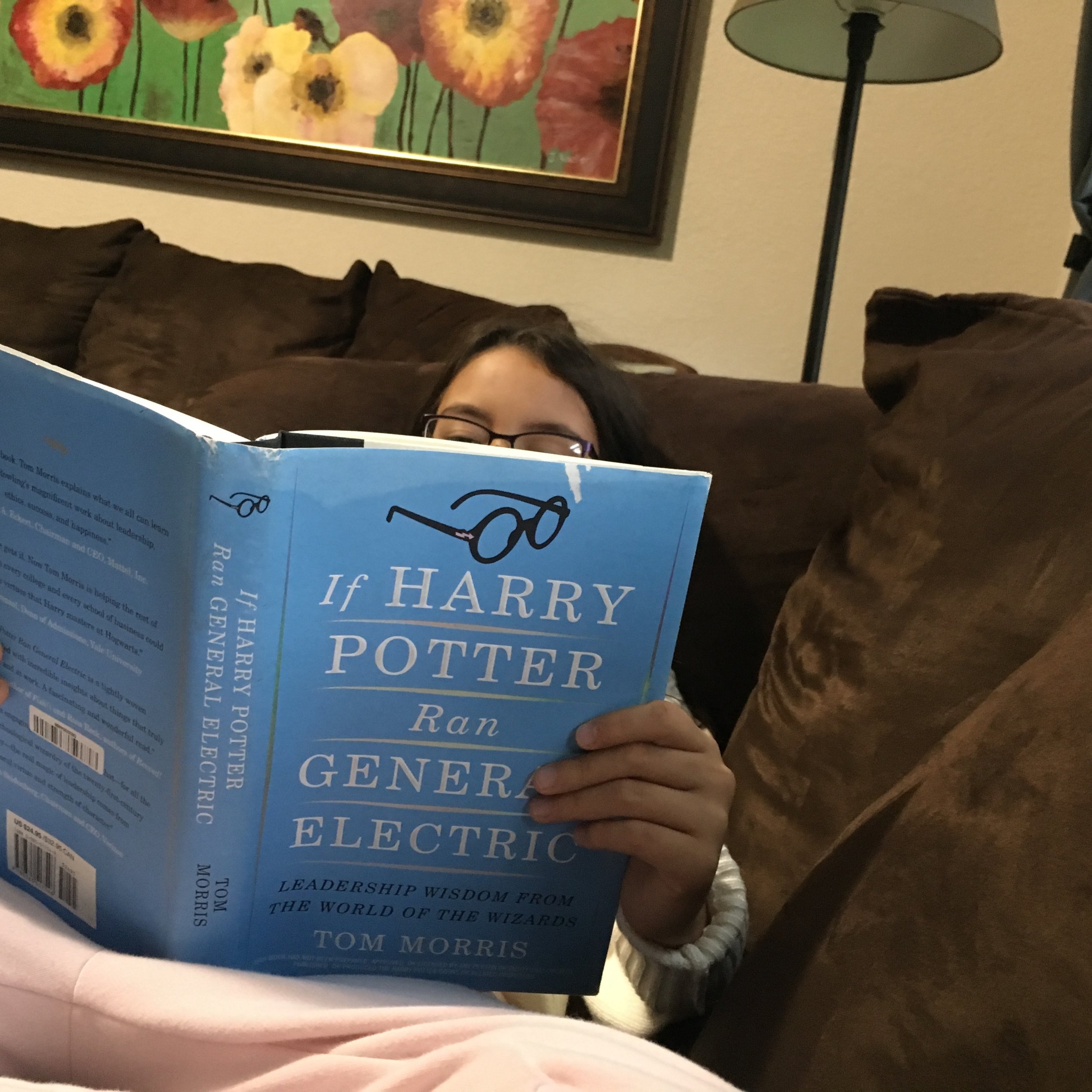
My Favorite Recent Photo: A young lady named Jubilee gets off to a head start in life by diving into some philosophy!

My Favorite Recent Photo: A young lady named Jubilee gets off to a head start in life by diving into some philosophy!

Great new Elizabeth Gilbert book on creative living and the creative experience.

Great new Elizabeth Gilbert book on creative living and the creative experience.

Two minutes on a perspective that can change a business or a life.

So many people have asked to see one of my old Winnie the Pooh TV commercials and I just found one! Here it is:

Long ago and far away, on a Hollywood sound stage, I appeared in two network ads for the wise Pooh, to promote his adventures on Disney Home Videos. For two years, I was The National Spokesman for that most philosophical bear. This is one of the ads. I had a bad case of the flu but I hope you can't tell. A-Choo!

One of my newest talk topics is "Plato's Lemonade Stand: Stirring Change into Something Great." Based on the old adage, "When life hands you lemons, make lemonade," this talk is about how to do exactly that. Inquire for my availability through the c…

One of my newest talk topics is "Plato's Lemonade Stand: Stirring Change into Something Great." Based on the old adage, "When life hands you lemons, make lemonade," this talk is about how to do exactly that. Inquire for my availability through the contact page above! Let's stir something up!

Above is a short video on finding fulfillment in anything you do, that was taped a few years ago. I hope you enjoy it!