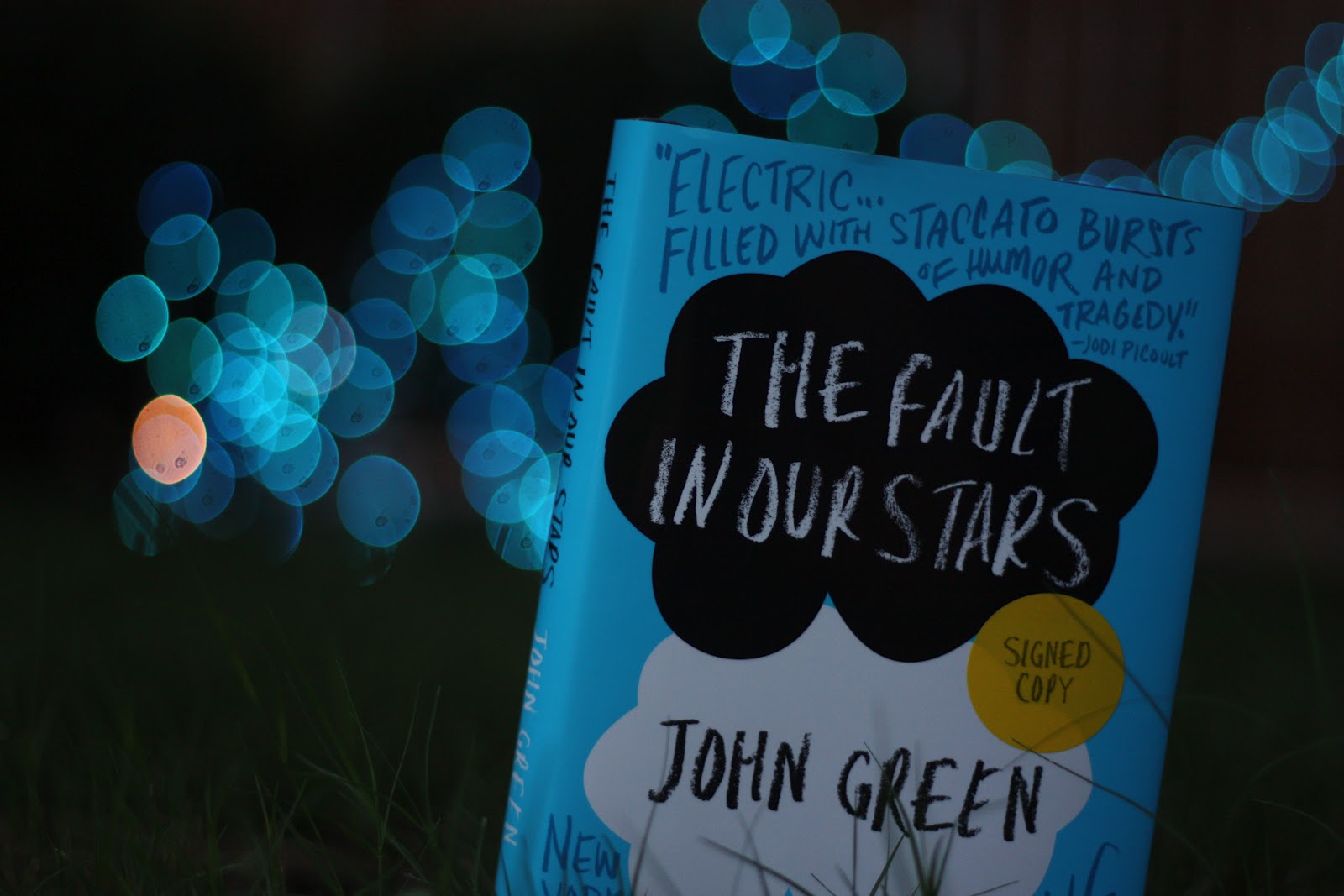
I wrote a couple of days ago about discovering the Young Adult mega hit novel, The Fault in Our Stars. I had heard about the author and his legendary editor, and just wanted to see what the two of them had come up with that was such a blockbuster. I first noticed the exceedingly advanced vocabulary of the main characters, the 16 year old Hazel and her 17 year old boyfriend, Augustus. Today, I want to look briefly at their thoughts about life and the world.
In a cancer support group for young people, before Hazel and Augustus had actually met, the leader asked the group what they most feared. Augustus, the new "hot boy" in the room who had already caught Hazel's eye, answered, "Oblivion." Hazel could not contain herself and lectured him, as she recounts:
“There will come a time, when all of us are dead. All of us. There will come a time when there are no human beings remaining to remember that anyone ever existed or that our species ever did anything. There will be no one left to remember Aristotle or Cleopatra, let along you. Everything that we did and built and wrote and thought and discovered will be forgotten and all of this” - I gestured encompassingly - “will have been for naught. Maybe the time is coming soon and maybe it is millions of years away, but even if we survive the collapse of our sun, we will not survive forever. There was a time before organisms experienced consciousness, and there will be a time after. And if the inevitability of human oblivion worries you, I encourage you to ignore it. God knows that’s what everyone else does.” (13)
Augustus introduces himself, and they fall in love. Who could resist a girl with such an attractive worldview? I'm kidding. Hazel's words reflect a very famous and bleak passage in philosopher Bertrand Russell's old essay, A Free Man's Worship. Augustus later says to her:
"I’m in love with you, and I know that love is just a shout into the void, and that oblivion is inevitable, and that we’re all doomed and that there will come a day when all our labor has been returned to dust, and I know the sun will swallow the only earth we’ll ever have, and I am in love with you.” (153)
He even later reports a middle school science teacher's worldview with these words:
“You still secretly believe that there is an element of magic to this world? It’s all just soulless molecules bouncing off each other randomly.” 220
Hazel, toward the end of the book, writes:
“We live in a universe devoted to the creation, and eradication, of awareness.” 266
Here's the problem. We know consciousness and conscious awareness first hand. We have ample experience of it. We have absolutely no experience of the eradication of awareness. By definition, we can't. And we have no compelling evidence or proof of any sort that any instance of human consciousness, or animal awareness, for that matter, is doomed to extinction. But the fashionable nihilism of this captivating book relentlessly assumes the most reductionistic implications of modern science, with hardly a speck of acknowledgement that a hopeless, grim worldview is, as philosophers say, "severely underdetermined" by the facts we do have.
Biological life in this world surely ends. And all the bodies with brains, and the means of expressing the awareness that has been mediated through those brains, eventually cease to function. But we actually have no idea what happens to the consciousness that has occurred in connection with the functioning of those brains, from these facts alone. Reductionism holds that there is no existence of consciousness apart from the functioning of complex brains. But that is just as much an article of faith as anything can be.
At one point, the slightly older Augustus actually reveals that he suspects there is Something, or Somewhere for us after death. Hazel is quite surprised to hear this coming from such an otherwise obviously smart guy. She says:
“I’d always associated belief in heaven with, frankly, a kind of intellectual disengagement.” (168)
And yet, her father later says this to her, after admitting he doesn't quite know what to believe about such ultimate issues as afterlife:
“I believe the universe wants to be noticed. I think the universe is improbably biased toward consciousness, that it rewards intelligence in part because the universe enjoys its elegance being observed. And who am I, living in the middle of history, to tell the universe that it - or my observation of it - is temporary?” (223)
And that's about as positive a view as is ever expressed in the book. Augustus, though, seems to have glimpses of something big, and important, and heroic about our life under the admittedly challenging conditions that surround us. At one point, he says:
“Everyone wants to lead an extraordinary life.” (169)
And he seems to suspect, deep down, that, maybe, any heroism or extraordinariness that we do attain in this world connects up to something bigger, something he can't quite define or describe. And I suspect that he's right.
In my view, the contemporary fault in our thoughts is to merely assume any such suspicions are no more than wishful thinking, and that nothing more is possible, beyond the physical matter and energy that we can discover through our physical tools of observation. The flaw in our thoughts is to embrace such a bleak and reductionistic worldview as unavoidable, when the real mysteries of consciousness themselves may be small apertures into far greater mysteries that can invite us to rethink our lives more deeply. Anything that prevents our trying is a deep fault, and flaw, indeed.