Follow @TomVMorris
Retreats
Keynote Talks and Advising
About Tom
Popular Talk Topics
Client Testimonials
Books
Novels
Blog
Contact
ScrapBook
Short Videos
The 7 Cs of Success
The Four Foundations
Plato's Lemonade Stand
The Gift of Uncertainty
The Power of Partnership

Tom Morris

Great Ideas. With Power. And Fun.
Retreats
Keynote Talks and Advising
About Tom
Popular Talk Topics
Client Testimonials
Books
Novels
Blog
Contact
ScrapBook
Short Videos
The 7 Cs of Success
The Four Foundations
Plato's Lemonade Stand
The Gift of Uncertainty
The Power of Partnership
FeedingCow.jpg

Where's Your Cow or Goat?

I believe we all have a spiritual need to feel useful, to take action to make a difference in the world, on however big or small a scale. And I also think that this provides us with an important hint as to how we should approach each day.

In a recent New York Times article, Nicholas Kristof reported on some new studies on whether philanthropic giving really makes a difference, long term, for people living in poverty. It turns out that the most effective giving involves a cow, or a goat, or chickens. Seeds also help. What doesn't help much, it seems, is money. It's all about a certain way of giving hope, through an opportunity for action.

When impoverished people are given a useful animal, one that can provide milk or eggs, as well as a form of companionship, and almost a sort of partnership, they become more active generally in their lives. They work more, they take more odd jobs, they have a new form of hope. They've been given the possibility of an activity, a usefulness in their own lives, that can make a difference for how they and their families live. And this is a form of giving that works. You know the old adage about giving a man a fish, or teaching him how to fish. Research now bears this out in more ways that we might have imagined.

And this provides a hint for all of us. How much time do you spend wishing things were better, or simply regretting the way things are? Most of us perceive a gap between where we are and where we'd like to be. And it bothers us. We worry about it. Or we even resent it. Sometimes, we feel hopeless to change it. Imagining how things could be better can almost take the wind out of our sails, if we stay passive in those imaginings.

But here's the insight: We all need a cow or a goat or some chickens. We need seeds. But then we need to plant the seeds. It's not merely having a cow, but taking action and milking it. It's not just the companionship of chickens, the camaraderie of the coop, but gathering the eggs that makes a big difference for impoverished people.

And here's something universal. We all need to feel a sense of control over our destinies. Desperately poor people given a cow develop that sense and experience hope. They're given a path, something they can do to feel some measure of control over their destinies. We all need that.

It seems to me that we all have a spiritual need for a sense of usefulness, and control, and action. We need to feel that we can begin to close the gap between what is and what could be. For me, the cow, or goat, might be my personal library, or my computer, or my website. I can read and discover. I can write. For you, it might be the same thing. Or something about your job could be it. Or a friend may provide you, through your relationship with him or her, that metaphorical goat, or those chickens you need. But remember that you need to take action.

When we see opportunity, we feel a glimmer of hope, and that combined with real actions, however small, can create a path forward.

What's your cow? What's your goat? Where are your chickens? When we clearly identify our opportunities and act on them daily, we begin to close the gap and move into our proper future with the feeling of hope that will help to get us there.

PostedMay 23, 2015
AuthorTom Morris
CategoriesAdvice, Life, Business, Performance, Wisdom
TagsOpportunity, Hope, Action, Spirituality, Spiritual Needs, Poverty, Giving, Nicholas Kristof, New York Times, Tom Morris, TomVMorris, Philosophy, Insight, Wisdom, Life
Post a comment
DisneyLand.jpg

The Magic You Can Do

More than sixty years ago, Walt Disney looked at an ordinary orange grove and saw DisneyLand. Later, he gazed on some remote swamp in Florida and caught a glimpse of DisneyWorld. What are you looking at right now and not seeing?

Aristotle believed that the great oak naturally lives in the small acorn. It takes vision to see it. But that's not all. The alchemy of human creativity can go far beyond what's natural, and expected. The world is a warehouse of raw materials for our creative magic. It's not always easy to recognize the materials that are right for you and then to collect them together. But the right vision can help you to see how.

The great creators, like all artists, learn how to look, and how to see. Shake up your ordinary ways of viewing your surroundings. Try on a different perspective. Engage in "What if" musings. Stretch the borders of the expected. You may see things you've been missing - whether among the orange trees or in the swamp.

It could be that your very own DisneyWorld awaits, right now, lying magically within some setting that you've been seeing as just water, grass, mosquitoes, and gators that just is what it is, and that you can't do anything about. The people like Walt Disney, and Steve Jobs, help us to understand that the ordinary is all around us, just waiting to be transformed. The extraordinary can be yours.

PostedMay 22, 2015
AuthorTom Morris
CategoriesAdvice, Attitude, Business, Life
TagsCreativity, vision, ordinariness, the extraordinary, Walt Disney, Disneyland, Disneyworld, Tom Morris, TomVMorris, Philosophy, Wisdom, Insight
Post a comment
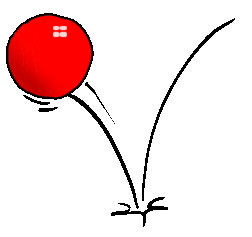
RedBall.gif

Bouncing Back

A few years ago, I wrote a book called The Stoic Art of Living, which had the subtitle "Inner Resilience and Outer Results." The more I had read the ancient Roman stoic philosophers on the ups and downs of life, they more I had come to appreciate the quality of resilience as crucial to success in an uncertain world.

In a book called, Resilience: Why Things Bounce Back, author Andrew Zolli defines this quality as “the ability of people, communities, and systems to maintain their core purpose and integrity among unforeseen shocks and surprises.” I see it as a psychological tendency to bounce back from challenges, difficulties, and obstacles. The resilient person absorbs "the slings and arrows of outrageous fortune," as Hamlet put it, and bounces back with a positive attitude and renewed action toward his or her goals. 

We can cultivate resilience in our lives in many ways. The stoics had mental techniques a couple of thousand years ago that work today as well as they did then. One friend says that when big trees of misfortune fall across his path and block the way forward, he says to himself, "It's time to get out the chainsaw!" A Roman would have thought of his ax. A simple go-to image can make a difference, and turn around your emotions.

One particular ancient image can be helpful here. The debris of difficulty will at times fall like mounds of trash into almost any life. Many will feel smothered and give up. But if your spirit burns brightly enough with the fire of enthusiastic commitment, that debris is just more fuel for the fire. The amount of garbage that could smother a small flame will be consumed by a great one, which will then grow bigger. Difficulty can actually feed your determination. It's most often up to you.

The inertia of resistance typically pushes back against great new things, and creative people. A resilient individual lets this become a badge of honor, and uses it to fuel even greater efforts. So burn brightly, and enjoy the benefits of resilience that can result!

There's hardly anything in this world as satisfying as bouncing back from difficulty, challenge, and adversity, and attaining a level and form of success that can surprise and delight you.

PostedMay 21, 2015
AuthorTom Morris
CategoriesAdvice, Attitude, Life, Business
TagsDifficulty, Challenge, Obstacles, Hardship, Resistence, Resilience, Tenacity, Commitment, Stoic Philosophy, The Stoic Art of Living, Tom Morris, TomVMorris, Andrew Zolli, Philosophy, Wisdom, Life
Post a comment
CuriosityLight.jpg

Curiosity Has a Magic

Curiosity has a magic that's equal parts attention and desire.

It means you care, and makes you observe. Your mind is alive. Your perceptions are heightened. You now have a quest, however big or small.

Curiosity shines a light into the darkness. It chases away shadows and illumines what's hidden. It reaches out and feels its way forward. It's a collector of endless gifts.

It's a birthright. It's the push that makes the unknown to be known. Uncertainty piques it. Certainty ends it. Its job is to move on, farther down the road of possibility of what can be done and discovered.

Both delight and danger begin with curiosity.

Curiosity is the engine of innovation, the cradle of creativity, the air that genius breathes. It's fragile in some, and robust in others. Can it be cultivated? Can it be enhanced?

I'm curious.

I am.

PostedMay 19, 2015
AuthorTom Morris
CategoriesAttitude, Business, Life, Wisdom
TagsCuriosity, Uncertainty, Unknown, Certainty, Light, Discovery, Life, Knowledge, Wisdom, Tom Morris, TomVMorris, Philosophy
Post a comment
Oracle.jpg

Lessons From The America's Cup

The other night, I had a chat at the Eagle Point Golf Club with Russell Coutts, the man who has won more America's Cup Yacht Race victories than any other captain in the long history of the sport. I had first met him several years ago, and heard him speak about the challenge of bringing together great team members from various parts of the world and then winning against the top competition from around the globe. On that occasion, I first showed him my little laminated wallet card on The 7 Cs of Success, and he read through the conditions carefully, and then looked up at me and said, "This is what my guys do to come together and win."

As a reference, here they are. For true success in any difficult challenge, we need:

C1: A clear CONCEPTION of what we want, a vivid vision, a goal clearly imagined.

C2: A strong CONFIDENCE that we can attain the goal.

C3: A focused CONCENTRATION on what it will take to reach the goal.

C4: A stubborn CONSISTENCY in pursuing our vision, a determined persistence.

C5: An emotional COMMITMENT to the importance of what we're doing.

C6: A good CHARACTER to guide us and keep us on a proper course.

C7: A CAPACITY TO ENJOY THE PROCESS along the way.

It's amazing that philosophers thousands of years ago could grasp what it takes to win an America's Cup, or a National Championship, or a World Series, or an Olympic Gold Medal. I've had top athletes across sports tell me how surprised they are to see in The 7 Cs formula the ideas they've followed intuitively in order to attain the success they've had.

In speaking with Russell Coutts the other night, two related things came up. First: Our implementation of The 7 Cs has to be relentless in the face of difficulty and failure. In the latest America's Cup, the Nespresso team was ahead of Team Oracle USA by a whopping 7-1 score, with only one more point needed to beat Russell's guys. But his boss, Oracle founder Larry Ellison, had summed up what he had learned in the tech business by telling Russell, "NEVER GIVE UP." 

Russell said that when they were down 7-1, his guys never lost their confidence, but that the captain of the adversary boat, the Nespresso team, started worrying that something would happen. Then, it did. It's like the famous tightrope walker, Karl Wallenda, whose wife reported that earlier on the day he fell and died, she heard him say, for the first time ever, "I hope I don't fall today." And, he did. Confidence can be that important. And so can what we focus on.

Russell also talked about nerves before a race. The best people get nervous energy from the fact that they care, that they're committed. Confidence doesn't require a blindness to the challenges you'll face. In fact, to the contrary, a realistic estimation of the difficulty in any given task allows for powerful confidence, and a focused concentration on what it will take to overcome and prevail. Oracle USA did overcome and prevail, in what The Wall Street Journal called possibly the greatest comeback in the history of sports.

Like Russell's teams, I like to sail The 7 Cs. I hope you do, too.


PostedMay 18, 2015
AuthorTom Morris
CategoriesAdvice, Business, Life, Wisdom, Philosophy
TagsSuccess, Achievement, Accomplishment, Winning, Adversity, Obstacles, Overcoming difficulty, Wisdom, Insight, The 7 Cs of Success, Tom Morris, TomVMorris, Russell Couts
Post a comment
TomBrokaw.jpg

Tom Brokaw on Luck

Parade Magazine recently ran a nice little article on the role luck has played in the life of newsman Tom Brokaw. He says some things of which we all need to be reminded.

I've long said that a rational person can be an optimist by being an activist. Unlike with slot machines or roulette wheels, the odds in life are something we can often change by taking action. Brokaw says this:

I believe you make your own luck. My motto is ‘It’s always a mistake not to go.’ So I jump on the airplane, try new things—sometimes I get in way over my head, but then I think, I'll work my way out of this somehow. A big part of making your own luck is just charging out of the gate every morning. The thing I love about living in New York is that I never fail to get up in the morning and think, Something adventurous is going to happen today. The energy is operating at full throttle all the time. And if you want to be lucky you’ve got to go out and take advantage of it.

This is what I call the activist approach to life and luck. The more I do, the luckier I get. There's a new adventure awaiting. But it won't wait forever. So go for it.

Brokaw has a new book out on all this. It's called A Lucky Life Interrupted: A Memoir of Hope. Check it out. It may spark something adventurous.

PostedMay 16, 2015
AuthorTom Morris
CategoriesAdvice, Business, Life
TagsLuck, Action, adventure, activism, optimism, Tom Brokaw, A Lucky Life Interrupted, Tom Morris, TomVMorris, Philosophy, Wisdom, Life lessons
Post a comment
JoyofGiving.jpg

Go-Givers Beat Go-Getters

Marc Lore, an entrepreneur and co-founder, Chief Executive Officer, and chairman of Jet.com, an e-commerce startup meant to challenge Amazon, recently wrote this:

At 22, I evaluated my first job based on what I could get out of it. But I have since learned that you can achieve much greater success if you focus on what you can give. Ultimately, I have realized that success is not a measure of your salary, title, or degree, but the impact you have on others and the collective happiness of the people you touch.

I've been lucky to have that attitude throughout my whole career. When I went to graduate school in religious studies and philosophy, it never even occurred to me to ask anyone how much careers in those fields paid. And it's a good thing I didn't! When I hit the job market with a double PhD from Yale in 1980, starting salaries for professors were ridiculously small. My children wore hand-me-down clothes from other professors' kids, who had done the same thing. We were in it to give, not to get. I wanted to tackle the big questions, and come up with new insights I could benefit from myself, and then give to other people. I learned in those years the power of giving.

Now, we're all learning it, through new research, as well as in our broader cultural experiences. In the book Give and Take, Wharton professor Adam Grant does a great job of showing how givers can prosper exceptionally well in the long run and actually become the most satisfied receivers of all.

In everything we approach, we should ask what we can give, first and foremost. Then, we may be amazed at what we can get, as a result. It's not the motivation, but the wonderful side effect, that those who give most prosper most deeply.

PostedMay 15, 2015
AuthorTom Morris
CategoriesAdvice, Business, Attitude, Life, Wisdom
TagsGiving, Getting, Happiness, Success, Adam Grant, Give and Take, Attitude, Focus, Business, Achievement, Fulfillment, Tom Morris, TomVMorris, Philosophy, Wisdom, Insight
Post a comment
IfAri.jpg

The Four Foundations of Greatness

Years ago, I did a book called If Aristotle Ran General Motors: The New Soul of Business. It could have been called "Happiness, Fulfillment, and Greatness." It's all about the most deeply human factor in our work and lives - what brings people together, makes for superior teams, real loyalty, and great results? My claim in the book is that from the moment we wake up in the morning, to the instant we fall asleep at night, we experience the world along four dimensions and need four things to satisfy us:

1. The Intellectual Dimension, that aims at Truth

2. The Aesthetic Dimension, that aims at Beauty

3. The Moral Dimension, that aims at Goodness

4. The Spiritual Dimension, that aims at Unity.

For great relationships, great teams, unshakable associate loyalty and real customer love, we need to live and work in accordance with these four things - Truth, Beauty, Goodness, and Unity. We need to respect everyone's need for these things, and nurture them as much as we can. Whenever we depart from one of these things, these great ideals that the Greeks knew as transcendentals (transcending and applying to everything in life), we suffer diminishment. When we cultivate them, we can experience extraordinary levels of success.

And each of them needs to be respected and lived in connection with the other three. That's where the real power is to be found.

I got to speak on this topic in Orlando this week, and it was so much fun! For more details on the ideas, go check out the book!

PostedMay 14, 2015
AuthorTom Morris
CategoriesBusiness, Leadership, Advice
TagsTeams, Unity, Loyalty, Customer Love, Satisfaction, Beauty, Truth, Fulfillment, Goodness, Excellence, Tom Morris, Greatness, TomVMorris, If Aristotle Ran General Motors
Post a comment
BellJar.jpg

The Bell Jar Danger

 A friend recommended that I read Sylvia Plath's 1963 novel, The Bell Jar, as an example of an early and quintessential piece of Young Adult Literature. Plath was a gifted poet at a young age, but had struggled with getting her work published. One magazine rejected her 45 times before it accepted one of her poems. She then wrote this novel under the sponsorship of The Eugene Saxon Fellowship affiliated with Harper and Row. But when she submitted the final manuscript, the publisher rejected it, calling it "disappointing, juvenile and overwrought." It went on to publication initially in England, and it subsequently become a rare modern classic, read throughout the world. Plath even posthumously received a Pulitzer Prize for her collected poems.

The protagonist of The Bell Jar is a college-age woman named Esther Greenwood. We get to know her first while she's on a fellowship in New York City, working during the summer for a famous women's magazine, and being treated to gala openings, parties, and celebrity events. The "girls" she works with are portrayed with that distinctive and witty chatter often seen in movies made during roughly the same period, in the 1950s and early 60s. You can clearly hear the rapid fire delivery of clever dialogue exchanged between the young ladies visiting the magazine. In the course of the story, Esther descends from Bright Young Thing With a Promising Future to psychological madness and a serious attempt at suicide. After a period of confinement in an asylum and a series of electro-shock treatments, she eventually seems to be returning to some semblance of her old self, however fitfully and slowly. But the story ends right before she's set to be released from the institution and launched back into normal life. The author herself famously committed suicide about a month after the book's first publication in the United Kingdom, and it was quickly seen as autobiographical.

I'm writing about it today because of its main image - the bell jar, a common piece of laboratory equipment at a certain stage of modern science that was shaped like a dome or a bell, and most often made of clear glass. It could be used to create a special atmosphere for plants, or a weak vacuum when most of the oxygen was removed from it. As she returns to clarity, Esther sees herself in her madness as living in a bell jar, with little atmosphere, where it's hard to breathe. But then she insightfully extends the metaphor to the college girl she knew in her dorm, gossiping, playing cards, and living an endless round of parties and boys that's cut off from the real world outside the artificial atmosphere of the campus.

What struck me most about the book is the bell jar image and its wide applicability. It's very easy for any of us to get stuck in our own bell jar, with an artificial atmosphere that we take to be real, but that actually cuts us off from the broader world around us. The bell jar can be many things - madness, or superficiality, obsession, or desire, or something professional and work related that gets out of control. Years ago, the executives at Enron and several other high profile companies were living and working in their own bell jar. So were many mortgage officials and traders, just a few years back, and they were as a result the people whose work plunged us all into a deep and long recession.  

A bell jar is created around us when we allow something to cut us off from the real sources of meaning and insight that are to be found more broadly and more deeply in life. There is a spiritual sickness and even a kind of death that can result. A life can spiral out of control. A business can crumble. Self destruction can ensue. We all know of leaders who've created around them an echo chamber, cutting themselves off from any fresh breeze of truth. They're in a bell jar of their own making. 

Any person, or group of people, can be endangered by a bell jar that results from their attitudes and actions. Are you in one? Is your company or community?

The bell jar is a serious danger that we're all well-advised to avoid. Don't let anything become your bell jar, and cut you off from the fresh air of life and wisdom and love and meaning that you could and should be breathing. Keep on your guard. It's hard to see at first when one descends around you. Its transparency, or invisibility, is especially insidious. And that's why it's such a common trap. When you allow yourself to escape the confines of any such bell jar that threatens to constrain you, you benefit from a rush of fresh air, and get enough of an independent perspective to recognize the jar for what it is, and stay out of it, as a result.

PostedMay 13, 2015
AuthorTom Morris
CategoriesBusiness, Attitude, Life, Philosophy, Wisdom, Performance
TagsSylvia Plath, The Bell Jar, Madness, Despair, Danger, Isolation, Separation, Business, Enron, Trading, Tom Morris, TomVMorris, Philosophy, Wisdom, Meaning, Insight
Post a comment
DVF.jpg

Diane von Furstenberg on Clarity

For 25 years, I've spoken on what the great philosophers realized about attaining success in anything we do. Long ago, I isolated seven universal conditions for success. The first two are:

1. A clear CONCEPTION of what we want, a vivid vision, a goal clearly imagined,

2. A strong CONFIDENCE that we can attain the goal.

In this week's Sunday Business Section of the New York Times, Adam Bryant did his great "Corner Office" interview with fashion legend Diane von Furstenberg. I've referred to it earlier this week. Let me share one more question and answer here:

Q: How do you get the best work out of creative teams on your staff?

A: I think the most important thing is to believe in what you do. And identifying a goal, to have clarity, is very important. You cannot fake clarity. When you don’t have clarity, you don’t. And then all of a sudden, the fog lifts and you’re clear. It’s very important to constantly try to look for clarity, like pruning a tree or cleaning the plumbing.

DVF starts with condition #2 and quickly backs it up with condition #1.

I've found that a lot of CEOs take for granted that everyone around them is clear on their corporate goals, while fog is actually enveloping everyone on the ground. We can't just assume that our own clarity has been communicated well. And sometimes, we find that we ourselves aren't as clear as we need to be. We allow general vague slogans with feel good language to substitute for rigorous clear thought. And that's always a problem. We need to heed the fashion mogul's words. In any pursuit, Confidence and Clarity are needed. And they'll never go out of fashion.

For a video related to the interview with DVF, click here.

PostedMay 8, 2015
AuthorTom Morris
CategoriesAdvice, Business, Leadership
TagsConfidence, Clarity, Goal Setting, Creative Teams, Success, Diane von Furstenberg, Tom Morris, TomVMorris, Philosophy, Wisdom
Post a comment
OwlFlySnow.jpg

The Night I Flew the Plane

Have I ever told you about the time that, as the sole passenger on a fairly large twin engine corporate airplane flying through a blizzard at night somewhere over the midwest, I was called up into the cockpit by the pilot, and asked to fly the plane? 

Yeah. In case I’ve never mentioned it before, I’m not making this up. I was staring out my window from my plush leather seat on the right side of the plane, looking at the torrent of huge snowflakes swirling all around us in the darkness, when the co-pilot suddenly came back to my seat and told me the captain wanted me up front.

What? Was it a logic emergency? Or an unexpected metaphysical conundrum? In the circumstances, I was hoping he didn't want to chat quickly about arguments in favor of life after death.

When I got over my surprise and made it into the cockpit, the somewhat elderly looking captain said, “So, I’ve been told you’re a little worried about flying.” I was, at that time in my life many years ago, actually worried more about crashing, but I agreed to his milder characterization, not even wanting, in the situation, to bring up that other topic, or even the word.

“Have a seat,” he said. “I want you to fly the plane for a while.”

“Wait. What?”

“I’m going to show you how to fly the plane.”

"Right now? In all this snow?”

“Yep.”

“Are you sure?”

He said, “I don’t think you’ll ever be worried any more.”

Or anything else any more, I thought. “You’re really absolutely sure?”

“Yes, indeed. Take the open seat here.”

So, to make a long story short, but not as short as it could have been, with the plane under my command, I learned how to fly that night.

And I learned how far we are, in normal circumstances, from really paying attention to what we’re doing. There are times, like, for example, in flying a plane for the first time in your life, and at night, in a blizzard, where your senses are instantly so enhanced you almost feel like you have perceptual superpowers. Your mind is so clear that you can’t believe such a degree of clarity is possible. Your focused concentration is so complete - well, you get the idea. If we could tap into that in more normal situations, just imagine.

It helps the story for me to tell you that the airplane was a vintage Grumman Mallard, a sea plane that had been shot down and dredged up after the second world war from the bottom of Tokyo Bay and then completely rebuilt. And, no, I’m not making this up, either. That’s what they told me when I had said how remarkable it was. It was such a beautiful plane, full of gorgeous woods and supple leather, and all in a style not seen since 1945. When I first got on board, I felt like Humphrey Bogart. That was before I started feeling like Amelia Earhart.

That night I learned a lot about how airplanes fly, and how the controls work - enough to have great admiration for the people whose job is to get us in this mode to where we’re going. And for some reason, that surreal experience did give me more assurance about flying. I mean, if I can do it, even for just a few minutes, I guess I can trust the licensed professionals, two of whom are busily getting me somewhere as I type these words. I just hope they don’t need me up there again. It’s a 757, a little big for my current and rusty skills.

And, Oh, this blog post should probably have a philosophical point, or moral - so here goes: Philosophers are capable of more than mere flights of fancy.

Just kidding. If a philosopher can fly a plane at night in a blizzard, then I guess almost anyone can do almost anything - at least, with a trained professional hovering close by.

And if you ever see me walking down the street wearing surgical scrubs, or SWAT gear, don’t look so surprised. My toga might be at the cleaners.


PostedMay 7, 2015
AuthorTom Morris
CategoriesAdvice, Life, Business
TagsPossibility, Focus, The Mind, Success, Philosophy, Tom Morris, TomVMorris
Post a comment
Lemonade.jpg

Life's Lemons

Ten years ago, I realized I knew a lot of people who had trouble dealing with change in their lives. I would get asked over and over, "What do you do when bad things happen, or disappointing things, unexpected and difficult things?" People wanted strategies for handling challenges in their lives.

I had grown up hearing the old adage, "When life hands you lemons, make lemonade," which pretty much sums up the attitude of the ancient stoic philosophers toward the problem, but in my childhood no one who repeated these words also explained how to do it. How do you turn lemons into lemonade? So I got to work, reading all the great thinkers on the topic, and writing my own book of advice. It was called "Lemonade!" Then I changed the name to "Lemons to Lemonade" and after 24 total re-writes, it became "Plato's Lemonade Stand: Stirring Change into Something Great." Previous versions have been turned down by publishers 45 times, because they're not convinced that a practical book about the personal alchemy needed to turn something sour into something sweet will sell. I'm convinced they're wrong. And whenever I've done the ideas on retreats, people have insisted on having the book available. No one has seen the newest version yet. And I really, really like it. But I'm prepared for more lemonade making before someone in the world of publishing says, "Wait. People need this."

In the Sunday Business Section of the New York Times, Adam Bryant had a very interesting interview with the fashion designer and design mogul Diane von Furstenberg. Let me give you one Q&A:

Q. You’ve said many times that your mother was your biggest influence. What are the most important lessons you learned from her?

A. My mother was a Holocaust survivor and, having survived 13 months in the concentration camps, she taught me that fear is not an option. And no matter what happens, never be a victim. Life is a journey, and when you face obstacles the only thing you can do is accept them and embrace the reality. Very often, with things that are bad or not what you wanted, it’s your job to turn them into something positive.

I love the sentiment about accepting obstacles. Maybe the things that block your path can be taken up and assembled into just the bridge you need. That last sentence of the answer says it all:

Very often, with things that are bad or not what you wanted, it’s your job to turn them into something positive.

That's one of the enduring themes of the practical philosophers. And it's become something I believe deeply. So, when you face your next challenge, difficulty, or disappointment, get out a paring knife, some sugar, ample ice, and whatever additional spices you think you'll like, and make from the lemons that confront you some world class lemonade. Plato would have wanted it.


PostedMay 5, 2015
AuthorTom Morris
CategoriesAdvice, Life, Business
TagsChallenge, Life's Lemons, Difficulties, Disappointment, Change, Pain, Lemonade, Stoic philosophy, Tom Morris, TomVMorris, Diane von Furstenberg, New York Times, Adam Grant
Post a comment
Money.jpg

Your Money Or Your Life

Decades ago, the famous television comedian Jack Benny did a routine that played off his reputation as being a cheapskate. In the sketch, a robber came up to him with a gun and demanded "Your money or your life!" Benny just stood there, silent, staring into space. The robber said something like "Come one! What'll it be?" And Benny replied with frustration, "I'm thinking. I'm thinking."

Let me ask you a question. Why do you do what you do? Is your goal in life to make as much money as possible? Maybe that's not a realistic aim in your current job. But is it a dream? Many people tell me that they indeed fantasize about "The Number" - the amount of money they'd have to make and save in order to just stop working and enjoy themselves lavishly for the rest of their lives. The fantasy is one of immense wealth and all its trappings. So they start a company, or play the lottery, whichever path their circumstances seem to allow. Some people work almost all the time, in pursuit of that number. They'll do whatever it takes. They'll pay any price.

But do a thought experiment with me. Suppose you came across a wise person with the ability to see the future. Imagine that she's always right. She has an unblemished track record. She could see what is to be, and also what would be if you were to keep on your current path. Imagine then that you shared with her a dream of riches and she said to you, "You can be wealthy beyond imagining, if you choose, but you will be miserably unhappy if you take that path." Let's say you asked for clarification. She replies, "Chase money, and you'll be wretched. Pursue a greater purpose and you'll find happiness."

How would you react? Would you doubt her words? Or would you heed them? 

Many people replicate the Jack Benny skit in their lives. The guy with the gun is just pointing out the choice they face. Will they give up their entire lives just to get as much money as possible? Or will they give up some money for the sake of a life?

I attended a meeting the other day where my friend Matt Ham spoke to a real estate company on the topic of his new book, Redefine Rich. His presentation was about how to define riches in a way that will be deeply satisfying, and and that will lead you to pursue all the right things, so that the treasure you attain will be something that no one can take away. There is no amount of money that's forbidden to a wise person, as Thales in the ancient world demonstrated. But there are ways of living that are. When we understand that, we truly prosper. 

PostedMay 4, 2015
AuthorTom Morris
CategoriesAdvice, Life, Business, Wisdom
TagsMoney, Meaning, Purpose, Life, Riches, Redefine Rich, Matt Ham, Tom Morris, TomVMorris, The Number
Post a comment
GreatBooks.jpg

Should You Study Philosophy?

A couple of weeks ago, the New York Times columnist Nicholas Kristol wrote an essay in praise of the humanities, entitled "Starving for Wisdom." In it, he argued vigorously in favor of college students taking serious courses in philosophy, literature, history, and the other humanities and arts. In prose reminiscent of C. P. Snow's famous book, The Two Cultures, he showed ways in which we need both the sciences and humanities in our educations.

The comments the piece generated were telling. Angry fathers wrote that a humanities degree wouldn't get their kids a good job. Barely literate rejoinders suggested that such frivolity is a luxury for the elite who come from vast wealth, and can't be indulged in by students who have had to borrow the money for an education.

I found myself worried about both the negative comments and many of the positive ones, endorsing a study of the humanities. Whether college coursework in the humanities is worthwhile or not ultimately turns on a principle you learn while studying the humanities - a view from ancient Greece and Rome that the value of most things in this world depends on how they function in our lives. Will a college course in philosophy elevate a student and bring practical wisdom, or will it deprive him of a vocational boost that he could have gotten from one more course in business, or engineering? It all depends on the way in which the course was taught and the way in which the subject was studied. Both the professor and the student have the chance to ruin their time together by their choices along the way. But if each is performing masterfully well in his or her own respective capacities, magic can happen.

It may surprise you to learn that, as a philosopher, I don't go around recommending that people take philosophy courses or read philosophy books - except for mine, I should quickly add. The wrong courses and books can be an absurdly monumental waste of time. But the right courses and books can be life changing. It took me years to learn how to tell the difference.

There is a game that academics learn to play, and play well. Professors in the humanities are typically smart enough to discern what will get them promoted and tenured, and even intellectually esteemed by those who work in their field. That doesn't necessarily translate into writing or teaching on issues of general life significance and value. But those who focus on the right issues and take penetratingly wise approaches to those issues can confer on their students advantages in work and life that are impossible to replicate in any other way.

Great philosophy confers great advantages. And the same is true of work in any of the humanities, which is not just an area of study for college, but for life.

That's why I often recommend to people what great books they may want to read. Books can be great for different reasons, and not all of those reasons relate directly to a life well lived or work extraordinarily done. The right books, though, can make all the difference for cultivating personal wisdom and guiding professional success. When you do it right, there is no study worth more than work in the humanities.

PostedMay 3, 2015
AuthorTom Morris
CategoriesAdvice, Life, Business, Wisdom
TagsHumanities, Philosophy, General Studies, College, Science, Tom Morris, TomVMorris, Great Books
Post a comment
BoxerDown2.jpg

True Grit

Looking back over my life so far, I've noticed an interesting quality, which is, actually, a firm tendency.

Knock me down, and I'll get back up. Knock me out and I'll wake back up. I stay in the game, regardless. I have what seems to be an innate drive never to give up, even on goals that look impossible and things that seem hopeless. Maybe I'm just trying to live up to my middle name. Victor.

My first book was turned down 36 times. At rejection number 20, I guess some people would give up. I couldn't. I've had another book "passed over" by editors 45 times. Ditto. That's part of the reason I've had over twenty books published. If I have something to say, I'm going to say it.

When I was a professor at Notre Dame, I would often suggest something very new to the administration. As a result, I typically heard the words, "Well, there's a problem with that." I would always respond, "That's fine, I'm a problem solver. What can we do about it?"

There are many psychologists now deeming this to be the most important quality for success. They call it grit. I'm glad I have it it. And maybe it's no surprise. Nearly every morning of my southern childhood, I grew up eating grits. And at least one remains. And it's a big one. Grit. Determination. Persistence. Heart. Consistency through trouble, disappointment, and "No."

Is it a form of optimism? Often, yes it is. But really, it can even be independent of any confidence that I will in the end prevail in a certain project or aim. I'm going to keep going whether I win or not. Shut down the arena, turn out the lights, and I'll probably still be at it. Stubbornness may indeed be a close cousin to this drive.

When you're passionate about what you're doing, when you're a true believer in the task, then giving up seems dishonorable, disloyal, and maybe, at times, a disgrace. We may not be in this world always to succeed, but it seems to me that we're here to persist. That doesn't mean that you can't change tactics, adjust a goal as you learn, and perhaps go at the whole thing in a new way. It just means you never fold accept defeat. Any failure along the way is a step, an opportunity to learn, a moment to rest on the canvas before your next charge.

If the game is not worth the effort, then you're in the wrong game.

When I was in high school, I had long-distance friends in Chicago who liked to make fun of my North Carolina accent, but not nearly as much as they enjoyed mocking me for my love of grits. One of the greatest days of my life was when I was able to present them with a large container of  standard Quaker Grits, turn over the cylindrical box, and show them on the back the words 'Made in Chicago.'

Where is real grit made? In your heart. In your soul. And if you don't feel you have it, you can cultivate it. You can create it. You just have to find a way to be passionate about what you're doing, to care with all your heart. Commencement speakers are criticized this days for advising graduates to "Do what you love," as if that's a luxury available only to the very few. But anyone can be advised to "Love what you do." Because there's always a way. By nature, we are all discoverers of meaning. But most of all, we're makers of meaning. When what you're doing, or seeking, or chasing is meaningful to you, there's an extra resilience in your soul, a flexibility and strength that we all need for tough jobs, and worthwhile achievements. And that's true grit.

PostedMay 2, 2015
AuthorTom Morris
CategoriesAdvice, Business, Life, Wisdom
TagsGrit, persistence, determination, fight, defeat, victory, Tom Morris, TomVMorris
Post a comment
GlassHalfFull.jpg

Half Glass Living

One night at dinnertime, years ago, when my son Matt was at the ripe old age of thirteen, he walked into the kitchen, put a plate on the table, and said, out of the blue, “Dad, I've figured out that glass question.” I drew a total blank.

“What glass question, Matt?” I asked as I quickly searched my memory for anything we might have been talking about in the preceding hours.

He said, “You know, the one about the glass being half empty or half full.” Oh, that glass question. You know the famous scenario: A water glass contains liquid up to its midpoint. The question is then asked whether the glass is half empty or half full. Everyone then tells us that a pessimist will say it’s half empty, while an optimist will say it’s half full. The situation is supposed to be a test for inner attitude. It’s assumed that there's no objectively better answer. Either can be right, and yet neither is objectively preferable. What you say will be determined by what you are as an observer, not just by what the glass is as an item apart from you in the world.   

Well, my son wasn’t about to buy that. He had heard the question somewhere, and apparently it had been bothering him. He now had his own take on it. “So, what's the answer?” I asked with real curiosity, wondering how someone his age would approach this old classic. And, in reply, he said something that proved to me again the simple truth that you can be a philosopher at almost any age.  

He thought for a second and said, “It all depends.” Well, of course, when I heard these opening words, I thought that we’d be quickly going straight into the familiar and well trod territory of attitude relativism. But his next words surprised me and took us into a totally different direction. He said, “If you were filling the glass up just before you got to that point, it’s half full. If you were drinking from it or pouring it out just before that, then it’s half empty.”    

Aha! “It all depends,” people have always said, but they’ve thought the answer depends on the attitude of the person looking at the glass. Matt couldn’t accept that as the final word. It does all depend, he was saying, but it depends on what real process had been going on previously, in order to bring the glass to its present state. What something is sometimes depends on where it came from, on how it got to be as it is, and maybe even on where it’s in the process of going. That’s a pretty profound insight.  

There’s a lesson here for us all. How’s your glass these days? How’s your life? Is it pretty good, or pretty bad? If you’re like most people, you may think of yourself as somehow representative of roughly half-glass living. There are some good things in your life. And there’s a lack, or an empty space, as well. Well, then, if this is even remotely an accurate representation, the question arises: Is your life generally half full, or basically half empty? According to young Matt, it all depends. Have you been emptying it out, dissipating your energies, squandering your deepest self, alienating those who are closest to you, and as a result losing things of real value – or have you been filling up your life in the best possible way, adding elements of true value and deep worth to your daily experience? Have you been depleting or enriching yourself? What real process has been going on up until now, and is perhaps still presently occurring in your life, right now, or in your business? Where have you been, in this regard, and where are you now going?


PostedApril 27, 2015
AuthorTom Morris
CategoriesAdvice, Life, Business, Wisdom
TagsLife, Fulfillment, Happiness, Psychology, Philosophy, Half Full Glass, Half Empty Glass, Tom Morris, TomVMorris, Creativity
Post a comment
Error.jpg

Mistakes

We all make mistakes. Even with the most information we can gather, the greatest care in planning, and the best of intentions, we make mistakes. That's simply a part of what it is to be human.

But this is just as important. The world can forgive most mistakes. Most reasonable mistakes aren't completely self destructive. They're part of the process. And the world is typically even more than forgiving. It actually often rewards our mistakes in an interesting way. I talked with a man the other day who admitted making a great many mistakes in his career, and his account of them was both very funny and telling. What didn't work, or even went terribly wrong, often set him up for what did work, and worked magnificently.

We're here to try things. As Emerson said, "Life is an experiment." Make as many good experiments as you can. Sure, many will be mistakes. But from them we can learn. And they can often have oddly good consequences we never could have anticipated.

This adventure we're on can never be completely planned. It just has to be lived.

PostedApril 23, 2015
AuthorTom Morris
CategoriesAdvice, Life, Business
TagsPlans, Efforts, Mistakes, Experiments, Emerson, Tom Morris, TomVMorris
Post a comment
People.jpg

Relationships Rule The World

There are two fundamentally different approaches to work and life - a transaction mentality, and a relationship focus. I've written about this before, but a review might be helpful. 

The transaction approach to work and life concentrates just on the sale, the deal, the event, the accomplishment. A relationship orientation focuses on people and getting to know them, helping them, and encouraging them. The great philosopher Martin Buber spoke of the "I-Thou" relationship, and the "I-It" alternative. What do we primarily relate to, people or things? Do we treat people like the amazing and valuable souls they are, or as if they were mere things to be move and manipulated?

The irony is that with a relationship mentality, you end up with far more satisfying transactions than you get with a transaction approach to life. The transaction guy loses relationships, and many valuable transactions, as a sad consequence of his focus. Transactions are immensely important. That just show how valuable the vastly more important relationships in the world are.

Be a relationship person. Then, enjoy the great transactions that result. Priorities matter. So does focus.

PostedApril 22, 2015
AuthorTom Morris
CategoriesAdvice, Business, Life, Wisdom
TagsRelationships, Transactions, People, Things, Our Orientation, Work, Life, Philosophy, Tom Morris, TomVMorris, Martin Buber
Post a comment
Hope.jpg

Hope

Years ago, someone said to me, "People love your talks so much because you don't just give them philosophical insights and practical ideas, you give them hope." That's stayed with me ever since. I hope it's true.

We all need hope. And yet, we often find ourselves without it, in some context. Things go badly. A difficult situation arises. And we feel helpless to do anything about it. When we feel helpless, we soon begin to feel hopeless, as well. And there's a reason for this.

In a psychological experiment which makes me glad I'm not a psychologist, a thermostat, or climate control mechanism, was installed in a factory. People for the first time could walk over and set the device, raising or lowering it. Finally, they felt a sense of control over their environment for the first time. Morale went up. And if I'm remembering this well, so did their work performance. People felt better about their jobs. And yet what they didn't know is that the control wasn't connected to anything but the wall. Yeah. A philosopher wouldn't do that. But here was the conclusion: Even a false belief that we have a measure of control improved our emotions and performance. When we don't feel any sense of control, or even influence over a challenging situation, we lose a measure of hope.

I prefer to give people hope through truth, not illusion. But what exactly am I giving, and how can I be in a position to do this at all?

Hope is not the same thing as belief. When we hope for a better future, we're not necessarily believing that the future will be better, only that it can be. But the state of hope goes beyond that. The possibility conviction is joined to an attitude of positive expectation, again, different from actual belief, but closely aligned to it. Like belief, hope can be rational or irrational. And like belief, its status as such is connected with matters of evidence. But hope looks beyond actual belief, and beyond the existing evidence, to wait expectantly for a better future.

The New Testament speaks of Faith, Hope, and Love. Faith is about trust. Love is about commitment. Hope is about patient expectation and positive values. We're told that love is the greatest of these things, because with the right commitments, faith and hope can flourish. And when you think about it deeply enough, you quickly realize that we can't do great and creative work without faith, hope, and love.

How then do I give hope to people? By bringing them the wisdom of the ages for how they can improve their lives and business endeavors. I give people tools - old tools, and great ones that have proved their worth over centuries of use. And I show people how to use them. Then, they expect more strongly than ever the better future that can be theirs, in personal or professional things.

And their response - and for some of you readers, I know I can say "your response" - loops back to undergird my own hope for the future that we all need. Thanks, as always, for reading. And thanks for any comments.

PostedApril 21, 2015
AuthorTom Morris
CategoriesBusiness, Life, Wisdom
TagsHope, Faith, Love, Commitment, Expectation, Work, Excellence, Philosophy, Wisdom, Tom Morris, TomVMorris
Post a comment
Rut.jpg

The Rut

You're in a rut. I almost know you are. At least a little. Because most of us are like that. You have lots of habits, ways you do things, and things you do, daily, or weekly. Most of our habits benefit us in some way or we wouldn't have them. But they can also tie us up and hold us down. And so I have some advice.

Get out of your rut. For just a little bit, in a small way, stick your head above the habits that define your normal stuff and catch a glimpse of what's out there. I often do this by reading a different kind of book, something I wouldn't ordinarily try. In the past week, I've read one by a famous movie producer, The Curious Mind, and a fascinating young adult novel that was surprisingly full of philosophy, The Fault Is In Our Stars. They get me out of my rut and spark all sorts of new ideas. 

A few days ago I helped instal a fence. Now that's way outside my rut. And I really enjoyed it. I haven't otherwise done any fencing since 1982, which is a long time ago. I got outside my rut, and I had a new experience that was deeply satisfying.

Watch a TV show you wouldn't normally view, or go see a film that's outside your normal parameters of moviegoing. It's still good to avoid junk. But try something new. Talk to someone you've never talked to, or about something different. I meet people on airplanes all the time, and have conversations that I sometimes remember years later. It's all about the little act of stretching beyond what you normally do. You never know how a little rut-desertion, if even just for a few minutes, might spice up your day, and give you just that nudge of energy or creativity you need.

PostedApril 16, 2015
AuthorTom Morris
CategoriesAdvice, Life, Business
TagsHabit, Novelty, New, Experience, Creativity, Tom Morris, TomVMorris
Post a comment
Newer / Older

Some things that may be of interest. Click the images below for more!

First up: Tom’s new Silver Anniversary Edition of his hugely popular book on The 7 Cs of Success!

The New Breakthrough Guide to Stoicism for our time.

Tom's new book, out now!
Finally! Volume 7 of the new series of philosophical fiction!

Finally! Volume 7 of the new series of philosophical fiction!

Plato comes alive in a new way!

Plato comes alive in a new way!

On stage in front of a room full of leaders and high achievers from across the globe.

On stage in front of a room full of leaders and high achievers from across the globe.

Maybe, my favorite book of all time. Published in 1905, it's a charming and compelling tale about the power of the imagination and simple kindness in dealing with great difficulties. You'll love it. Click the cover to find it on Amazon!

Maybe, my favorite book of all time. Published in 1905, it's a charming and compelling tale about the power of the imagination and simple kindness in dealing with great difficulties. You'll love it. Click the cover to find it on Amazon!

My favorite photo and quote from the first week of my new blog:

I'll Rise Up and Fly.

My Favorite Recent Photo: A young lady named Jubilee gets off to a head start in life by diving into some philosophy!

My Favorite Recent Photo: A young lady named Jubilee gets off to a head start in life by diving into some philosophy!

Great new Elizabeth Gilbert book on creative living and the creative experience.

Great new Elizabeth Gilbert book on creative living and the creative experience.

The back flap author photo on the new book The Oasis Within.

The back flap author photo on the new book The Oasis Within.

Something different. Paola Requena. Classical guitar. Sonata Heróica.

Two minutes on a perspective that can change a business or a life.

On the beach where we do retreats, February 16, 2018, 77 degrees. Philosophy in shorts and a T shirt done right.

On the beach where we do retreats, February 16, 2018, 77 degrees. Philosophy in shorts and a T shirt done right.

So many people have asked to see one of my old Winnie the Pooh TV commercials and I just found one! Here it is:

Long ago and far away, on a Hollywood sound stage, I appeared in two network ads for the wise Pooh, to promote his adventures on Disney Home Videos. For two years, I was The National Spokesman for that most philosophical bear. This is one of the ads. I had a bad case of the flu but I hope you can't tell. A-Choo!

Now, for something truly unexpected:

Five Years ago, a friend surprised me by creating an online shop of stuff based on my Twitter Feed. I had forgotten all about it, but stumbled across it today. I should get this shirt for when I'm an old man, and have my home address printed on the …

Five Years ago, a friend surprised me by creating an online shop of stuff based on my Twitter Feed. I had forgotten all about it, but stumbled across it today. I should get this shirt for when I'm an old man, and have my home address printed on the back, along with, "Return if Found." Click to see the other stuff! I do love the dog sweaters.

Cat videos go philosophical. The now famous Henri Le Chat Noir, existential hero. Click image for the first video I saw and loved.

Cat videos go philosophical. The now famous Henri Le Chat Noir, existential hero. Click image for the first video I saw and loved.

Another Musical Interlude. Two guys with guitars, one an unusual classical seven string, one a bass, but playing chords.

I memorized the "To be or not to be" soliloquy from Hamlet months ago, and recite it nearly daily. It's longer than you think, and is a powerful meditation on life and motivation, fear, and the unknown. To find some good 3 minute videos of actors pe…

I memorized the "To be or not to be" soliloquy from Hamlet months ago, and recite it nearly daily. It's longer than you think, and is a powerful meditation on life and motivation, fear, and the unknown. To find some good 3 minute videos of actors performing these lines, click here. Watch Branaugh and Gibson for very different takes.

This is a book I read recently, and it's one of the best I've read in years on happiness and success. Shawn helped teach the famous Harvard course on happiness, and brings the best of that research and more into this great book. Click on it. I think…

This is a book I read recently, and it's one of the best I've read in years on happiness and success. Shawn helped teach the famous Harvard course on happiness, and brings the best of that research and more into this great book. Click on it. I think you'll like it!

A favorite performance of the great Brazilian bossa nova song Wave, by Tom Jobim. Notice Marjorie Estiano's fun, the older guitarist's passion, the flutist's zen. Marjorie's little laugh at the end says it all. That should be how we all feel about our work. Gladness. Joy.

I happened across this great book on death and life after death. Because of some uncanny experiences surrounding the death of her father and sister, this journalist began to research issues involving death. Her conclusions are careful and well docum…

I happened across this great book on death and life after death. Because of some uncanny experiences surrounding the death of her father and sister, this journalist began to research issues involving death. Her conclusions are careful and well documented. If you're interested in this topic, you'll find this book clear, fascinating, and helpful. A Must Read! For my recent conversation with the author on HuffPo, click here.

Henri discovers the first book about his unique philosophical ponderings. Click image for the short video.

Henri discovers the first book about his unique philosophical ponderings. Click image for the short video.

My favorite website to visit nearly every day. Maria Popova may read more and write more than any other human being on earth, and her reports are always amazingly interesting. This is really brain candy, but with serious nutritional benefits as well…

My favorite website to visit nearly every day. Maria Popova may read more and write more than any other human being on earth, and her reports are always amazingly interesting. This is really brain candy, but with serious nutritional benefits as well. Visit her often!

One of my newest talk topics is "Plato's Lemonade Stand: Stirring Change into Something Great." Based on the old adage, "When life hands you lemons, make lemonade," this talk is about how to do exactly that. Inquire for my availability through the c…

One of my newest talk topics is "Plato's Lemonade Stand: Stirring Change into Something Great." Based on the old adage, "When life hands you lemons, make lemonade," this talk is about how to do exactly that. Inquire for my availability through the contact page above! Let's stir something up!

A frequent inspiration. Monday, 30, April 2012. Sarah Brightman and Andrea Bocelli perform "Time to Say Goodbye." Notice how they indwell the lyrics, and still manage to relate to each other so demonstratively.

My friend Bill Powers writes on how to handle the technology in your life and stay sane. A beautiful meditation on how we've always struggled with the new new thing, and sometimes win. Recommended!

My friend Bill Powers writes on how to handle the technology in your life and stay sane. A beautiful meditation on how we've always struggled with the new new thing, and sometimes win. Recommended!

Above is a short video on finding fulfillment in anything you do, that was taped a few years ago. I hope you enjoy it!

This is a beautiful and difficult book on the odd relationship between repeated failure and eventual success. It's full of great stories and moments of meditation. You will find yourself teasing out the insights, but they're powerful and worth the w…

This is a beautiful and difficult book on the odd relationship between repeated failure and eventual success. It's full of great stories and moments of meditation. You will find yourself teasing out the insights, but they're powerful and worth the work.

One of the best books in the past year or more, G&T is a wonderful look at how givers can rise high. Grant is the youngest tenured professor at Wharton and its most popular teacher. Here, he shows why! A really good book.

One of the best books in the past year or more, G&T is a wonderful look at how givers can rise high. Grant is the youngest tenured professor at Wharton and its most popular teacher. Here, he shows why! A really good book.