Follow @TomVMorris
Retreats
Keynote Talks and Advising
About Tom
Popular Talk Topics
Client Testimonials
Books
Novels
Blog
Contact
ScrapBook
Short Videos
The 7 Cs of Success
The Four Foundations
Plato's Lemonade Stand
The Gift of Uncertainty
The Power of Partnership

Tom Morris

Great Ideas. With Power. And Fun.
Retreats
Keynote Talks and Advising
About Tom
Popular Talk Topics
Client Testimonials
Books
Novels
Blog
Contact
ScrapBook
Short Videos
The 7 Cs of Success
The Four Foundations
Plato's Lemonade Stand
The Gift of Uncertainty
The Power of Partnership
Focus.jpg

Focus and Flow

One of the most endangered skills in our time, and one of the most important, is the art of focus. The New York Times just ran an op ed about the importance of great lecture classes in our schools, and especially college, where students learn to listen and focus on complex ideas and sequences of ideas.

Call to mind a totally unfocused photograph, blurry and indistinct. Now contrast that with a picture that's crisp, clear and well focused. Our minds can range through a similar spectrum. Successful people in every domain of human activity tend to be those who can attain and keep a clear focus on what they want and what it takes to get there. 

At its peak, focus becomes flow, a transcendent mindset of absolute absorbedness in an activity or enterprise. And flow seems to be the key to both creativity and masterful levels of excellence.

The world around us conspires to distract us from ever experiencing focus or flow. But the only way we can contribute our best to the world is to resist its siren songs enough that we master focus and grow more adept at flow.

With focus and flow - Oh, the places you can go!

PostedOctober 22, 2015
AuthorTom Morris
CategoriesAdvice, Life, Business, Wisdom, Performance
TagsFocus, Concentration, The Mind, Clarity, Flow, Tom Morris, TomVMorris
Post a comment
DogChasingTail.jpg

Dogs Chasing Their Tails

The biggest danger in a capitalist economy is that we all become dogs chasing our tails. In the weight room the other day, a number of us began to discuss the benefits and perils of modern capitalism as we lifted. The conversation was spurred by one of our number commenting on how outrageous online news story titles have become. People will say anything to get you to click on their story, whether the title and lead-in have anything to do with the content of the piece or not. It's All Hyperbole All The Time. When Aliens do land on the White House Lawn, we won't believe it for a second - even if Donald Trump is swearing it took place and that it was the MOST INCREDIBLE THING THAT EVER HAPPENED and that, no, it wasn't how he came to be among us in the first place.

Here's the problem. Any country that gets the blessing of free market capitalism sees a decrease in poverty and an increase in living standards for lots of people. And for a while, things look very promising. And then, before you know what's happened, you get billionaire oligarchs, people moving money around for no reason other than profit, lots of people chasing oversize profits, and everyone else struggling. You also get an economy in which we all become dogs chasing our tails.

What's corrupted journalism? It's become a big business, chasing clicks and eyeballs. Why? Because it's really chasing advertising dollars. In medicine, doctors are trying to see more patients for more profits. Drug companies are trying to charge more for life-saving drugs. Lawyers are desperate for more billable hours. And here's what eventually happens. Years ago, backstage before a talk, I met the CEO of a very large drug store chain. I said, "How's business?" He said, "It's been a terrible flu season." I said, "I don't know anyone with the flu." He said, "Exactly."

It took me a second to realize what he was saying. And how he was thinking.

Our weight room talk became a discussion of the professions. Traditionally, something was a profession when the pursuit of it had to do mostly with internal motivators - doing an excellent job, serving people well, providing a useful and satisfying product or service. Medicine, law, journalism, and education were all professions. But mom and pop grocery stores and local clothing shops and corner bookstores had a lot in common with them, as well. Work was about making a positive difference for your neighbors and fellow human beings. Do that well, and you'd make a good living. But then the professions became businesses, focused on the bottom line and profits. And that unintentionally created distractions, distortions, corruptions, and ultimately the sort of mindsets represented by the drug store CEO.

Fifty years ago, doctors had to make a living. So did people in all the professions. But they weren't chasing profits first and foremost. Even businesses outside the professions could view profits as wonderful side effects of pursuing other valuable things well, and not as the focal point of everything.

When dogs are healthy and normal, and do things right, their tails follow along right behind them, as a matter of course. They go places, do things, and have a great time. They don't have to worry about the tail not accompanying them. It keeps up. But when their focus changes and they start chasing their own tails, well, they go around and around in circles and never get anywhere.

We can't let our economy and society become nothing but dogs chasing their own tails. We need to go out in pursuit of things that matter and take a healthier view that the profits we need will accompany good work, following us where we usefully go with the right things in view.

Otherwise, as another modern image has it, the view never changes.

PostedOctober 20, 2015
AuthorTom Morris
CategoriesAdvice, Business, Life, Wisdom
TagsBusiness, Profit, Capitalism, Professions, Tom Morris, TomVMorris, Philosophy, Wisdom
Post a comment
Glory.jpg

Glory

The word 'glory' is interesting. It's old-fashioned. But it's important. Maybe it's even a key to our deepest fulfillment. And it's a word that's rarely used in our time.

I knew a man twenty-five years ago who brought it to work every day. He was a janitor, a custodian in a building of a hundred PhDs. He vacuumed up, emptied trash cans, and washed windows. But really, he was a custodian of souls. And when any of those PhDs was having a bad day, they went looking for him, for just a chat. To maybe feel, for a moment, something that could turn around their heart, and their day. It was something that shone through that man. And everyone felt it.

Glory. To me, it connotes a dazzling fullness of greatness and love. With that in mind, here's a thought. Maybe our highest calling is to bring glory into whatever we do. But we can't accomplish that when the smallness of a swollen ego gets in the way. Again, humility and nobility work together. Then you get, sometimes, glory. And everyone is lifted up. Amen?

PostedSeptember 25, 2015
AuthorTom Morris
CategoriesAdvice, Attitude, Life, Business, Wisdom
TagsGlory, Humility, Nobility, Ego, work, inspiration, character
Post a comment
PopeFrancis.jpg

Humility, Nobility, and Leadership

There was a great article in the New York Times the other day, with an eye-catching title:

“A Humble Pope, Challenging The World.”

The Times ran this teaser and explanatory line under the title:

“Francis, the first Latin American pope, has drawn from his life in Argentina to try to create a humbler papacy, albeit one with lofty ambition.”

It’s not often that we see humility and lofty ambition mentioned together. And that’s too bad, because they’re perfect partners. In fact, lofty ambition is closely connected with a fundamental quality that is, together with humility, crucial for great leadership. The best explanation I know of has come from the mouth of a character in my new book, The Oasis Within. He’s seventy years old. His name is Ali. And he’s just said something about humility and nobility to his thirteen-year-old nephew Walid, as they sit and talk under the stars in the vast desert of western Egypt. The year is 1934. The boy wants to understand what nobility and humility really are. Ali explains it all better than I can, so let me quote this short passage. Ali speaks.

“Nobility is a sense of your own greatness, and the true greatness of what you rightly value, along with the importance of what you’re doing in this world. Nobility comes from inside you. It arises in your soul. It’s an attitude and a sensibility that you bring to everything you do, every action, by caring about little things, knowing they’re actually big, and attempting big things, knowing that they’re never bigger than your calling, your quest, and the adventure for which you’re here.”

“That’s a good answer.”

“Thank you.”

“So: What about humility?” The boy was entranced by these ideas and suddenly found himself wanting to understand more.

“Humility is a sense of our smallness in the vast sweep of things, and a recognition of the greatness in other people, along with a realization that we need each other in order to accomplish our best dreams. Absolutely anyone and anything can teach us, as I’m teaching you on this marvelous night.”

“I see. This makes sense to me. But it’s also strange. I’m big and I’m small.”

“Yes. And so are we all. Each of us is of inestimable importance. None of us owns all the wisdom and virtue of the world. You need others. And they need you. Humility recognizes our wonderful limits. Nobility embraces what is also ours and is limitless.” This was a lot for Walid to take in all at once. But he could feel that these words resonated with truth.

The old man continued. “Humility means being open to learn from everyone and everything that crosses our path. The camel can teach us. The storm can teach us. The viper can teach us. Our mistakes can teach us. The stars can, too. If you’re humbly open to learning and growing, then you can become everything you’re meant to be, in the fullness of your inner nobility. In addition, a proper humility allows you to serve others eagerly and well, and there is nothing nobler than that.”

“So, nobility and humility go together.”

“They’re meant to walk arm-in-arm. But, unfortunately, each of these qualities often wanders along without its intended mate. When they work together, there’s magic, and there’s tremendous power for good. Combined, they lead to extraordinary things.”

This was important for the boy to grasp well. The old man thought for a moment, and then continued. “The greatest kings and leaders on earth are both noble and humble. One who is noble and not humble is presumptuous and arrogant. One who is humble and not noble is hesitant and lost, and never in possession of his full power. To be the great regent you’re here to become, you must embrace both these qualities, my friend. Nobility and humility together form the path of true greatness.”

This is important for us all to remember as a new presidential political season gets underway. It’s not just the Pope who benefits from blending these two great qualities. Any leader should embody them, and keep them in proper balance.

There's a lot more on this topic and related issues in the new book. If you have a chance to read it soon, I hope that it speaks to you, and that you will enjoy it deeply. Please let me know what you think. It always helps me as a philosopher to hear the perspectives of other thoughtful people.

For more, go to www.TheOasisWithin.com.


PostedSeptember 22, 2015
AuthorTom Morris
CategoriesAdvice, Business, Leadership, Life, Wisdom
TagsNobility, Humility, Pope Francis, The Oasis Within, Tom Morris, TomVMorris, Leadership
Post a comment
ManinDiner.jpg

The Man With the Thousand Dollar Bill

I have a good story and an ethical conundrum for you today.

My father built some of the early radio stations throughout the southeast US in the late forties and early fifties of the last century. He wasn't ever the money guy, just the expert hired help who knew how to set up a radio station, find the right person to put in the electronics, get a guy to build the tower, and then call on all the local businesses to sell ad time on the new station before it went on air.

In the course of working in small towns in North and South Carolina, Georgia, and Florida, he met some real characters along the way. One guy he told me about when I was growing up was a man who always dressed very nicely and carried in his wallet only one thing: a one thousand dollar bill. He took my dad out to eat several times in small restaurants and diners and it was only on the second or third occasion that he told my father his special trick.

He never had to pay for a meal. Ever. He had done this for at least a year. He'd go into a local joint, looking like a million dollars in his sharp suit, order a meal, and at the end, when the check came, he'd get out his wallet and open it up, and then exclaim: "Well, my goodness. Would you look at that? All I have is a thousand dollar bill? Can you change it?"

The waitress would be shocked. She'd ogle the bill, and exclaim, "Goodness Gracious!" or some such Southernism, and call the cook, or owner over to see. They'd then continue to exclaim.

The man would be so apologetic. "I usually try to carry something smaller than this! I'm so sorry!" The locals would be simply stunned.

"Is that real?"

"Yes, ma'am, as real as it gets!"

"I've never in my life seen such a thing!" Everyone would examine this rare specimen of US currency. It would be like seeing the Hope Diamond in person. And then whoever was in charge would inevitably say, "Well, it's just a treat and quite an honor to see a greenback like that. I bet you only come across those in New York City or Hollywood!"

"And hardly ever there!" our character would knowingly remark.

"Well, look. Dinner's on the house! We just appreciate you coming in today. I wish my wife was here to see this. It's my treat."

"You don't have to do that."

"Heck. I can't change that anyway. And I'm just pleased to have a fellow like you come into the joint and grab a bite. It's been a great pleasure to meet you and talk to you. Let it be on the house."

"Well, if you insist. That's quite gracious of you. And, next time, I'll try to have a more ordinary collection of bills in my wallet." They'd then shake hands, all around. And the character would leave, with one of the restaurant's mints in his mouth, or a toothpick in his teeth.

Now, the question: Was this guy's action ethical? Was he ethical? Or was what he was doing wrong? Please explain your answer.

I'll have the graded copies back to you next week. Class dismissed.

PostedSeptember 15, 2015
AuthorTom Morris
CategoriesBusiness, Life, Philosophy, Wisdom
TagsEthics, Rules, Intent, Tom Morris
Post a comment
GreekWarriors.jpg

Amazon and The Warrior Virtues

Do you need a work environment that pushes you relentlessly to be tougher and better at what you do? Is it good to have harsh feedback and to be pressured during all your waking hours? Will that make you dig deep and excel? Is it legitimate to treat a business as involving something even remotely like Navy Seal Training?

There's been a lot written recently about the retail giant Amazon and its company culture. A New York Times article unleashed the firestorm of controversy when it portrayed Amazon as a modern Darwinian jungle where there is survival only of the toughest and most ruthless. Some former employees have subsequently written their own accounts of how difficult and demanding an environment it can be, while others have taken issue with the portrayal in the Times and agree with Jeff Bezos that the brutal description there is nothing like the real environment of the company. I don't want to wade into the controversy over this one organization or its values, but simply to comment on the main issue I see the controversy as raising.

Aristotle, along with the tradition following his lead, long ago identified a set of virtues, or strengths for human life - characteristics that empower us in any challenging situation - that we benefit from embodying as we live and work with other people. Those virtues include the following, with the now old fashioned labels, and my gloss on what they mean:

Courage - A commitment to do what's right, in the face of risk

Temperance - Moderation and proper self-restraint

Liberality - A freedom in giving to others what can help them

Magnificence - A capacity for acting on a big, or grand, scale

Pride - A true sense of honor and worthiness

Good Temper - An inner calm displayed outwardly

Friendliness - The demeanor of treating others sociably

Truthfulness - A strong disposition toward honesty

Wittiness - The ability to see and express humor appropriately

Justice - A basic commitment to treating others well.

It's quite a list. And it has some initially surprising components, considering that the virtues add up to what Aristotle saw as good character. In my books If Aristotle Ran General Motors, and If Harry Potter Ran General Electric, I suggest that these are universally great qualities to have, in business and in life.

But prior to Aristotle, the ancient Greeks, joining people from most other early cultures, had their focus on another set of virtues, or strengths, what we can insightfully call "The Warrior Virtues" - qualities that empower us in times of physical warfare. Here's a representative list, that starts with the same quality to be found at the top of Aristotle's list:

Courage

Physical Power: Force, Stamina, Endurance

Mental Acuity: Perceptiveness, Clarity

The Ability to Adapt and Create

A Disdain for Mediocrity

An Intolerance for Weakness

Craftiness

The Ability to Deceive Convincingly

Fierceness: An Intensity just short of Brutality

A Willingness to Kill

We might also call these The Homeric Virtues, as in the west, we first encounter them, typically, in Homer's ancient poetry. It's well known, and has often been noted, that American business leaders throughout most of modern corporate history have very often had athletic backgrounds or military experience. Given the widely recognized fact that most sport in some way re-enacts warfare, it's then safe to say that most business leaders have had experience with, and a tendency to embrace at least most of the Homeric Virtues, the warrior virtues. And some very tough corporate environments are a lot like the military in times of war. The demands are high, excuses are not allowed, and everyone is expected to be utterly dedicated to the mission. In some circumstances, companies have risen and succeeded by emphasizing at least most of the warrior virtues. And at least some people in those companies can appear to flourish as individuals in such an environment. But I think we have good reason to question or reject the application of at least a couple of those virtues outside contexts of real physical battle. I hope you instantly join me in that rejection. In fact, I've argued in several of my books that the subset of warrior virtues that do apply in business endeavors need to be guided and constrained by the more Aristotelian virtues, as well as by such transcendentals as Truth, Beauty, Goodness, and Unity - what I call The Four Foundations of Greatness.

The problem often seen in companies that exalt the warrior virtues in isolation from an Aristotelian framework and The Four Foundations is that the warrior mentality quickly and easily becomes a cloak for something very different than a quest for excellence. And, in fact, you begin to see what I like to call counterfeit warrior virtues:

Arrogance

Callousness

Vengefulness

Cruelty

Sadism

Rapacity

A Touch of Evil

And this is clearly not a recipe for a great company culture, to put it mildly. But this is exactly what you often get when people proudly focus on the warrior virtues as centrally ingredient in their enterprises. The warrior mindset outside any real battle field easily becomes a cloak for vices to pass as virtues, and the whole environment quickly turns poisonous.

When people say "Business is War" or even just that "Business is Sport," the danger is that they can easily break loose from the civic virtues of Aristotle, and stray into the realm of warfare virtues where counterfeits easily tempt people in any leadership or management position to create a thoroughly corrosive and corrupt enterprise that will eventually collapse of its own weight.

Again, I don't write this to point a finger at any particular company, but only to warn of something vitally dangerous that is often seen in corporate contexts where it can do only great harm. The war we do need to fight is to bring the Aristotelian virtues front and center, supported by The Four Foundations. Then greatness can be both attained, and sustained.

PostedSeptember 10, 2015
AuthorTom Morris
CategoriesLeadership, Business, Performance, Wisdom
TagsCulture, Corporate Culture, Virtue, Pressure, Stress, Amazon, New York Times, Tom Morris, TomVMorris, Aristotle, Homer
Post a comment
PicnicBeach.jpg

What We Celebrate on Labor Day

Each year, we set aside a day to celebrate an aspect of our lives whose importance is often underestimated, or even badly misunderstood. On Labor Day, we’re meant to commemorate work, as well as those of us who do it, and all who have done it long before us. What we’re being called upon to celebrate isn’t a necessary evil – an unfortunate and arduous requirement for simply gaining the resources it takes to live in an increasingly costly world. Work isn’t the sort of thing we can and perhaps should regret every other day of the year, but then get away from it to, paradoxically, raise a glass and praise it for just one twenty-four hour period, annually. We’re meant to be celebrating on this day a good thing, even a great thing, that’s worth celebrating on every day.

Aristotle taught us long ago that we are all essentially goal-oriented beings, and that this facet of our nature is deeply connected both with individual happiness, as well as with what we often think of as the living of a good life. We all need things to do, work to accomplish, and goals to achieve. Without some form of work, whether externally compensated or not, we just can’t flourish in the fullness of our nature.

At its best, work is even a spiritual activity. It’s an expression of our souls into the world around us, an endeavor that ideally allows us to improve some aspect of the world, however slightly, on each day that we labor. And, of course, in working to enrich the world, we deepen and enrich ourselves in a great variety of inner ways, regardless of outer consequences. Through our work, we can become wiser, more insightful, hardier, and more capable. We can enlarge our capacities, expand our relationships, and deepen our sense of ourselves.

The good work of any person benefits, however indirectly, every person by improving the stage on which we all act out our individual dramas. We’re, all of us, connected, even though that’s a truth whose reality is sometimes hard to detect. But it’s a truth that allows our work to have an impact far beyond what we might realize, on any given day. And that’s something to be celebrated, indeed.

Happy Labor Day!


PostedSeptember 7, 2015
AuthorTom Morris
CategoriesAdvice, Business, Life, Wisdom
TagsLabor Day, Aristotle, Tom Morris, TomVMorris, Philosophy
Post a comment
BoyMeditating.jpg

Becoming More Intuitive

In every field of endeavor, there are innovators who naturally seem to pioneer new ways of doing things. There are individuals who are known for their endless creativity. They are often also people who, over and over, seem to be in the right place at the right time to make the right connections to do great things. The rest of humanity struggles, but these golden individuals, as if touched by the divine, seem to flourish effortlessly.

There are two things to say about such people. One is that their trajectory of success isn't typically as smooth or as easy as it seems. Such people tend to work very hard. And they long have. Because of that, they've attained a level of mastery in their field that's unusual. And this allows their work to have exceptional results. Like the metaphorical swan, all still and serene above water, they can seem to be at ease, but their hard paddling below the surface is what gets them across the lake.

And yet, there is a second thing to say, even more important than this.

These people tend to be highly intuitive. They don't just depend on normal "rational" thinking. And they don't feel a pressure to do everything the way everyone else does it. They listen to their heart, or maybe it's something beyond their heart.

The ancient Greeks talked of a spirit or muse. The Romans spoke of a guiding genius, not in you, but outside you, that's available to help you. However we conceptualize it, there seems to be an avenue of knowing and doing that's in some sense spiritual in nature. Accessing it requires us to get beyond our normal thought world, to reduce our mental chatter and clear out the clutter that otherwise blocks us from something deeper, and open ourselves to this powerful guidance. Sometimes it happens in extreme circumstances, during times of great danger. A switch flips. A strong clarity arises. And we're transported to a new level of being, feeling, thinking, and doing. It more often happens when there is preternatural calm within, a quietness and emptiness that allows itself to be filled. A supreme focus can facilitate it. A  great relaxation of the body, or a repetitive engagement of it, as in walking, or jogging, can at times create just the right soil, fertile for new ideas to be noticed and planted and to grow.

In a small meeting room yesterday at the large pharmaceutical development company PPD, I talked about how I have discovered my own best intuitive work. I told my story of unexpectedly coming to write eight novels in a period of four years, after forty years of authoring nonfiction philosophy books.  In this unexpected adventure of becoming a novelist, I've learned how to relax my body in order to disengage the normal flow of my conscious mind. And this is when the magic can happen. I think we all have that ability. And we can use it in whatever we do. Why don't we do so more?

My new book, The Oasis Within, begins the epic story whose main characters have taught me almost all I know about becoming more intuitive. I hope you'll also have a chance to learn from them as I have, and that it will have as big and deep an impact for you as it has had for me.

PostedSeptember 4, 2015
AuthorTom Morris
CategoriesAdvice, Art, Life, Business, Wisdom
TagsThe Oasis Within, Tom Morris, TomVMorris, Intuition, Genius, spirit, Spirituality, muse, inspiration, creativity, innovation, PPD
Post a comment
PeopleAtWork.jpg

Corporate Values That Work

The New York Times has recently stirred the pot on issues of corporate culture and working conditions in America. Some philosophical issues are being talked about anew that I think are crucial for any business. 

In 1997, my book If Aristotle Ran General Motors: The New Soul of Business was published. It was all about what it takes to create a great company culture - whether it's a big company like GM or a small mom and pop business or anything in between. I came to realize that the principles and values that make for great workplaces apply just as well to any friendship or marriage. We're people wherever we are. And we have certain deep needs that will govern what we're able to accomplish in any situation. What then does it take for people to feel great together and do great things in their interactions, in their relationships? Aristotle and the other practical philosophers had some amazing insight for this.

When that book of mine was first out and I was flying coast-to-coast to be on radio and television shows promoting it, the one person interviewing me who had read it the most carefully and thoughtfully was Matt Lauer, on the NBC Today Show. We had nearly nine minutes of conversation about it on the show, which is forever in morning TV time. He told me that, in his opinion, the book captured everything he believed about ethics, and he even asked if it was Ok if he quoted from the book in some talks he was going to be giving about ethics in journalism. But he also challenged me that day by asking me whether American corporations were really ready to become great places to work, focusing attention on such things as Truth, Beauty, Goodness, and Unity - the intellectual, aesthetic, moral, and spiritual values that my book was built around. There was even a chapter on "Business and the Meaning of Life." Matt wondered whether any big company could really pay attention to such an issue. Is there time? Is it business-efficient to care about such things? Would a necessary concern on the bottom line allow it? 

My answer was simple: Yes. People can't do their best over the long run unless they feel their best about what they're doing. Aristotle understood the deep role that our unconscious quest for happiness, or wellbeing, plays in any of our lives. And he knew that this is the most deeply motivating factor for anything we do. When we aren't happy in our work, when it doesn't contribute to our sense of deep fulfillment in our lives, we can't attain and sustain the highest, most creative excellence. Ultimately, meaning and mastery go together.

In a big front page essay called "Rethinking Work" in the New York Times Sunday Review this week, psychologist Barry Schwartz argues that companies had better pay attention to such issues. And Schwartz has evidently touched a nerve, because 24 hours later, it's the most emailed article in this week's paper. I commend it to your attention. And if it resonates with you, take a look at If Aristotle Ran General Motors and tell me what you think. In light of the recent controversies surrounding Amazon and corporate culture in America these days, I think we need to return to some of these issues. I'll likely write more about them this week.

Meanwhile, may you experience Truth, Beauty, Goodness, and Unity in what you do and where you do it. Aristotle would want it that way.

PostedAugust 31, 2015
AuthorTom Morris
CategoriesAdvice, Business, Leadership, Wisdom
TagsWork, Corporate Culture, Business Ethics, Happiness, Amazon, Barry Schwartz, New York Times, Meaning, Work excellence, Fulfillment, People, Human Resources, Matt Lauer, Today Show, NBC, Tom Morris, TomVMorris
Post a comment
WindowWaiting.jpg

Patient Waiting

Patience means waiting. But waiting doesn't necessarily mean not doing. We all understand the former. And yet, few seem to grasp the latter.

There are times when we need to be still and at peace, take a break, and rest from our work, while simply allowing the world its turn to play a role in our endeavors. Every quest for achievement in the world is a partnership with powers that go beyond our own. And often it takes patience to allow our partner to do the work that we can't do alone. We have a phrase, "Watch and Wait." We've done all we can. We've tossed our little toy boat into the stream. Will it float? We await the results.

Waiting. It's something we might do in repose, on a beach, in a hammock, or utterly relaxed in a comfortable chair. We can wait on a yoga mat, or even while taking a nap.

But waiting does not have to be an utterly passive state. It's not the same thing as being inert, frozen, now helpless, and without options for action. "Waiting" is a verb. And it can connote all sorts of different actions. 

Waiting. It's a good time to pray, or play, or otherwise turn away from the focus of activity that has otherwise occupied us. A cook puts a pot on the stove. And then it's the pot's turn to boil. Sometimes, the cook can merely turn away to chat, or check email, or sit and sip coffee while gazing at the garden outside. Waiting can take many forms. And, of course, in some of those forms, the cook can stay quite busy in the kitchen.

Waiting often means preparing.

You've done all that you can do to get the project out there into the potential client's hands. Now, you wait. What does that require? Well, it can mean preparing for the positive go-ahead you hope to receive, and in this way playing a different role in the process, getting yourself ready for the success you want. There will be a next step. So, while you wait, you prepare for whatever is next. Waiting here takes the form of preparation. And at other times, it can mean just turning your attention elsewhere, while allowing the water to heat.

So, in the most general sense, there are two forms of waiting. One does involve resting. But the other involves a different form of doing. Either can help equip you for whatever is to come. But neither will serve you well if it's heavily spiced with hot anxiety. And that, for many people, is the problem. 

You're awaiting a decision. It could go either way. Uncertainty mixed with desire produces anxiety. Or you're awaiting a result that's not uncertain, but is not as yet in hand. Anticipation mixed with desire, or the very different aversion of fear, brings another form of anxiety. There are many ways in which waiting is fraught, tense, and hard. But, fortunately, there are two solutions to any such anxiety.

First, you can emotionally release the situation, whatever it is. Shed it. Let it go. Find a zen peace within. Trust God. Or reconcile yourself to the constant vicissitudes of the cosmos, as the stoics did. They believed that hardly anything is as good as it seems or as bad as it seems, so we should all just calm down. They understood that the discipline of waiting is largely the skill of governing our emotions well. But they also understood something else that's vital.

We all have to learn how to turn our attention from what we can't control to what we can control. And that's often facilitated by engaging in some new, and even slightly different, activity that engages our minds and hearts while we wait. Maybe it's in preparation for the result we want, or the one we'd prefer to avoid, or both. At other times, it's another activity altogether, perhaps one that has nothing to do with the focus of our concern. That doing then becomes a useful and happy distraction that can ease the worry, or the anticipation, which otherwise can be so tough. Action can displace agitation. And action can be the form that waiting takes.

If you have trouble waiting for things, analyze what exactly the problem is, and then take the proper action to solve it. For as you see, action can be just what waiting needs.


PostedAugust 17, 2015
AuthorTom Morris
CategoriesAdvice, Attitude, Life, Business, Wisdom
TagsPatience, Waiting, Action, Worry, Anxiety, Stoics, Tom Morris, TomVMorris, Wisdom, Philosophy
Post a comment
FlyHigher.jpg

Friendly Encouragement

How often are we tempted to pressure people to get better at what they're doing? How much do we actually do it? Maybe we push. Or we pull. We criticize and lay down the law. We demand. Some of us may even threaten. Well, not me. And, likely, not you. But it's too common, isn't it?

We want to get better, ourselves. We want to grow. And we want our kids, and our colleagues, and our employees, to get better, as well. But can we push and pull and force it?

Consider a garden. The plants aren't growing fast enough for you. You're wanting more. What are you going to do, grab them and pull? That's obviously not going to work. And it won't with people, either.

People grow best with friendly encouragement and guidance.

Yeah, I know. There are some people who don't respond to friendly encouragement or guidance. So why do you have anything to do with them? Move on. Or move them on.

Friendly encouragement is one of the best things we can give good people.

So: Encourage someone today. Help them fly higher.

PostedAugust 6, 2015
AuthorTom Morris
CategoriesAdvice, Attitude, Business, Leadership, Life
TagsEncouragement, Motivation, Guidance, Threats, Force, Badgering, Leadership, Management, Growth, Improvement, Kindness, Tom Morris, TomVMorris
Post a comment
Language.jpg

Our Philosophy of Language Matters!

I posted a version of this blog during the campaigns of 2016. But I think it's important to revisit it now that we're hearing from supporters of our new administration, and members of it, about "alternative facts" and truth being just something "in the eye of the beholder." We need to understand the two different views of language in order to see what the new administration is trying to do.

In the upcoming days of the new administration, we're apparently going to hear a lot of people distorting the truth, and actually lying to us. Of course, that's no revelation. It's already been happening. And it's unfortunate. But we come across this a lot in business, as well, and in any other area of life where something of value is at stake. And there's an important reason that distortion and lying is so widespread at present. It may surprise you.

There are two very different philosophies of language out in the world. Which one we operate by matters. The noble view, on my analysis, holds that the overall two-fold purpose of language is to connect and cultivate. It connects us first with reality, and with each other, and even within ourselves, in a variety of ways. And it cultivates us, or develops us as human beings, in just as many ways. This view of language is focused on linking our words to truth, beauty, goodness, and unity—the four transcendental values of ancient philosophy. We can call it The Spiritual View of Language. At its best, language connects and cultivates the spirit.

Going back in human history and prehistory, language has always had many uses - for example: to warn, call, express, exclaim, inquire, infer, inform, and create. It's also had a deviant use, interestingly dependent on these more straightforward uses. It can be employed to deceive. But that's a secondary and parasitic use. If language had not already first been used to inform, warn, and express, for example, it could never have been used to deceive. The reason is simple. In deceiving, you're pretending to inform or express, or warn, and so on, but your use of language departs from the expected connection with truth that those uses ordinarily presuppose and convey. At the same time, you're depending on your listener to simply assume that you are sincerely informing or warning, and so on. But to the contrary, you say what you know to be false. You warn when you know there's no real danger. You express an anger or an empathy that you don't actually feel. The primary uses of language had to be established and accepted in order for any twisting of them into deception to work.

If you hold the Spiritual View of Language, you're going to see deception as something forgivable or appropriate only at the extremes of human behavior—in competitive games or sports, and in life or death situations. In games or sports, when we're outside the normal spheres of life, and we're playing, however hard, it's ok to bluff, or fake. We don't morally judge the quarterback who fakes a run but passes instead. But secretly deflated footballs are something else. There are rules within which the deceptions can take place.  In basketball, a great fake under the basket shows not corruption but skill. Certain such forms of deception are fine. And in situations of life or death, it's normally thought to be strongly preferable to use deception if that's the only way to avoid an act of killing or being killed, or maiming or being maimed.

In game situations, we've suspended "normal life"—whereas, in life or death situations, we've arrived at an extreme, on the other end, beyond normal life, where an intensity of conflict or likelihood of severe bodily damage has gotten so bad that a lie or a deception can be not only excused, but actually demanded in order to prevent something much worse and potentially irreversible. Lying in politics or business doesn't normally qualify—to put it mildly.

But there's another philosophy of language altogether and it's the one that now tends to dominate highly partisan or extremist politics, and even some business circles. It's a view that the primary purpose of language is to gain, exercise, and hold power—power over people, situations, and things.

On this Machiavellian view, language isn't tied to truth, beauty, goodness, or unity. It's not a spiritual vehicle for connecting and cultivating ourselves. It's a cruder tool. It's about manipulating. It's all about getting others to do your bidding. On this view, language is about crafting perceptions, and evoking those beliefs and feelings in others that will open doors for you and feed into your own purposes. It's a clearly ignoble view of language. And it's as parasitic as deception is in any of its forms. If most people didn't hold, at least implicitly, what I'm calling the Spiritual View of Language, no one could hold this Manipulative View of Language and make it work. The manipulators pretend to be doing the things that the rest of us expect them to be doing—truly informing, accurately warning, honestly expressing, and so on. But they're often only pretending to do such things, at least much of the time. They'll actually seek to show a concern for truth, beauty, goodness, and unity now and then, when they believe it's their interest to do so, but only to fortify their basic strategy of manipulation. They want power. And they talk to get it and use it and keep it.

We all need to persuade other people, and help position others to see the value of our projects and propositions. But we can do that by connecting and cultivating, rather than by manipulating. And that's the only path of honor. It's also the only one that's sustainable, long term. Those of us who hold the Spiritual View of Language can use our words in all sorts of creative ways, to inspire, enthrall, or entertain. But if we ever catch ourselves manipulating another adult human being, we need to do a philosophical self-check. Is our context that of a game or sport? Is it truly like war? When too many people start to think of politics or business as primarily a game, or a sport, or as the equivalent of war, there comes to be a subtle and secret shift in how they think of language. As a result, we all suffer.

Who knew? Our philosophy of language matters!


PostedJuly 29, 2015
AuthorTom Morris
CategoriesAdvice, Business, Leadership, Life, Wisdom, Philosophy
TagsLanguage, Truth, Beauty, Goodness, Unity, Manipulation, Power, Lies, Lying, Deception, Politics, Business, Campaigns, Presidential Race, Tom Morris, TomVMorris
Post a comment
Snowboarder.jpg

Life Skills

How skilled are you? Do you seek to identify, acquire, develop, and improve the most important life skills, in an ongoing way? 

We often think about success, and even happiness, as if it's mostly about talent and luck - what you're born with, and what comes your way, completely apart from your control. But obviously, this is a passive and even fatalistic viewpoint. We don't get to choose our talents, or innate levels of talent, and we can certainly position ourselves for luck to strike, but we can't call it down from the heavens. It happens, or it doesn't. That's inherent to the concept of luck.

I've come to realize that this common way of thinking is both wrong and terribly unhelpful. Life success is more about skill than it is about either talent or luck. A skill is something that can be learned and developed. Riding a bike, swimming, dancing, and golf all involve skills. You don't start off in life innately knowing how to do these things well, but you can learn, and you can get better with time, effort, and deliberate practice.

A lot in life is like that. Goal setting is a skill. Listening well is a skill. And because of that, great conversations tend to result from the cultivation of a skill, or a set of skills. Building and maintaining confidence is a skill. So is the mental act of concentration. Building a business, or a career, is all about cultivating the right skills and using them well.

I've come to think that building a life of fulfillment and happiness is like that, too. There are skills to be learned and cultivated. They are things we can get better at doing, as we seek to improve. But if we have a passive mindset, we won't even try. To me, the exciting thing about the concept of a skill, and especially the idea of life skills, is that once we have the concept and begin to apply it, we can change our lives for the better, and improve greatly. We begin to see little things everywhere that we can work on in our emotional and behavioral repertoire. And as we become more skilled at doing the things that count, that elusive partner called luck seems to find us more often, and treat us much better.

For good books related to this, books that will help you to understand this more and develop your own best life skills, go get Talent is Overrated, by Geoff Colvin, and Mindset, by psychologist Carol Dweck.

PostedJuly 20, 2015
AuthorTom Morris
CategoriesAdvice, Life, Business, Wisdom
TagsLuck, Skill, Talent, Success, Happiness, Tom Morris, TomVMorris, Carol Zweck, Geoff Colvin
Post a comment
AA.jpg

A Philosophy for Success

I’m a philosopher. That gives me access to the wisdom of the ages – as well as an answer that completely perplexes people when they ask what I do for a living. But, on airplanes, and at parties, after the puzzlement subsides, people often ask me, within a few minutes, if the great thinkers of the past had any good advice about life, or life success, that we can use now. The answer is yes. From Plato and Aristotle on, the wisest people have left us powerful advice for success in anything we do. It boils down to seven universal conditions. I've alluded to this or talked about it in this blog before. Let's take a brief overview. Reminders can be helpful.

The 7 Cs of Success

For the most satisfying and sustainable forms of success, we need:

(1) A clear CONCEPTION of what we want, a vivid vision, a goal clearly imagined.

(2) A strong CONFIDENCE that we can attain that goal.

(3) A focused CONCENTRATION on what it takes to reach the goal.

(4) A stubborn CONSISTENCY in pursuing our vision.

(5) An emotional COMMITMENT to the importance of what we're doing.

(6) A good CHARACTER to guide us and keep us on a proper course.

(7) A CAPACITY TO ENJOY the process along the way.

There are certainly other tips associated with success, but every other one is just a version or application of one of these in specific situations. The 7 Cs give us the most universal, logical, and comprehensive framework for success. So, let’s take a quick look at each. 

(1) A clear CONCEPTION. In any facet of our lives, we need to think through as clearly as possible what we want to accomplish. True success starts with a clear inner vision. The world as we find it is just raw material for what we can make it. We’re meant to be artists with our energies and our lives. The only way to do that well is to structure our actions around clear goals.

(2) A strong CONFIDENCE. Inner attitude is a key to outer results. Harvard psychologist William James learned long ago that confidence can have powerful effects. In any new enterprise, we need upfront, resilient faith in our prospects. James called that "precursive faith" - faith that runs ahead of the evidence. Sometimes we have to work hard for this attitude. But it’s worth the work, because it raises our probability for success. The best confidence comes from careful preparation and then augments it with a can-do perspective. It’s no guarantee of success. But it is a chief contributor to it.

(3) A focused CONCENTRATION. Success at anything challenging comes from planning your work and then working your plan. A focused concentration generates new perceptual abilities. Concentrating your thought and energy toward a clear goal, you begin to see things that will help with it. This focus involves planning, acting, and adjusting along the way. Even a flawed plan can get you going and lead to a better one. A focused concentration of thought and action is key.

(4) A stubborn CONSISTENCY. The word ‘consistency’ comes from two Greek roots, a verb meaning “to stand” and a particle meaning “together.” Consistency is all about standing together. Do my actions stand together with my words? Do the people I work with stand together? This is what true consistency is all about. It’s a matter of unifying your energy in a single direction. It’s also known as harmony. Inconsistency defuses power. Consistency moves us toward our goals.

(5) An emotional COMMITMENT. Passion is the core of extraordinary success. Truly caring. It’s a key to overcoming difficulties, seizing opportunities, and getting other people excited about their work. Too much goal setting in in business is done just with the intellect and not the heart. We need both to guide us and keep us functioning at the peak of our abilities, despite the obstacles we inevitably face. 

(6) A good CHARACTER. Character inspires trust. And trust is necessary for people to work together well. But good character does more than provide for strong partnerships. It has an effect on each individual’s own freedom and insight. Bad character corrupts and blinds. Good character makes sustainable success more likely. In the end, character is all about strength.

(7) A CAPACITY TO ENJOY. The more you can enjoy the process of what you’re doing, the better the results tend to be. It’s easier to set creative goals. Confidence will come more naturally. And so on. A capacity to enjoy the process is linked to every other facilitator of success.

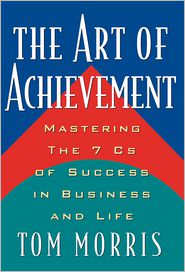
These conditions are deeply interconnected. They constitute a unified framework of tools for most fulfilling forms of achievement. It's been my joy to speak and write on them in books like True Success and The Art of Achievement, as well as The Stoic Art of Living and the ebook The 7 Cs of Success. I've been able to ponder them and discover their surprising depths for over 25 years. They can help us make our proper mark in the world. So, why should we ever settle for anything less?

PostedJuly 16, 2015
AuthorTom Morris
CategoriesAdvice, Life, Business, Performance
TagsSuccess, True Success, Art of Achievement, Tom Morris, TomVMorris, Goals, Challenges, Philosophy
Post a comment
MakeItHappen.jpg

Making Something Happen

The best people most often have a simple common tendency. They dwell not on how hard a task is, but on how to make it happen. In the New York Times Sunday Business section, the current CEO and President of Montblanc North America, Mike Giannattasio, talks about his office and his work life. At one point he says:

When I suggest that employees do something, they'll sometimes say, "It's not that easy." I gave everyone in the office a Staples Easy Button, and I tell them "You are able because you think you are able," which I've paraphrased from Virgil. People need a good understanding of what they can do.

I once heard that the New York Times was doing an article on bringing philosophy to a broader public audience. I had just published Philosophy for Dummies in the famous Dummies series of books, to help jump start their foray into the Humanities with the Metropolitan Museum of Art curator Thomas Hoving, who wrote for them the estimable Art for Dummies. I called the publicist for the series and told him what I'd heard about the Times piece being done, and that I'd love to be interviewed for the article. He said, in a trembling voice, "Well, I don't know. The New York Times is a REALLY big place." I sighed, and thanked him, and found the writer doing the article myself, and ended up being the lead person interviewed.

One of the smallest bestselling books ever written was on this precise problem. It's called, enigmatically, A Message to Garcia, and is by Elbert Hubbard. The President of the United States needed to get a message to a rebel leader named Garcia somewhere in Cuba. He was told that there was one man who could do the job, no matter what it took. The President summoned him and gave him the message. The messenger didn't ask where Garcia was, or explain how hard it might be to find him. He didn't make excuses, dwell on obstacles, or "manage expectations." He got going, took a boat, went into the jungle for three weeks, and accomplished his mission. Hubbard suggests that we almost never come across a person who is ready, willing, and able to do such a thing. Those who are able to take a message to Garcia will be the ones who make a big impact on the world.

If we're in a managerial or leadership position, how often do we ask someone to do something interesting and hear them say, "Well that's harder than you might think." And how often do we already know both exactly how hard it is and that the person we've asked can certainly do it if they actually try? And of course, most of us have also been on the other side of the request. I was once asked to do a talk about Steve Jobs. I could have said, "Well, I really don't know anything about Steve Jobs, and it would be really hard to put together a talk that was both original and helpful on him." But instead, I said, "Sure. Let me look into it. I'll come up with something great." And it was hard. And I made it happen. I've given that talk several times and even have the draft of a book based on it.

I've often said that if I was asked what the most important quality is that successful people share in common, I'd probably identify an overall action orientation - the proclivity toward making it happen, whatever the relevant "it" is, in context. They don't ignore obstacles. But they don't dwell on them either. The success mindset is one of making things happen.

And, no, that's not me at the top of this blog post. I still have hair. But not all great thinkers do. That's Seth Godin. Take his advice and mine. Go make something happen. Now.


PostedJuly 14, 2015
AuthorTom Morris
CategoriesAdvice, Business, Leadership, Life
TagsAction, Excuses, Inaction, Obstacles, Effort, Initiative, Gumption, Seth Godin, Elbert Hubbard, Mike Giannattasio, New York Times, Montblanc, Philosophy for Dummies, Art for Dummies, Thomas Hoving, Tom Morris, TomVMorris, Wisdom, Philosophy
Post a comment
Holly.jpg

You Got To Want It

What's necessary in order to be really good at something? Well, the right talent, or set of talents, for one thing. And lots of work, or practice, for another. But still, there's something else.

Let's ask a really different question. How should you react when someone wanting to help you suggests or even recommends you for a new job, position, role, opportunity, or goal that doesn't strike you as quite right? Your friend/fan/helper/coach/mentor/agent is excited about the new possibility, but you're uneasy, or unsure. You don't feel an inner fire. Sometimes, it's great to stretch outside your comfort zone. And yet, you should always listen to your heart. Here's an example. A Hollywood agent in the 1950s has discovered an attractive young woman he wants to put in the movies. Good things are happening for her already. A prominent man in the community, a bold-faced name in the papers, someone having his picture taken all the time, wants to marry her. The agent is himself relating what happened next, out in Los Angeles:

Then wham! The Story of Dr. Wassall. You see that picture? Cecil B. DeMille. Gary Cooper. Jesus. I kill myself, it's all set: they're going to test her for the part of Dr. Wassell's nurse. One of his nurses, anyway. Then wham! The phone rings." He picked a telephone out of the air and held it to his ear. "She says, this is Holly, I say honey you sound far away, she says I'm in New York, I say what the hell are you doing in New York when it's Sunday and you got the test tomorrow? She says I'm in New York cause I've never been to New York. I say get your ass on a plane and get back here, she says I don't want it. I say what's your angle, doll? She says you got to want it to be good and I don't want it. I say what the hell do you want, and she says when I find out, you'll be the first to know.

That's O.J. Berman talking to our narrator, the upstairs neighbor of Holly Golightly, in Truman Capote's short novel Breakfast at Tiffany's.

Holly's words ring true: You got to want it to be good. It's true of acting, and of almost anything else. In considering a new opportunity or possibility, you have to ask yourself, "Do I really want it?" Can I envision it happening? Does it stir me up? Would it be fulfilling and fun? If not, it's probably not right for you, at least, not now. But if so, if you do want it, if it lights a flame in you, then you have one of the main conditions for success - an emotional commitment.

Life is too short to concentrate our energies on things we really don't care about. Find something you want, and pursue that with your whole heart. And if you're like me and are already doing it, keep at it!

PostedJune 24, 2015
AuthorTom Morris
CategoriesAdvice, Attitude, Business, Life, Wisdom
TagsWork, Desire, Emotion, Commitment, Truman Capote, Holly Golightly, O.J. Berman, 7 Cs of Success, Tom Morris, TomVMorris, Philosophy, Excellence, Wisdom
Post a comment
IndiaVilage.jpg

When Things Go Wrong

We live in a world where things often go wrong. In fact, you can divide all of your life into three basic kinds of time segments:

1. The time when you're waiting for something to happen, wanting it to happen, and perhaps doing all you can to make it happen,

2. The time when it either happens, and you're glad, maybe even elated, or perhaps relieved, or else,

3. The time when it was supposed to happen and didn't, and you're either sad, or mad, discouraged, or even worse.

In the book by Hermann Hesse, Siddhartha, published in 1922, which I wrote about yesterday, there's one very interesting story. The young man Siddhartha is working for a very successful and wealthy businessman. The rich man is always worried about something, or angry when anything doesn't go right. Siddhartha is never worried or angry. He treats business like a sport to play, and in a very pure way, where he simply enjoys the playing, without any concern about who wins or loses. And because of his attitude, he wins much more often than he loses.

One day, he makes a trip to a distant town where he's hoping to purchase a crop that he and his partner can then resell for a major profit. But when he arrives at the town, he learns the deal has already been made, with someone else. Rather than reacting with sadness, anger, frustration, irritation, regret, resentment, concern or worry, fuming that he's wasted all the time and energy of travel for nothing, he quickly turns nothing into something. He meets the people of the town and gets to know them. He visits with them, eats with them, and plays with their children. He has a wonderful time making new friends with those who will probably now very much want to do business with him in the future. His older partner wouldn't likely have done any of this, but would typically have stormed off in a huff, furious that he'd missed the great opportunity he'd pursued.

A CEO once told me that it's his job to worry. And from what I could see, he does it very well. But is that really a mission critical job? What does his worry accomplish that simple planning, checking, and exercising vigilant care couldn't do? I can't see how the worry, the tension of anxiety, adds anything to the mix of productive endeavor. Most negative emotions, in most situations, are the same. Our hero, Siddhartha, by not worrying or allowing any negative emotions to overtake him, was easily able to turn nothing into something. He showed how we can all be opportunistic in a very positive way, at those times when things initially don't seem to go our way, and, in fact, in almost any situation in which we find ourselves. We can deal positively and creatively with whatever happens, and make the best of it.

And I can't think of anything better than that.

PostedJune 3, 2015
AuthorTom Morris
CategoriesAdvice, Attitude, Business, Life, Wisdom
TagsHermann Hess, Siddhartha, Emotion, Anger, Frustration, Worry, Positivity, Action, Opportunism, Tom Morris, TomVMorris
Post a comment
JarOfRocks.jpg

Priorities

We all have priorities. We value some things over others. We prefer certain activities to alternatives. And yet, we're not always aware of our priorities. Twentieth century theologian Paul Tillich suggested that everyone has what he called an "Ultimate Concern" - a priority that trumps all others, a most important thing in your life. For some people, it might be life itself. For others, love, or family. For too many, it seems to be money, or power, or status.

The ancient stoic philosophers believed that our chief concern should be to know what is properly our ultimate good. Then we can take care to govern our lives accordingly, not letting our priorities get out of order, but giving the most time and attention to what's most important, and the least to the least. The fake urgencies of life often cause us to get this backwards, giving our focus to ephemeral things that are actually of little value, and letting them crowd out the things that are of greatest meaning and significance.

You've heard the old story, of the rocks and the jar, I'd imagine. A professor has a very large glass jar on a table in front of the class. He tells his students that he's going to fill it with rocks, and he does. "Is it full?" he asks. They all agree. It's full to the top. Then he produces a bucket of pebbles and begins to pour them in around the rocks, filling it even more. "You see, it wasn't actually full before," he explains as they all contemplate the much more packed container. Then he produces a bucket of sand and starts to pour it also into the jar, filling in all the cracks and spaces between the rocks and pebbles.

The professor explains that the jar is like a life. If he had started out filling it up with the little things, the grains of sand, and had packed it to the top that way, there would have been no room for the bigger pebbles, or the much larger rocks. But by filling it with the biggest things first, there was also ample room for the smaller things. He then explained the metaphor explicitly. If we allow the little urgencies and demands of life to fill our time and hearts, we'll have no space left over for the bigger things. But if we start of with a focus on what matters most, we'll also have plenty of room for life's smaller matters. It's all about priorities.

And then, there is, of course, the variant of the story where an enterprising student suddenly stands up, walks up to the desk, pops the top of a beer can he's carrying, and slowly pours it into the apparently full jar, explaining as he does, one more insight: "There's always room for Bud."

How are you with priorities? They matter in a business just like they do in a life. Get them wrong, and all sorts of things go wrong as well. Get them right, and many other things go right, things worth celebrating. Then, there's room for a Bud.

PostedJune 1, 2015
AuthorTom Morris
CategoriesAdvice, Business, Life, Wisdom
TagsPriorities, Values, Time, Energy, Concerns, Life, Life lessons, Wisdom, Philosophy, Tom Morris, TomVMorris, Paul Tillich
Post a comment
Plane.jpg

The Deadliest Jobs

The Business Insider just ran an article on "The Ten Deadliest Jobs in America." Most didn't surprise me at all. Roofers sometimes fall. And it's dangerous to work on high power electrical lines. Voltage, in that setting, is not your friend. Long haul truckers struggle with exhaustion, and with all the bad drivers on the road. But out of the top ten most deadly jobs, the THIRD most fatal was "Airplane Pilots and Flight Engineers." Now, as a frequent airplane passenger, that bothers me. A lot. When fishermen have a problem (#2 Most Deadly Job) the fish with them are already goners. When loggers have an accident (#1) the trees on the truck are already dead. But commercial airplane pilots? Their problem is our problem.

Long ago, I was afraid to fly, and for many years. But after nine years of completely avoiding airplanes, I suddenly started to fly again, to give talks around the country, and in other parts of the world. People who knew of my former phobia, colleagues at Notre Dame then asked me, "Wait. Do you suddenly think it's safe to fly?" I answered, "No, I just suddenly think I'm supposed to do it."

Our task in life is not to stay perfectly safe. That's impossible. Our job is to reasonably employ our talents for the good of others as well as ourselves. If that involves, as it has for me, as many as 400 to 500 airplanes a year, well then, Ok. But I do sincerely wish the pilots of our nation had a safer job. I really do. I care about them. You probably do, too - even if you just fly a few times a year and, hopefully, even if you don't.

Metaphor Alert: Philosophers are a little bit like airline pilots. When we go down, a lot of other people do, too. Bad ideas can ruin lives. So that's why I've always been as careful a thinker as I could be, giving people the best ideas I can find and clarify. I test philosophies before I speak or write on them. I make sure they're reliable. Then, I can safely share them.

I'm determined and dedicated to the good of everyone who listens to anything I write or say. My commitment is that we can all fly some truly friendly skies together.

PostedMay 31, 2015
AuthorTom Morris
CategoriesAdvice, Business, Life, Philosophy
TagsDanger, Philosophy, Airline pilots, dangerous jobs, Philosophical ideas, Tom Morris, TomVMorris, Wisdom
Post a comment
LoriSenecal.jpg

Action, Opportunity, and Impact

We all know that personal action is required to take advantage of opportunities in life. Otherwise, they lie inert for us and then dissipate. But there's also a deeper perspective available. In Adam Bryant's New York Times column "Corner Office," Lori Senecal, Global CEO of ad agency C. P. &B. and CEO of the MDC Partner Network said something interesting this week while reflecting back on her own graduation from college and going for her first job. She got an offer and decided to take it without even realizing what all it involved. She comments:

That was a time when I embraced one of the philosophies that I go back to a lot today, which is that action creates opportunity. I didn’t know what the nature of the job would be, but I knew that if I took action, other possibilities would appear, and they did. Ever since then, I’ve often thought about action creating opportunity.

Bryant later asked her what advice she would give to new college graduates, and she said:

I talk to them about action creating opportunity. So dive in, and great things will come of it. The other thing I like to focus on is the importance of impact. You have to learn to prioritize the impact opportunities rather than just being busy. There’s an infinite amount of things that you can do, but focus on the things that will catapult the company and your career forward.

Action and opportunity - action and impact: Two vital connections. Taking action in reasonable ways, in ways that are right for us, creates opportunities, and then among those that arise, we should choose to act further on the ones that will have the greatest likely impact for good on the world, our businesses, and our own careers. Well directed action is the key, at both levels.

This is the philosophy I call activism. It's up to us to take action. Do things that matter, both by creating new possibilities, and by having impact. This is nice advice to keep in mind, not just for recent graduates, but for all of us along life's way.

PostedMay 27, 2015
AuthorTom Morris
CategoriesAdvice, Business, Leadership, Life, Wisdom
TagsAction, Opportunity, Possibility, Impact, Initiative, Decisions, Choice, Careers, Graduates, Lori Senecal, Adam Bryant, New York Times, Tom Morris, TomVMorris, Philosophy, Wisdom
Post a comment
Newer / Older

Some things that may be of interest. Click the images below for more!

First up: Tom’s new Silver Anniversary Edition of his hugely popular book on The 7 Cs of Success!

The New Breakthrough Guide to Stoicism for our time.

Tom's new book, out now!
Finally! Volume 7 of the new series of philosophical fiction!

Finally! Volume 7 of the new series of philosophical fiction!

Plato comes alive in a new way!

Plato comes alive in a new way!

On stage in front of a room full of leaders and high achievers from across the globe.

On stage in front of a room full of leaders and high achievers from across the globe.

Maybe, my favorite book of all time. Published in 1905, it's a charming and compelling tale about the power of the imagination and simple kindness in dealing with great difficulties. You'll love it. Click the cover to find it on Amazon!

Maybe, my favorite book of all time. Published in 1905, it's a charming and compelling tale about the power of the imagination and simple kindness in dealing with great difficulties. You'll love it. Click the cover to find it on Amazon!

My favorite photo and quote from the first week of my new blog:

I'll Rise Up and Fly.

My Favorite Recent Photo: A young lady named Jubilee gets off to a head start in life by diving into some philosophy!

My Favorite Recent Photo: A young lady named Jubilee gets off to a head start in life by diving into some philosophy!

Great new Elizabeth Gilbert book on creative living and the creative experience.

Great new Elizabeth Gilbert book on creative living and the creative experience.

The back flap author photo on the new book The Oasis Within.

The back flap author photo on the new book The Oasis Within.

Something different. Paola Requena. Classical guitar. Sonata Heróica.

Two minutes on a perspective that can change a business or a life.

On the beach where we do retreats, February 16, 2018, 77 degrees. Philosophy in shorts and a T shirt done right.

On the beach where we do retreats, February 16, 2018, 77 degrees. Philosophy in shorts and a T shirt done right.

So many people have asked to see one of my old Winnie the Pooh TV commercials and I just found one! Here it is:

Long ago and far away, on a Hollywood sound stage, I appeared in two network ads for the wise Pooh, to promote his adventures on Disney Home Videos. For two years, I was The National Spokesman for that most philosophical bear. This is one of the ads. I had a bad case of the flu but I hope you can't tell. A-Choo!

Now, for something truly unexpected:

Five Years ago, a friend surprised me by creating an online shop of stuff based on my Twitter Feed. I had forgotten all about it, but stumbled across it today. I should get this shirt for when I'm an old man, and have my home address printed on the …

Five Years ago, a friend surprised me by creating an online shop of stuff based on my Twitter Feed. I had forgotten all about it, but stumbled across it today. I should get this shirt for when I'm an old man, and have my home address printed on the back, along with, "Return if Found." Click to see the other stuff! I do love the dog sweaters.

Cat videos go philosophical. The now famous Henri Le Chat Noir, existential hero. Click image for the first video I saw and loved.

Cat videos go philosophical. The now famous Henri Le Chat Noir, existential hero. Click image for the first video I saw and loved.

Another Musical Interlude. Two guys with guitars, one an unusual classical seven string, one a bass, but playing chords.

I memorized the "To be or not to be" soliloquy from Hamlet months ago, and recite it nearly daily. It's longer than you think, and is a powerful meditation on life and motivation, fear, and the unknown. To find some good 3 minute videos of actors pe…

I memorized the "To be or not to be" soliloquy from Hamlet months ago, and recite it nearly daily. It's longer than you think, and is a powerful meditation on life and motivation, fear, and the unknown. To find some good 3 minute videos of actors performing these lines, click here. Watch Branaugh and Gibson for very different takes.

This is a book I read recently, and it's one of the best I've read in years on happiness and success. Shawn helped teach the famous Harvard course on happiness, and brings the best of that research and more into this great book. Click on it. I think…

This is a book I read recently, and it's one of the best I've read in years on happiness and success. Shawn helped teach the famous Harvard course on happiness, and brings the best of that research and more into this great book. Click on it. I think you'll like it!

A favorite performance of the great Brazilian bossa nova song Wave, by Tom Jobim. Notice Marjorie Estiano's fun, the older guitarist's passion, the flutist's zen. Marjorie's little laugh at the end says it all. That should be how we all feel about our work. Gladness. Joy.

I happened across this great book on death and life after death. Because of some uncanny experiences surrounding the death of her father and sister, this journalist began to research issues involving death. Her conclusions are careful and well docum…

I happened across this great book on death and life after death. Because of some uncanny experiences surrounding the death of her father and sister, this journalist began to research issues involving death. Her conclusions are careful and well documented. If you're interested in this topic, you'll find this book clear, fascinating, and helpful. A Must Read! For my recent conversation with the author on HuffPo, click here.

Henri discovers the first book about his unique philosophical ponderings. Click image for the short video.

Henri discovers the first book about his unique philosophical ponderings. Click image for the short video.

My favorite website to visit nearly every day. Maria Popova may read more and write more than any other human being on earth, and her reports are always amazingly interesting. This is really brain candy, but with serious nutritional benefits as well…

My favorite website to visit nearly every day. Maria Popova may read more and write more than any other human being on earth, and her reports are always amazingly interesting. This is really brain candy, but with serious nutritional benefits as well. Visit her often!

One of my newest talk topics is "Plato's Lemonade Stand: Stirring Change into Something Great." Based on the old adage, "When life hands you lemons, make lemonade," this talk is about how to do exactly that. Inquire for my availability through the c…

One of my newest talk topics is "Plato's Lemonade Stand: Stirring Change into Something Great." Based on the old adage, "When life hands you lemons, make lemonade," this talk is about how to do exactly that. Inquire for my availability through the contact page above! Let's stir something up!

A frequent inspiration. Monday, 30, April 2012. Sarah Brightman and Andrea Bocelli perform "Time to Say Goodbye." Notice how they indwell the lyrics, and still manage to relate to each other so demonstratively.

My friend Bill Powers writes on how to handle the technology in your life and stay sane. A beautiful meditation on how we've always struggled with the new new thing, and sometimes win. Recommended!

My friend Bill Powers writes on how to handle the technology in your life and stay sane. A beautiful meditation on how we've always struggled with the new new thing, and sometimes win. Recommended!

Above is a short video on finding fulfillment in anything you do, that was taped a few years ago. I hope you enjoy it!

This is a beautiful and difficult book on the odd relationship between repeated failure and eventual success. It's full of great stories and moments of meditation. You will find yourself teasing out the insights, but they're powerful and worth the w…

This is a beautiful and difficult book on the odd relationship between repeated failure and eventual success. It's full of great stories and moments of meditation. You will find yourself teasing out the insights, but they're powerful and worth the work.

One of the best books in the past year or more, G&T is a wonderful look at how givers can rise high. Grant is the youngest tenured professor at Wharton and its most popular teacher. Here, he shows why! A really good book.

One of the best books in the past year or more, G&T is a wonderful look at how givers can rise high. Grant is the youngest tenured professor at Wharton and its most popular teacher. Here, he shows why! A really good book.